| |
|
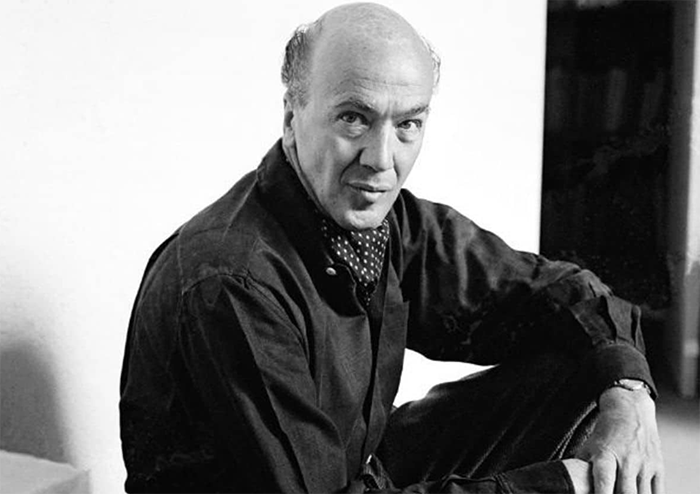
Luis Barragán was at the forefront of a generation of Mexican architects who followed
a fascination with European functionalist design; they endeavored to reconcile modernism with the indigenous architecture of Mexico, in order to express a distinct sense of place.
Barragán is best known for a small body of post-World War II buildings and landscapes that merge modern materials and minimalist cubic form, with discreet references to local culture, personal memory, figurative surrealist painting, and Mexican and Mediterranean vernacular forms. These works are marked by frequent use of brilliant saturated colors (pinks, blues, yellows, and reds are prevalent) and by a sophisticated handling of space, texture, siting, and natural light. His most significant projects involved speculative designs for residential subdivisions, and private houses for wealthy clients. Among the former are the seminal Jardines del Pedregal (1945–50), which he called his most important work; Las Arboledas (1958–59); and Los Clubes (1963–64), all in Mexico City. Among his private houses, key examples include the González Luna and Cristo houses (1928 and 1929) in Guadalajara, his private residence in Mexico City’s Tacubaya district (1947), and houses for Eduardo Prieto López (1950), Antonio Galvez (1959), Folke Egerstrom (1967–68), and Francisco Gilardi (1976), all built in Mexico City as well. He also built other projects, including small chapels, such as the one for the Capuchinas Sacramentarias del Purísimo Corazón de Maria (1953–55) again in the Tacubaya district. There were also multifamily housing units, such as the apartment house he designed with José Creixell and Max Cetto for Mexico City’s Plaza Melchor Ocampo (1940); public sculptures, such as the Satellite City Towers (1957), with Mathias Goeritz, for Mario Pani’s Ciudad Satélite subdivision north of the City; and semi-public gardens, as those for the Hotel Pierre Marquez (1955) in Acapulco.
Barragán was born in Guadalajara to a large, wealthy, devoutly Roman Catholic family. Following long stints on his family’s cattle ranch near the Jaliscan village of Mazamitla, and preparatory school in Guadalajara, he received his civil engineering degree in 1925 from Guadalajara’s Escuela Libre de Ingenieros. He later completed his course in architecture there under Agustín Basave, who was a disciple of the French Beaux-Arts master Hippolyte Taine, but the school closed shortly before his degree was awarded. This formal study was followed by travel to Europe. In 1924–26, during the first of two trips, Barragán was especially impressed by visits to the Alhambra, and the Parisian Exposition des Arts Decoratifs, where he first encountered works by Le Corbusier (whom he met there) and French author, illustrator, and landscape gardener Ferdinand Bac. In 1930–31, he visited Bac at his home, Les Colombières, in Menton, on the French ?ote d’Azur. Bac encouraged his interest in the poetic use of vernacular architecture and nostalgia. The visual impressions and contacts he gained on these voyages were to nourish Barragán’s thought process and practice for many years to come.
Barragán’s career can be divided neatly into three periods. The first lasted from 1927– 36, and included his work in and around Guadalajara. During this time, he completed work on a city park, Parque de la Revolución (1935), with his brother Juan José, and a dozen villas and small rental houses. The houses, such as those for Efraín González Luna and Gustavo Cristo, are thick walled and cubic, with clay tile roofs, deep-set round- arched voids, and complicated spatial arrangements, and reflect a formal vocabulary indebted to Moorish and Jaliscan vernacular sources, and to Bac’s illustrated books Les Columbiè res and Les Jardines Enchantés (both published in 1925).
In 1936 Barragán moved to Mexico City, then booming after the cessation of a long and devastating civil war. Over the next few years there, he built some 30 small houses and apartment buildings. Most of these were speculative ventures that he financed himself, and most were done in collaboration with other architects, such as Creixell and Cetto. Like much of the architecture then being built in Mexico City, Barragán’s thin- walled, glass and concrete buildings, with their roof terraces and factory windows, borrowed heavily from the work of Le Corbusier. Buildings such as these, built by Barragán, Juan O’Gorman, and others, were seen by many progressive Mexicans as appropriately quick, cheap, efficient, and modern, and free of the historical and ideological baggage of earlier revival styles.
During the early 1940s, Barragán slackened his professional pace. He
spent time designing a group of private gardens at his home in Tacubaya, and on property that he had acquired in the rugged lava fields south of Mexico City. This last area, known as El Pedregal, or “the rocky place,” provided the inspiration and the setting for the 865-acre Jardines del Pedregal, the first major work of Barragán’s third and final phase. At El Pedregal, he and his staff worked with or took inspiration from many others, including Max Cetto, sculptor Mathias Goeritz, painters Diego Rivera and Dr. Atl, financier José Alberto Bustamante, city planner Carlos Contreras, and photographer Armando Salas Portugal—and designed roads and water systems, public plazas and sculpture, demonstration houses and gardens, and launched an extensive print and broadcast advertising campaign. Roads, gardens, and modern, flat-roofed houses— some bearing subtle, formal similarity to the walled courts and high- beamed ceilings of Mexican colonial-era convents and haciendas—were fitted amidst the swirling stone eddies and distinctive native vegetation of the site. Many of Mexico’s best-known modern architects, including Francisco Artigas, Enrique del Moral, and Felix Candela, built houses there. Barragán was criticized at times by his Mexican colleagues for his work’s “scenography” and diversion from functional and politically progressive concerns, but during the early 1950s El Pedregal became a substantial financial and international critical success.
Barragán’s subsequent projects, such as Las Arboledas and the Egerstrom and Gilardi houses, carry the themes explored in El Pedregal forward. In them, one finds more evolved versions echoing the play of light, shadow, water, and wall, its dramatic use of color and varied textures, its startling juxtapositions of the old and the new, the local and the imported, and the natural and the man-made. These designs capture scenography at its best, stage sets for unspecified yet solemn rituals, thick with silence, time, and gravitas.
Although much of Barragán’s best work, including the Jardines del Pedregal, has been insensitively modified or destroyed, his influence continues to be wide ranging. Many younger Mexican architects, including Ricardo Legorreta, have treated his forms and signature colors as the basis of a distinctly Mexican modern architecture. Outside Mexico, designers as diverse as Tadao Ando and Mark Mack have attributed his work as a source of inspiration.
In 1976 the Museum of Modern Art in New York presented a retrospective exhibition of his work. This honor came as he was completing his last projects prior to suffering a long and debilitating illness and brought him renewed attention after two decades of neglect. Four years later, in 1980, he was awarded the Pritzker Prize.
KEITH L.EGGENER
Sennott R.S. Encyclopedia of twentieth century architecture, Vol.1. Fitzroy Dearborn., 2005.
|
| |
|
1902 Born in Guadalajara, Jalisco, Mexico, 9 March;
1924-26 Traveled in Spain and France;
1925 Received degree in engineering, Guadalajara;
1931-32 Attended Le Corbusier’s lectures, Paris;
1927-36 Practiced in Guadalajara;
1936 Worked in and near Mexico City;
1940-45 Concentrated on planning studies and real estate;
1945-52 Founder and director, with José Alberto Bustamante, Jardines del Pedregal de San Angel, SA, Mexico City;
1957 Co-founder, Las Arboledas Residential Zone Foundation, Mexico City;
1958 Co-founder, La Hacienda Golf Club, Mexico City;
1976 Partner, with Raul Ferrera, Luis Barragán y Raul Ferrera Arquitectos, Mexico City;
1980 Pritzker Prize;
1984 Fellow, American Institute of Architects;
1984 Honorary member, American Academy of Arts and Letters;
1988 Died in Mexico, 22 November; |