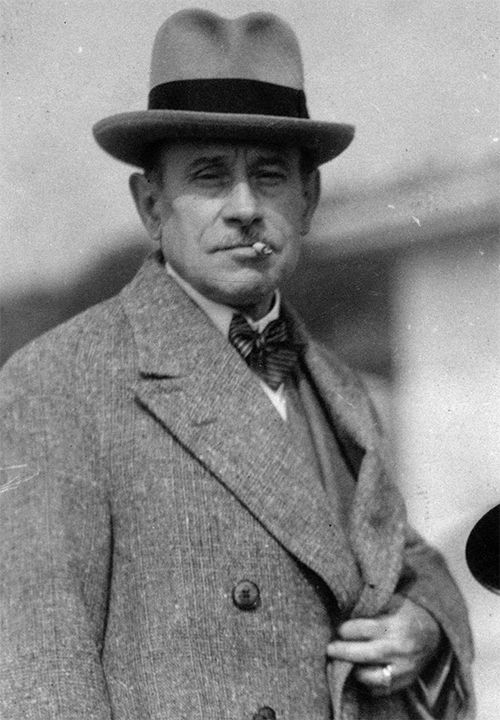
Tony Garnier’s famous publication, Une Cité Industrielle (1918, 1932), secured his position as an important precursor of modern architecture and urban planning according to the evolutionary schema drawn up by architects, critics, and historians of the Modern movement. Only recently, however, has the real historical specificity of Garnier’s particular amalgam of classicism and modernism been located in contemporary aspects of socialist utopianism and modern labor technologies and materials.
Garnier was born in Lyon, the major industrial city of France, during the 19th century. The son of a silk designer and a weaver, he spent his childhood in the working-class area of Croix-Rousse. At the age of 14, he enrolled in the École Technique de la Martinière in Lyon (1883–86), where he received his initial training as a draftsperson and painter. In 1886, he entered the École des Beaux-Arts in Lyon (1886–89) to study architecture under Elvin and Louvier. His success at the school, including the Prix Bellemain, enabled him to further his architectural studies in Paris.
In 1890, Garnier was admitted to the École des Beaux-Arts in Paris (1890–99), where he studied with Paul Blondel, Scellier de Gisors, and the theorist Julien Gaudet. He won the prestigious Prix de Rome in 1899 for his design of a national bank headquarters. The entry demonstrated his ability to formulate clear circulation routes, organize complex services, and allow for a building's future growth and expansion. Garnier’s approach to planning—rooted in his mastery of Beaux-Arts principles of composition—would develop with the increasing industrial and urban scale of his work. The Prix de Rome earned him the right to reside as a pensionnaire at the Villa Medici in Rome for four years (1899–1904). During this period, he associated with other pensionnaires, such as Henri Prost, Léon Jaussely, and Ernest Hébrard, all of whom shared his interests and later became the first generation of urban planners in France.
Garnier contested the strict study of classical architecture required by the academy in the form of the annual submission of envois, or reconstructive drawings of ancient monuments. His first envoi (1901) was a rendering of the Tabularium, across which he wrote a provocative statement of faith: “Since all architecture is based on false principles, ancient architecture was a mistake. Only truth is beautiful.” Yet Garnier hardly disavowed the classical tradition; rather, he critiqued the academicians’ inability to link this tradition to modern social and urban needs. Addressing this problem, he supplemented the 1901 envoi with his first plan for an ideal, industrial city, called Une Cité Industrielle.
For his final envoi in 1904, Garnier explicitly linked the classical tradition with his interest in urban planning by submitting a reconstruction of the entire antique town of Tusculum. Again, he attached a supplementary project, a more elaborate version of his Cité Industrielle. Although his 1904 Cité Industrielle drawings were exhibited, the project was not published until 1918. The publication was a much-enlarged and revised version of the initial plans. Garnier included many additional references, drawings, and photographs of his later work in Lyon, such as his industrial quarter for the silk-weaving industry, villas, a municipal stadium, and a market hall.
These plans describe an ideal city of 35,000 inhabitants located between a mountain and a riverbank to access hydroelectric power for local industry. The city was organized into a series of zones according to function: industrial, civic, residential, health-related, and entertainment-related. Garnier built flexibility into the plan by allowing free circulation within and between these zones, as well as anticipating their future expansion and growth. Other components of the plan include the use of greenbelts throughout the city and the introduction of new materials—primarily reinforced concrete—for the architecture. These new materials enabled a standardized variation of building types and an aesthetic of simple geometric shapes that relied on plasticity rather than ornament for effect. The chief factor determining Garnier’s design, however, was his emphasis on industrial labor. He was influenced by Émile Zola’s great socialist utopian novel Travail (1901), which first appeared in serial form in 1900–01. Zola described a city strikingly close to the Cité Industrielle, and several passages from the novel are literally inscribed on the assembly hall of Garnier’s Cité.
Because of favorable reviews in the Lyon press of his early conceptions of the Cité, Garnier returned there in 1904. His first major commissions were for a livestock market and slaughterhouse (1906–24) in the Mouche district and the Grange-Blanche Hospital (1910–27). Both designs allowed Garnier to elaborate on urban-planning issues only hinted at in his Cité Industrielle. The market-slaughterhouse represented a complete study of the butchering process, from the transportation and classification of animals in the large-span market hall (built of steel and reinforced concrete), to the hygienic division of services in the reinforced-concrete pavilions, to the circulation of products via interior roadways linking the pavilions. (Significantly, the 1914 International Urban Exhibition, directed by Garnier, took place in the market hall of the slaughterhouse.) Likewise, in the Grange-Blanche Hospital, Garnier classified services such as surgery and medicines, separated them into distinct pavilions, and linked them with underground passageways. The hospital's simple, reinforced-concrete pavilions with flat roofs are rhythmically aligned within a pastoral environment, characteristics that also echo the green spaces included in the Cité. These projects also began Garnier’s career-long relationship with Lyon’s socialist mayor, Édouard Herriot, who was responsible for making him the city’s chief architect. In 1913, Garnier was appointed a professor at Lyon’s École des Beaux-Arts.
Garnier’s work on low-cost housing projects further demonstrated his skill in meeting the aesthetic and technical challenges of modern urban planning. For the Foundation Rothschild housing competition in Paris (1905), Garnier submitted an innovative design for standardized apartment buildings angled at 45 degrees. This zigzag pattern maximized sunlight for each apartment, suppressed long corridors and enclosed courtyards, and created open green spaces around the buildings. Two other low-cost housing projects designed by Garnier for Lyon—an industrial quarter (1908, unbuilt) for the silk-weaving industry and the Quartier des États-Unis (1919–35)—included the full range of domestic, industrial, and entertainment services necessary to support large working populations. Through these projects, Garnier came closest to achieving the large-scale ambitions of the Cité Industrielle.
The classicizing aspects of Garnier’s work are particularly striking in his villas, built in Lyon (1911, 1913, 1921), Saint-Didier (1921), and Cassis (1930). All are reinforced-concrete structures, yet they evoke a Mediterranean classicism through their simple geometric forms, lack of ornamentation, terrace roofs, atrium-like spaces, pergolas, and intimate fusion of architecture and site. Many of these villas recall his first studies of pared-down domestic architecture depicted in the 1904 envoi of Tusculum and the Cité Industrielle. His Municipal Stadium in Lyon (1914–18)—the Stade de Gerland—is another study in abstract classicism on a monumental scale.
During the 1920s and 1930s, Garnier completed work on major projects that were conceived before the war, such as the Slaughterhouse, Grange-Blanche Hospital, Municipal Stadium, and the Quartier des États-Unis. He also began new projects, such as a sanatorium (1923) at Saint-Hilaire de Touvet, the Lyon-Saint-Étienne Pavilion (1925) for the Decorative Arts Exhibition in Paris, and a city hall (1928–34) for the new town of Boulogne-Billancourt. He produced little after 1937. In 1939, he left Lyon to live in Bédoule, where he died in 1948.
In 1920, Garnier published Les grands travaux de la ville de Lyon, documenting his additional works. The second edition of Une Cité Industrielle was published in 1932. Apart from his brief preface to the Cité, Garnier wrote little. His drawings served as his main vehicle of thought and the principal means by which his work gained the attention and admiration of modern architects and critics such as Le Corbusier and Sigfried Giedion.
Aron Vinegar
Sennott R.S. Encyclopedia of twentieth century architecture, Vol.2 (G-O). Fitzroy Dearborn., 2005.
|