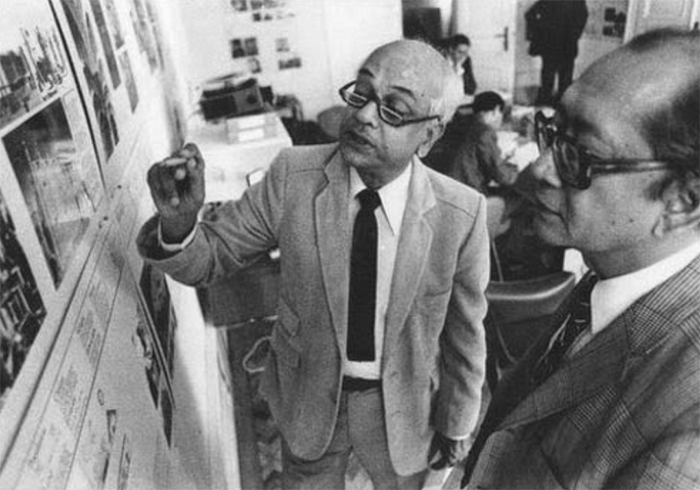
Muzharul Islam has been active since the early 1950s in defining the scope and form of a modern architectural culture, first in Pakistan and, after 1971, in Bangladesh. Beginning in the early 1950s as the only formally trained architect working in Dhaka, Bangladesh, Islam undertook the enormous task of creating a modern yet Bengali paradigm for architecture. His steadfast commitment to a modernist ideology stems from an optimistic vision for transforming society. For Islam, modernism is more than an architectural vocabulary; it is, above all, an alternative ethical and rational approach to addressing what he perceives as social inequities and deprivation in the region. Consequently, his commitment to establishing a strong design culture in Bangladesh is paralleled by an equally deep engagement with the political and ethical dimensions of society.
Islam's contribution to creating a vibrant architectural culture depended on establishing the architectural profession of a new nation in the face of strong opposition from bureaucratic and engineering circles. To this end, he introduced an international and national dialogue in Bangladesh by inviting Louis Kahn, Stanley Tigerman, and Paul Rudolph to work there. As a teacher, mentor, and organizer, Islam influenced the development of vigorous architectural activities, the most notable of which was the founding of the Chetana Architectural Research Group in 1983.
Islam was the Senior Architect of the Government of East Pakistan (1958–64) before opening his own practice in Dhaka. His architectural repertoire is wide—he has designed and built universities, large-scale housing, government buildings and institutions, and numerous residences. His architectural production, from his earlier skeletal approach expressing the pavilion paradigm of the hot, humid Bengal delta, as seen in the N.I.P.A. Building at Dhaka University (1964) and his own house (1969), to his later stereotomic, earth-hugging idiom, best shown in the National Library (1980), has sought to derive a place-oriented architecture from modern tectonic and constructional methods, environmentally sensitive responses, and abstract cultural typologies overlaid with geometric order. His buildings respond to the nature of dwelling in the hot, humid delta as receptacles of "light, green, and air."
In Islam's large-scale projects, especially Jahangirnagar University (1967–70) and Joypurhat Housing (1978), the order of the plan is determined by a geometric web of tilted squares, triangles, and diagonals. These projects are situated in non-urban areas where the natural landscape is transformed into a scene of deep-green foliage and clustered masses of red brick. These projects address alternative ideas of urbanity by moving away from the conventional morphology of either city or countryside. In the Polytechnique Institutes, designed with Stanley Tigerman for five sites (1966–78), the project became an occasion to produce rational and methodological principles of design for Bangladesh, where none really existed in a contemporary sense. The initial study by the architects resulted in extraordinarily meticulous research on form determinants in relation to tectonics, ecology, climatology, materials, and traditional building techniques.
During the time Islam was establishing his practice—the 1950s and 1960s—Pakistan was in political turmoil. The dominant political consciousness in then East Pakistan, roused by the issue of economic disparities between the two provinces of Pakistan and the manipulative use of religion by the central government, polarized most Bengali intellectuals, including Islam, toward secular, socialist thinking. Islam has always insisted on architecture's link to larger social and political issues, especially within the South Asian context. His continued commitment to a rationalist and materialist philosophy has led to his vehement opposition to the manipulation of architecture and culture within highly politicized religious situations. In this context, his work, remaining distanced from exclusivist symbolization and what he sees as architectural fashion, has approximated a kind of ascetic architecture. Since his direct participation in the Bangladesh War of Liberation in 1971, he has received fewer commissions from various governments.
Islam holds the view that architecture is not only a reflection of society but also a medium for social critique and transformation. Through his increasing political engagement, he has argued for broadening the role of architects in South Asia to confront and transform existing social conditions, including the vast rural areas that mostly lie outside the scope of formal architectural activities.
KAZI KHALEED ASHRAF
Sennott R.S. Encyclopedia of twentieth century architecture, Vol.2. Fitzroy Dearborn., 2005.
|