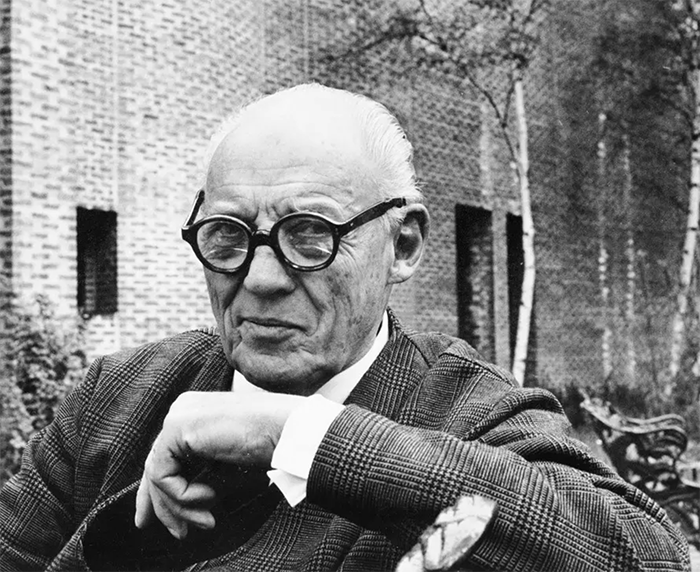
The work of Sigurd Lewerentz encompasses two of the strongest architectural currents of the 20th century; the first is classicism in its Nordic version, and the second is modernism. It is only recently that Lewerentz has been recognized internationally, and it is only in the final two decades of the 20th century that scholars in regions other than Germany and the Scandinavian countries have paid attention to Lewerentz’s prolific work, which is located solely in Sweden.
Lewerentz’s sensitivity to materials is a feature that characterized his lifelong work; it undoubtedly was first developed in Sandö, his native town located in the Västernorrlands region of central Sweden. Lewerentz learned the craft of forging at his father’s glass factory during the summers of 1905 and 1906. He also, during this time, studied at the Chalmers Technical Institute in Göteborg, from which he graduated in 1908. While at Chalmers, Lewerentz became very interested in the ideas of the emerging Deutscher Werkbund in Germany. Between 1908–09, he was an apprentice in Munich under Richard Riemerschmid and Theodor Fischer, who were members of the famous group.
In 1910 Lewerentz returned to Sweden and entered the School of Architecture of the Royal Academy of Arts in Stockholm. After one year of classical training, Lewerentz’s disagreement with the established classical precepts taught at that institution became evident. He and some of his classmates abandoned the academy and founded the Klara School. There, Lewerentz had the opportunity to explore some of the interests that had been elicited by the Deutscher Werkbund, as well as to share in the ideas from the Klara School movement, which included such figures as Ragnar Östberg, Carl Bergsten, and Ivar J. Tengbom. Among the principal concerns of these architects was the search for regionalism and authenticity through the use of indigenous materials and forms. One of Lewerentz’s classmates and contemporaries was Erik Gunnar Asplund (1885–1940), who would become the best-known figure in the development of modern Swedish architecture and played an important role in Lewerentz’s career.
In 1915 Lewerentz formed an architectural partnership with Torsten Stubelius. This lasted only two years but produced a significant number of designs, ranging from industrial objects—such as lighting fixtures and glass products—to churches, housing, and landscape interventions. Lewerentz’s interest and fascination with industrial design resonated throughout his entire professional career. In the 1920s he developed the IDESTA window system with engineer Claes Kreuger, and directed its manufacture during the following two decades, at his own factory in Eskilstuna.
During this initial period with Stubelius an important aspect of Lewerentz’s practice took shape specifically, his use of drawings to investigate and reveal the possibilities of site, architecture, and object. Thus, drawings became the tool he used to rigorously scrutinize all of the scales of a project, ranging from the topography to the minutest details.
In 1915 Lewerentz in association with his contemporary Gunnar Asplund, won a competition for the Woodland Cemetery in Enskede, Stockholm. This joint venture produced one of the most significant monumental sacred landscapes of the 20th century and became a locus of intervention by both architects for the next 20 years. Here, Lewerentz built his famous Neoclassical Resurrection Chapel (1926), and he remained responsible for the landscape design of the complex until 1935, when the Cemetery Authority excluded him from the design of the Chapel of the Holy Cross, and two additional minor chapels that were executed by Asplund alone. This unfortunate incident affected Lewerentz deeply, and he never reconciled with either his former friend and partner Asplund, or with the Cemetery Authority.
During the decade of the 1910s as a result of overcrowded cemeteries, traditional burial practices in Sweden were often ignored in favor of cremation. Lewerentz and his partner were responsible for the design of several new cemeteries, crematoriums, and churches. Among these, the Eastern Cemetery (1920–69) in Malmö became his main focus until his death. This cemetery includes neoclassical buildings executed prior to Lewerentz’s switch to a modernist vocabulary in the early 1930s.
Despite the fact that the furnishings, architecture, and landscape of Malmö’s Eastern Cemetery were designed over a span of half a century, they still speak in unison.
During the 1930s, Lewerentz explored rationalist and functionalist ideas in a variety of projects. They included architectural, industrial, and graphic designs for the 1930 Stockholm Exhibition, architectural projects such as the Malmö Theater (1933–44) with David Helldén and Erik Lallerstedt, the Villa Edstrand (1938–45) in Falsterbo; and large complexes and urban projects, such as the one for Lower Norrmalm, Stockholm (1932). In the early 1940s, Lewerentz’s chapels of St. Knut and St. Gertrude (1943) became, as critic Colin St. John Wilson pointed out, the markings of a definitive shift from the neoclassical form to the vigorous and original work that characterized his later output.
Following this commission, Lewerentz withdrew from architecture, emerging again only during the late 1950s. This final energetic and more mature period corresponds with three of his most important works: the Church of St. Mark (1960) in Björkhagen, Stockholm; St. Petri’s Church (1960) in Klippan; and his final project, the Flower Kiosk (1969) in Malmö’s Eastern Cemetery.
It is undoubtedly St. Petri’s Church that is the culmination of Lewerentz’s career, and it became an emblem of his long years of practice. The building can be considered a repository of sacred and secular memories that the architect used to emphasize the Lutheran rite and liturgy, and was achieved by exploring the experimental aspect of architecture. His primary strategy was the skillful manipulation of details and forms; conventional materials such as brick, mortar, and glass are treated in unorthodox ways, and light and water play an important role in creating an interior atmosphere for procession, introspection, and meditation.
The Flower Kiosk in Malmö’s Eastern Cemetery, which unfortunately has been altered now, is Lewerentz’s final statement and deals with the possibility of creating maximum sensory impact with minimal repertory of architectural forms and devices. It was executed with a limited vocabulary of materials: concrete, copper, glass, laminated wood, and ceramics. Nevertheless, the Flower Kiosk speaks eloquently—as pointed out by Alison and Peter Smithson—of the broad-mindedness of a man who was one of the silent architects of the 20th century.
RICARDO L. CASTRO
Sennott R.S. Encyclopedia of twentieth century architecture, Vol.2. Fitzroy Dearborn., 2005.
|