|
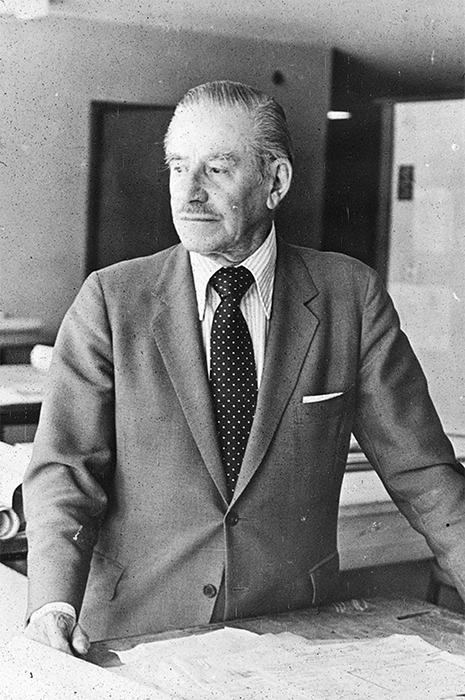
| ENRIQUE DEL MORAL |
| |
| |
|
| |
| |
 |
|
Name |
|
Enrique del Moral Dominguez |
| |
|
|
|
| |
Born |
|
January 20, 1906 |
| |
|
|
|
| |
Died |
|
June 11, 1987 |
| |
|
|
|
| |
Nationality |
|
Mexico |
| |
|
|
|
| |
School |
|
|
| |
|
|
|
| |
Official website |
|
|
| |
|
|
| |
| BIOGRAPHY |
|
|
|
|
| |
|
Enrique del Moral was a leading figure in the first generation of postrevolutionary Mexican architects. Over the course of over five decades of professional practice, del Moral participated in the search for a new national identity expressed in architecture and struggled with defining a new mission for itself in the wake of the Mexican Revolution of 1910.
Del Moral began his studies in architecture in 1923 at the Academy of San Carlos in Mexico City, a school that had trained Mexican students in classical architectural theory and practice since 1785. He had witnessed the destruction of the Revolution as well as the promises embedded in the Constitution of 1917 and noted a disparity between his training in architecture and the enormous needs of a society attempting to reconstruct itself along more egalitarian lines. With classmates Juan O’Gorman, Álvaro Aburto, and Juan Legarreta, he read Le Corbusier’s works and interpreted them to fit a Mexican reality. In sum, they believed urgent problems facing Mexico to be social in nature; the answer was structural.
Under the leadership of José Villagrán García, del Moral was guided toward functionalist theory, which involved intelligent use of construction methods and materials, application of advanced techniques such as reinforced-concrete foundations, the creation of forms corresponding to functions that buildings must discharge, and the imperative to construct new housing for the popular classes, hospitals, schools, and markets, among other facilities.
From 1928 to 1935, del Moral worked in the studio of Carlos Obregón Santacilia, whose works in those years encompassed diverse projects sponsored by the national government, including the massive Monumento de la Revolución. The functionalist movement continued to meet with considerable negative reaction from many architects throughout the early 1930s, who labeled functionalism an imperialist importation and a factor in the destruction of the city’s scenery, insisting on an architecture that could convey the Mexican national spirit and a “native” Mexican architecture—which they defined as colonial-era styles, sometimes with the additions of Aztec, Mayan, or Toltec elements.
In 1933 Alfonso Pallares, president of the Sociedad de Arquitectos de México, invited architect and engineers to participate in a historic debate at the Academy of San Carlos on the issue of national architectural styles. Discussions centered on the defense of functionalist architecture, particularly the “economical, sound and industrial architecture” that working people needed, as sustained by Juan Legarreta, Juan O’Gorman, and Álvaro Aburto, and the defense of the spiritual necessities and the production of architectural beauty by del Moral and others.
Del Moral believed it was imperative to fulfill economic needs while responding to cultural and geographic factors, employing a sense of aesthetic beauty and balance. This is clearly seen in his first works, in association with Marcial Gutiérrez Camarena, such as the workers’ homes in his birthplace of Irapuato (1936) or a series of houses in Colonia Chapultepec, Mexico City (1938–42). His use of native materials combined with modern construction techniques and an understanding of Mexican culture and use of interior space.
At the end of the 1940s, he began to collaborate with architect Mario Pani. This prolific association culminated with the development of the master plan for the new campus of the Universidad Nacional Autónoma de México (UNAM) and the design of the Torre Rectoría. Construction of this massive project on approximately six million square meters at the Pedregal of San Angel began in July 1950. Over 40 architects contributed to design of buildings in the school and administrative zones, such as those for the schools of law, medicine, architecture, and the Central Library. The Torre Rectoría, with its mural by David Alfaro Siqueiros depicting young people ascending to give their knowledge to the people, provides an example of unification of art and architecture. Additional works in collaboration with Pani include hotels and an airport in Acapulco (1952) and the Secretaría de Recursos Hidráulicos Building in Mexico City (1950).
Over the course of his career, del Moral designed hundreds of structures. Each manifests his dedication to aesthetics and economy. To this point, the Tejeda House (1943) and del Moral’s own home (1949) illustrate in particular his attention to light and color. Similar care is apparent in large-scale projects, including his extensive work in health care facilities, such as in the Hospital General de San Luis Potosí (1946) and the Hospital de Urgencias del Centro Médico (1958), and in government buildings, such as the Tesorería del Distrito Federal (1963) and the Procuraduría General de Justicia (1969).
PATRICE OLSEN
Sennott R.S. Encyclopedia of twentieth century architecture, Vol.2 (G-O). Fitzroy Dearborn., 2005.
|
| |
| |
| |
| |
| |
| |
| |
| TIMELINE |
|
|
|
|
| |
|
1906 Born in Irapuato, State of Guanajuato, Mexico, 20 January;
1923-28 Studied architecture at Escuela Nacional de Arquitectura, Universidad Nacional Autónoma de México, Mexico City, under José Villagrán García;
1928 Received professional certification;
1928-35 Employed in the studio of Carlos Obregón Santacilia;
1934-36 Assistant Professor, Escuela Nacional de Arquitectura;
1935 Began private practice;
1938-50 Professor, Escuela Nacional de Arquitectura;
1944-46 Advanced studies in philosophy, Facultad de Filosofía y Letras;
1944-46 Jefe del Zona del CAPFCE in Guanajuato;
1945-46 Member, Comité de Construcción del Centro Médico;
1945-46 Member, Comisión Nacional de Hospitales;
1947-52 Drafted the master plan for the construction of the new campus for the Universidad Nacional Autónoma de México;
1954 Member, CAM-SAM;
1959-63 Professor, Universidad Iberoamericana;
1972-73 President, Junta de Honor, CAM-SAM;
1974-75 President, CAM-SAM;
Member, Academia de Artes;
Member, Asociación Mexicana de Críticos de Arte;
1987 Died in Mexico City, 11 June. |
| |
| |
| |
| |
| |
| |
| |
| FURTHER READING |
|
|
|
|
| |
|
Selected Publications
“Arquitectura en Acapulco,” Arquitectura/México 45 (1954)
Defensa y Conservación de las Ciudades y Conjuntos Urbanos Monumentales, México, D.F.: Academia de Artes, 1980
El Estilo: La Integración Plástica, México, D.F.: Seminario de Cultura Mexicana, 1966
El Hombre y la Arquitectura, México, D.F.: UNAM, 1984
“Reflexiones sobre el Estilo,” Arquitectura/México 69 (1960)
“Villagrán García y la Evolución de Nuestra Arquitectura,” Arquitectura/México 55 (1953)
La Construcción de la Ciudad Universitaria del Pedregal (with Mario Pani), México, D.F.: UNAM, 1979
Further Reading
Anda, Enrique X. de, Evolución de la arquitectura en México: Época prehispánica, virreinal, moderna y contemporánea, Mexico City: Panorama Editorial, 1987; revised edition, as Historia de la arquitectura mexicana, Mexico City: G.G., 1995
Burian, Edward Rudolf (editor), Modernity and the Architecture of Mexico, Austin: University of Texas Press, 1997
Caso, Alejandro, “El humanismo en la obra del arquitecto Enrique del Moral,” Arquitectura y sociedad 25 (1983)
Fernández, Justino, Arte moderno y contemporáneo de México, Mexico City: Universidad Nacional Autónoma de México, 1952; 2nd edition, 1994
Gómez, Lilia and Miguel Ángel Quevedo, Testimonios vivos: 20 arquitectos: 1781–1981; Bicentenario de la Escuela de pintura, escultura, y arquitectura, Mexico City: Secretaría de Educación Pública, Instituto Nacional de Bellas Artes, 1981
González Gortázar, Fernando, La arquitectura mexicana del siglo XX, Mexico City: Consejo Nacional para la Cultura y las Artes, 1994
Moyssén, Xavier, “La formación filosófica de Enrique del Moral,” Arquitectura y sociedad 25 (1983)
Noelle, Louise, “Enrique del Moral,” in Arquitectos contemporáneos de México, edited by Noelle, Mexico City: Editorial Trillas, 1989; 2nd edition, 1996
Pinoncelly, Salvador, La obra de Enrique del Moral, Mexico City: Universidad Nacional Autónoma de México, Facultad de Arquitectura, 1983
Toca, Antonio, Arquitectura contemporánea en México, Azcapotzalco, Mexico: Universidad Autónoma Metropolitana, and Mexico City: Gernika, 1989
MORE BOOKS |
| |
| |
| |
| |
| |
| |
| |
| RELATED |
|
|
|
|
| |
|
LEGORRETA, RICARDO; MEXICO; MEXICO CITY; |
| |
|