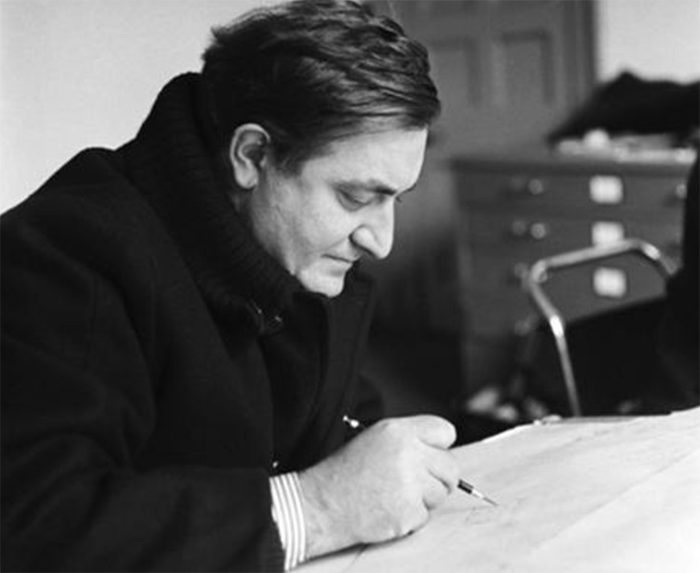
James Frazer Stirling was born in Glasgow in 1926 but was rather proud of having
been conceived on board a ship docked in Manhattan. His father was a marine engineer, and this might account for Stirling’s love of tight, shipshape modern design. He studied architecture at Liverpool University, where the presence of Colin Rowe as a fellow student may help explain the classical and humanist tendencies seen in his later work.
In 1953 Stirling worked for Lyons Israel and Ellis in London, where he met James Gowan. They commenced practice together in 1956 and soon became known for a series of buildings that, although uncompromisingly modern, owed little to the thendominant International Style. The principal works of the partnership were houses at Ham Common (1955–58); a competition project for Churchill College, Cambridge (1958); a project for Selwyn College, Cambridge (1959); and the Leicester University Engineering Building (1959–63), which achieved worldwide fame both for its dramatic contrast of red bricks and greenhouse glazing and for the audacity of its formal precision.
From 1964 to 1971, Stirling practiced alone. To this period belong many original designs, including the Cambridge University History Faculty Building (1964–67); residential units for students (1964–68) at St. Andrew’s University; the projects for Dorman Long Headquarters (1965) in Middlesborough; the Florey Building (1966–71) for Queen’s College, Oxford; housing for Runcorn New Town (1967–76); the Olivetti Training Centre (1969–72) at Haslemere; and projects for Siemens AG (1969) in Munich and for Derby Civic Centre (1970). In the two last projects, Leon Krier was assistant, and his hand may be detected in drawings made between 1968 and 1970. It seems that Stirling’s work did not conform sufficiently to the current ethos, and almost ten years were to pass before he again received an important British commission—for the extension of the Tate Gallery in London (1986).
From 1971 to 1992, Stirling was in partnership with his associate Michael Wilford. Their more important work includes projects for the Olivetti Headquarters (1971) at Milton Keynes and for an Arts Centre (1971) at St. Andrew’s University, competition designs for the Kunstsammlung Nordrheim-Westfalen in Düsseldorf and the Wallraf-Richartz Museum in Cologne (both 1975), extensions to the Staatsgalerie Stuttgart (1977, opened 1984), and a new building for the Württenbergisches Staatstheater in Stuttgart.
After taking part in a competition for lower Manhattan in 1968 and serving as a visiting critic and professor at the Yale University School of Architecture from 1960, Stirling became well known in the United States. As a result, he received a number of commissions, including an extension to the Rice University School of Architecture (1979–81) in Houston; the Sackler wing of the Fogg Art Museum (1984), Harvard University, Cambridge, Massachusetts; and the Chemistry Department (1981), Columbia University, New York. The latter project was abandoned, but the Performing Arts Center for Cornell University in Ithaca, New York, was completed in 1988 and the Science Library for the University of California, Irvine, in 1996.
Some critics have seen Stirling’s work after 1970 as taking on an increasingly formalist tendency. Works such as the Staatsgalerie Stuttgart and the Tate Gallery extensions have been referred to as Postmodern. Close examination, however, will show the underlying unity of all his work, although there is certainly an important shift (somewhat analogous to the shift in Le Corbusier’s late work with the Chapel of Notre Dame du Haut in Ronchamp) in that, compared with his earlier buildings, a freer rein is given to expressive gestures. Stirling is always consciously experimental in his use equally of eclectic reference and formal structures. In freely admitting the premeditated nature of all artistic creation, he has liberated himself from the false determinism that plagued so much architectural production after 1945. The element of historicity in his work is no less self- conscious and willful than was the element of modernity in his early work. It is this candor and lack of preconception that perhaps makes his work so vital.
Some of Stirling’s most interesting work remains in the form of projects, such as the superb design for a Public Library (1983) at Latina in Italy; the competition entries for the National Gallery Extension (1985) in London; the Thyssen Art Gallery (1986) in Lugano; a design for residential development (1988) at Canary Wharf, London; the Philharmonic Hall (1988) for Los Angeles; the Bibliothèque de France (1989); and the
Tokyo International Forum (1989).
However, other larger commissions have matured, giving us the Research and
Production Headquarters for Braun Pharmaceuticals (completed 1992) at Melsungen, near Frankfurt, with the collaboration of Walter Nägeli. Since Stirling’s death in 1992, we have the Music Academy (completed 1995) at Stutt-gart; the Science Library (completed 1996) for the University of California, Irvine; the Temesek Polytechnic University (1998) in Singapore; a mixed development at No. 1 Poultry (completed 1998) in the city of London; the mixed residential and offices building (completed 1999) in Carlton Gardens; and the Performing Arts Centre (under construction) at Salford, Lancashire.
Of these, the Braun Headquarters is especially remarkable for the expressiveness of its forms. The single line of conical capitals carrying the administration building is rendered immaterial in certain lights by the choice of materials, so that the building seems to float rather than bear down. It is as though the language of modern architecture had been taken into meditation and revised in the light of an inner vision.
All these works show a remarkable consistency in their conception and design, which is probably explained by the talent and the loyalty of the architects that Stirling and Wilford have employed. Since Stirling’s unnecessary death in 1992, the control of the office has passed to his partner, Michael Wilford, who has affirmed his commitment to the sort of architecture that Stirling practiced: experimental, making use of technology but not allowing technology to impose its values alone, aiming always to extend and improve the city fabric, and communicating enjoyment to ordinary people. The working team remains largely intact, and the work continues in large measure to be imprinted with his genius. In 1992, just before going into the hospital for a routine operation, Stirling accepted a knighthood.
ROBERT MAXWELL
Sennott R.S. Encyclopedia of twentieth century architecture, Vol.3. Fitzroy Dearborn., 2005. |