|
| GAE AULENTI |
| |
| |
|
| |
| |
 |
|
Name |
|
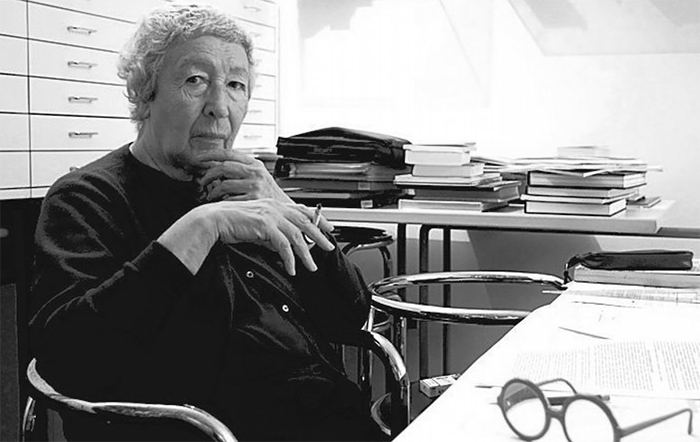
Gaetana "Gae" Emilia Aulenti |
| |
|
|
|
| |
Born |
|
December 4, 1927 |
| |
|
|
|
| |
Died |
|
October 31, 2012 |
| |
|
|
|
| |
Nationality |
|
Italy |
| |
|
|
|
| |
School |
|
|
| |
|
|
|
| |
Official website |
|
|
| |
|
|
| |
| BIOGRAPHY |
|
|
|
|
| |
|
Gae Aulenti is one of Italy’s best-known architects and one of the leading female
architects in the world. She has made her reputation in a versatile career that has combined architecture with designs for theater, furniture, museums, exhibitions, showrooms, gardens, and city-planning projects. In this way, she is very much a product of Milan in the 1950s, 1960s, and 1970s, when many architects, such as Vittorio Gregotti, combined architecture with design.
Aulenti graduated from the Faculty of Architecture at the Milan Polytechnic University in 1954. From 1955 to 1965, she was an editor in charge of layout at Casabella magazine in Milan, directed by Ernesto Rogers, her mentor. She was a member of a group of disciples of Rogers that included Vittorio Gregotti and Aldo Rossi, both of whom also were editors at Casabella. Her career as an architect began with a series of designs for showrooms: Olivetti (1967) in Paris; Olivetti (1968) in Buenos Aires; Knoll International (1970) in New York; and Fiat (1970) in Brussels, Zurich, and Turin. She also designed offices, such as Max Mara (1965) in Milan. She designed a traveling exhibition (1970) for Olivetti and participated in the exhibition, “Italy: The New Domestic Landscape,” at the Museum of Modern Art in New York (1972). In the 1960s, her interior designs are kaleidoscopic explosions of forms into space, though later they become calm and restrained, with curvilinear, surreal, and suggestive forms. The early showrooms are experiments in the breaking up of space without interfering with its functional use.
During the 1980s, Aulenti’s attention turned toward the design of museums and exhibition spaces. Her best-known project is the design of the Musée d’Orsay (1980–86) in Paris, made in collaboration with a team of French architects and the lighting designer Piero Castiglioni. This beautiful museum combines the iron structure and stucco decoration of a railway station into a modern architectural composition. Aulenti also worked on exhibition spaces for the National Museum of Modern Art at the Georges Pompidou Center in Paris (1982–85), the National Museum of Catalan Art in Barcelona (1987–95), and the Palazzo Grassi in Venice (1985–93). She designed “The Italian Metamorphosis 1943–68” exhibit at the Guggenheim Museum in New York (1994). The museum and exhibition designs always take into account, according to Aulenti, how the art is viewed by the visitor from different perspectives and combinations. Her exhibitions develop contrasts between open and closed spaces as well as between the autonomy and integration of spaces.
Throughout the 1980s and 1990s, Aulenti designed a series of stage sets for theatrical productions. These include sets for Rossini’s La Donna del Lago (1981–89), Rimski-Korsakov’s Zar Saltan at the Teatro alla Scala in Milan (1988), Strauss’s Electra in Milan (1994), and Shakespeare’s King Lear at the Teatro Argentina in Rome (1995). Aulenti’s stage sets contain beautiful dreamlike imagery that juxtaposes color and evocative forms that transgress the rules of perspectival construction. Aulenti sees the theater as a space of continuous transformation, where a relation between time and space is enacted. During the 1990s, Aulenti received several commissions for residences and public
buildings. The residences include a villa (1990) at Saint-Tropez, where four autonomous cubic structures are arranged on a square plan and connected in various ways, opening between interior and exterior. The public commissions include the entranceway to a train station in Florence, a college in Biella, and the Italian Pavilion at Expo ‘92 in Seville. At the Italian Pavilion, Aulenti emulates Mies van der Rohe in the aesthetic refinement and use of materials. Aulenti’s architecture always combines the application of an aesthetic order and the synthetic analysis of space. The designs take into account how space is experienced and how spaces and masses are combined. She experiments with relations among materials, distances, measurements, and equilibriums: primarily concerning how the body is experienced in the space.
In Italy, Aulenti’s work has been the subject of important critical essays by Ernesto Rogers, Vittorio Gregotti, Aldo Rossi, Manfredo Tafuri, and Francesco Dal Co. Although she is Italy’s most famous woman architect, Aulenti’s work has had very little influence on architectural practice in Italy and no theoretical influence in the architecture schools, as opposed to her peers Vittorio Gregotti and Aldo Rossi.
JOHN HENDRIX
Sennott R.S. Encyclopedia of twentieth century architecture, Vol.1. Fitzroy Dearborn., 2005.
|
| |
| |
| |
| |
| |
| |
| |
| TIMELINE |
|
|
|
|
| |
|
1927 Born in Palazzolo dello Stella, Italy, 4 December;
1954 Graduated from the School of Architecture, Milan Polytechnic;
1954 In private practice, Milan;
1954 Exhibition and industrial designer;
1955-65 Member, editorial staff, Casabella-Continuità, Milan;
1955-61 Member, Movimenti Studi per l’Architettura, Milan;
1960 Member, Associazione per il Disegno Industriale, Milan;
1960-62 Assistant professor of architectural composition, faculty of architecture, University of Venice;
1964-67 Assistant professor of the elements of architectural composition, faculty of architecture, Milan Polytechnic;
1966 Vice president, Associazione per il Disegno Industriale, Milan;
1967 Honorary member, Italian National Society of Interior Designers;
1967 Honorary member, American Society of Interior Designers;
1969-75 Visiting lecturer, College of Architecture, Barcelona, and Cultural Center, Stockholm;
1974 Member, board of directors, Lotus International, Venice;
1977-80 Joint executive member, Triennale, Milan;
1984 Corresponding member, Accademia Nazionale di San Luca, Rome;
1987 Chevalier, Legion d’Honneur;
1987 Commander, Ordre des Arts et Lettres;
1990 Honorary member, Bund Deutscher Architekten;
Honorary fellow, American Institute of Architects;
2012 Died in Milan, Italy, 31 October. |
| |
| |
| |
| |
| |
| |
| |
| FURTHER READING |
|
|
|
|
| |
|
Selected Publications
Un nuova scuola di base (with others), 1973
Il laboratorio di Prato (with Franco Quadri and Luca Ronconi), 1981
Further Reading
Bianchetti, Fabrizio, Le grandi architetture contemporanee, Faenza, Italy: C.E.L.I., 1991
Gae Aulenti (exhib. cat.), Milan: Electa, 1979
Galbiati, Augusta, Claudio Raboni, and Simonetta Rasponi, Venti progetti per il futuro del Lingotto, Milan: Etas, 1984
Petranzan, Margherita, Gae Aulenti, Milan: Rizzoli, 1996; as Gae Aulenti, translated by Susan Meadows, New York: Rizzoli, 1997
MORE BOOKS |
| |
| |
| |
| |
| |
| |
| |
| RELATED |
|
|
|
|
| |
|
GREGOTTI, VITTORIO; MIES VAN DER ROHE, LUDWIG; ROSSI, ALDO; |
| |
|