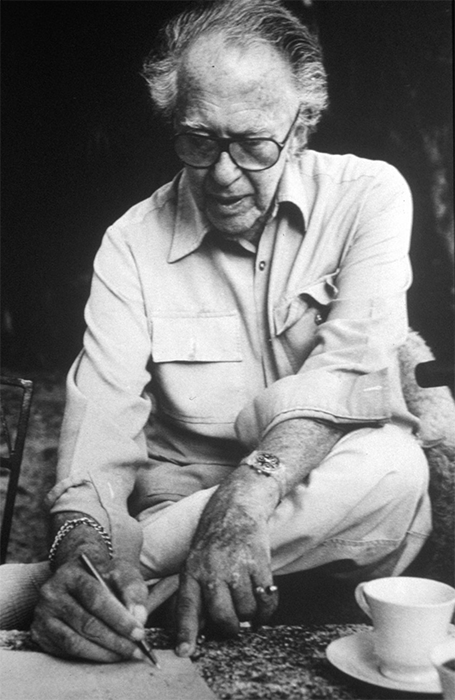
Geoffrey Bawa is a rare architect whose work combines an environmentally
appropriate beauty with a cultural sensitivity. Bawa was educated within the modernist tradition in the West, where he was trained both as a lawyer and as an architect. An urbane, widely read, and well-traveled person, he remains rooted in the soil of his native land. His buildings are predicated on the landscape and climate—he is as much an architect of landscape as he is of buildings.
To Bawa, the pitched roof is the archetype of southern Asian architecture. It is the dominant element that governs his aesthetic, in which shape, texture, and proportion are the strongest visual factors in his buildings. The great roof, with the building’s sides open to the flow of air and the view, give “presence to both function and form, to admit beauty and pleasure as well as purpose” (as told to the author, 1984). Another important feature of his work deals with movement through the building, modulated by the rooms, passages, and courtyards that frame vistas or parts of the landscape. Of equal importance is the play of light, in both the built areas and the “rooms” of the landscaping, which gives pleasure in addition to giving comfortable, functional use of the spaces. Bawa pays careful attention to detail, ranging from the expression of structure to the furnishing of rooms, regardless of the scale of the project.
Bawa has been fortunate to be in the position to choose his projects and select clients who are sympathetic to his approach. They include artists and intellectuals, private institutions, and government. The perception and organizational skills of his longtime partner, Dr. Poologasundram, an engineer, has enabled the Bawa to realize the buildings as conceived. He has worked with several others in his office for many years, and they also assist him in the development of his ideas. However, Bawa remains the principal and controls every aspect of the design.
Bawa designs using numerous freehand sketches, while simultaneously working on the site layout plan, section, elevation, and details. His partners and colleagues begin to formalize the work with schematic and working drawings. Often construction drawings and details are discussed with the craftsman and are changed. In the mode of the master architect, Bawa will alter his design on-site while the building is under construction. This technique was even used on his large Parliament Complex Colombo which was built by a Japanese company on a turnkey basis, but Bawa’s on-site decisions and solutions proved better and more cost-effective than the original plan.
His personal residences best illustrate his approach to design. His country house, Lunuganga, has been a continuing project since 1950. Set in a garden of 25 acres, the house and its free-standing pavilions overlook terraces and a lake, and illustrate his concerns with site and the expression of a contemporary vernacular. He has periodically added new buildings and elements, such as a large concrete chess set and a grove of trees and benches. Each of the pavilions has its own character and fits into its natural setting. It is perhaps his masterpiece, and was once described by one of the workmen as “a sacred place.” His principal residence in Colombo dates from 1969, and consists of four townhouses joined together with multiple small courtyards and a maze of rooms. It illustrates well his characteristic skill in working with small spaces to create intimacy and a sense of place.
The theme of pavilions set in a landscape typifies his architecture, as in the Ena de Silva House (Colombo, 1962) and the 12 pavilion houses (1973) built in Batujimbar, Indonesia, and designed with artist, Donald Friend. Low-cost schools such as Yahapath Endra Farm School (1966) in Hanwella extend this approach into the realm of institutional buildings. Bawa works this on an even larger scale at the University of Ruhunu (1984–86) in Matara, on the southern coast. There he not only planned the university, but also designed the Arts and Sciences faculty building as well as others. Pavilions of varying size, some of which are placed on stilts, are arranged to take advantage of the verdant site and the view to the sea.
Bawa is also known for his tourist beach hotels. Bentota Beach Hotel
(Bentota, 1969) has a dramatic entry staircase that spotlights the Sinhalese batik cloths on the ceiling. The Triton Hotel (1981) in Ahungalla has open spaces and public facilities on the ground floor with bedrooms above, and all have vistas of the beach and sea. A huge, ornamental entry pool leads to an open-sided reception area, which in turn overlooks a swimming pool that appears to merge into the sea and sky. This progression of spaces and visual effects is a common theme that appears in his work. Bawa’s Kandalama Hotel (1995) in Dambulla is sited on a hillside and approached from a lake. It takes full advantage of the views, and the concrete-frame structure is expressed in a modernist facade.
This aesthetic and the use of concrete, steel, and glass mark some of his office buildings and institutional complexes. His largest single structure, the Parliamentary Complex in Kotte (1982), is set in an artificially constructed lake. Pavilions of varying size flank the ceremonial building, with its large central volume containing the government assembly chamber and ancillary spaces. The huge copper roofs are reminiscent of monastic and royal buildings of the past yet convey a contemporary image. Bawa’s buildings, both public and private, cover a range of types, and although his work is often classified as “vernacular,” it is executed in varying styles.
Bawa’s work is contemporary yet seems to have existed in the landscape over the ages; it is a truly timeless architecture. Artist Barbara Sansoni wrote that his work “represents the distil-lation of centuries of shared experience, and links at the first level of achievement, its ancient architecture to that of the modern world” (Taylor 1986).
HASAN-UDDIN KHAN
Sennott R.S. Encyclopedia of twentieth century architecture, Vol.1. Fitzroy Dearborn., 2005.
|