|
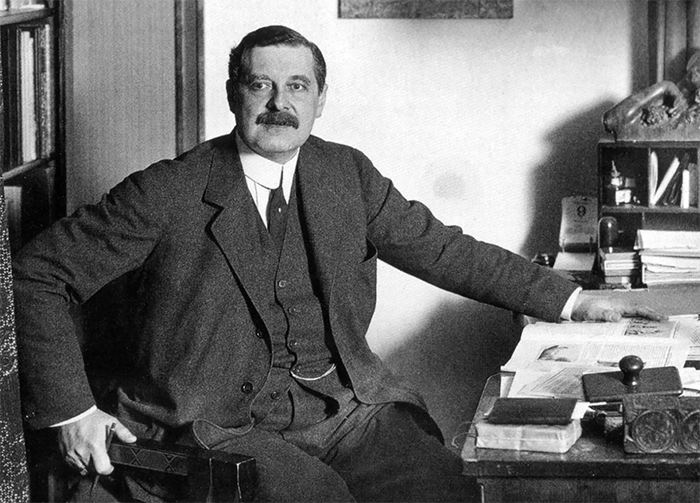
| PETER BEHRENS |
| |
| |
|
| |
| |
 |
|
Name |
|
Peter Behrens |
| |
|
|
|
| |
Born |
|
April 14, 1868 |
| |
|
|
|
| |
Died |
|
February 27, 1940 |
| |
|
|
|
| |
Nationality |
|
Germany |
| |
|
|
|
| |
School |
|
|
| |
|
|
|
| |
Official website |
|
|
| |
|
|
| |
| BIOGRAPHY |
|
|
|
|
| |
|
Peter Behrens was one of the most prolific architects of his generation. He created
buildings ranging from embassies, monuments, bridges, churches, and giant factories to domestic houses, workers’ estates, and apartment blocks. He also became the first industrial designer in the modern sense; he was responsible for mass-produced furniture, textiles, cutlery, ceramics, and glass in addition to his well-known range of electrical appliances for the AEG, or General Electric Company. His graphic work was enormously successful, and he was active in theater design, calligraphy, and typography. He was a teacher and a writer, and he had a strong influence on the development of his assistants, who were to become the most celebrated architects of the next generation. Behrens was born in St. Georg, Hamburg, and he was the son of a landowner who did not marry his mother. Both his parents died when he was young, and he was reared by a guardian from the age of 14. On leaving school in Altona in 1886, he chose to study art and attended the Gewerbeschule, Hamburg, and the Kunstschule, Karlsruhe, until 1889, before becoming first a pupil of Ferdinand Brütt in Düsseldorf and then of Hugo Kotschenreiter in Munich. Behrens went through various phases in his painting style; at first he was influenced by the realist and impressionist work of Dutch-German and Dutch artists, such as Wilhelm Leibl and Max Liebermann, before turning to studio compositions of a more symbolist approach. Behrens never sought or acquired formal qualifications as an architect. In the later 1890s, while still living in Munich, he executed a number of woodcuts in a flat, linear style and became drawn into the group that formed the Vereinigten Werkstätten für Kunst im Handwerk, designing and exhibiting ceramics, glass, jewelry, furniture, and women’s clothing. His large woodcut, Der Kuss (1898), became one of the best-known images of Jugendstil, or German Art Nouveau.
In July 1899, as a result of his reputation as an artist and designer, he was invited to join the artists’ colony at Darmstadt, which was being established under the patronage of Grand Duke Ernst Ludwig of Hessen. This colony was planned and launched with ducal, government, and industrial support to stimulate the role of applied art in the local economy and to bring prestige to the city. The seven artists brought together at Darmstadt were to be a free creative community, and to exhibit their work regularly; they were to live in houses designed by the Austrian architect Joseph Maria Olbrich, with the exception of Behrens, who designed his own.
This house, his first, was to accommodate himself, his wife, and their two young children. It was intended, like the other houses of the Künstlerkolonie (artists’ colony), to be at once a dwelling and a permanent exhibit of the new architecture, a statement of a way of living and a model of style.
Behrens’s house is basically cubic in form, with a red-tiled pyramidal roof. A gable dominates the main facade, and the plain white walls are relieved with decorative pilaster strips, quoins, and architraves in molded green-glazed bricks. Internally, the ground floor is comprised of an entrance hall with wide sliding screens that open into a music room that in turn connect to a dining room, so that virtually the whole space can be unified when desired. The studio is a principal room upstairs. Behrens designed all the interior decorations—the furniture, carpets, curtains, light fittings, cutlery, glass, china, and linen—in harmony. He and his house played a major role in the 1901 exhibition of the artists’ colony, titled Ein Dokument Deutscher Kunst (A Document of German Art). In his first year in the colony, he wrote and published a long essay on the theater, Feste des Lebens und der Kunst, and designed a round, highly centralized Festival Theatre, the plans of which were published but never realized.
In 1902 Behrens’s first printing type, Behrens-Schrift, was published. He was to design a number of typefaces, including a special face for the AEG that is still used today for that company’s logo, and, with Anna Simons, the inscription on the portico of the Reichstag in Berlin, Dem Deuts chen Volke (1909).
Of importance to his growing reputation was his contribution to the First International Exhibition of Modern Decorative Arts in Turin in 1902. He was responsible for the Hamburger Vorhalle, a powerfully modeled, cryptlike, top-lit hall. It may be considered the most Art Nouveau of Behrens’s architectural works, and the strongest expression of his admiration for Frederich Nietzsche’s philosophy. Following this, his architecture became more rectilinear and geometric, and indeed it remained so for the rest of his career.
In 1903 Behrens moved to Düsseldorf, where he had been appointed director of the School of Arts and Crafts. In that year, he traveled in England and Scotland, visiting houses by Edwin Lutyens and Charles Rennie Mackintosh. A striking demonstration of Behrens’s new, coolly geometrical style was seen in the garden layout and pavilion that he designed for the Düsseldorf Gartenbau und Kunstausstellung (Garden Design and Pavilion) of 1904. In harmony with the restaurant pavilion (which Behrens furnished with Mackintosh-like ladder-backed chairs) were rectangular white latticework pergolas, creating what was described as “habitable nature, a living room in the open air” (Osborn). A lasting influence on Behrens’s design procedure came from the proportional grids, based on the square and the circle evolved by the Dutch architect J.L.M.Lauweriks, who joined Behrens’s staff in that year. Behrens spent the summer of that same year studying the antiquities of Rome and Pompeii.
Between 1904–06, Behrens designed a number of buildings that directly fuse the elements of simple geometry with classically derived decoration. For example, the complex of buildings for the Northwest German Art Exhibition of 1905 was symmetrically grouped on a broad rectangular space to form an ensemble of cubes, pyramids, domes, and triangles. The stark white buildings with their bold geometric surface patterns suppressed any expression of their material or constructional elements. His domed, octagonal exhibition pavilion in Dresden for the Delmenhorster Linoleumfabrik of 1906, as well as the range of linoleum patterns exhibited in it, led to Behrens’s recognition as an artist who was gifted for and suited to working with modern industry.
Behrens’s friendship with the patron Karl Ernst Osthaus of Hagen led to a number of commissions in the city, as well as to his famous Crematorium nearby at Delstern (1906– 07). They included a lecture theater for the Folkwang Museum (1905), a shop for the firm of Josef Klein (1905–07), a large octagonal Protestant church that was never built (1906– 07), and an important group of houses on an estate at Eppenhausen, for which Osthaus was the developer. The garden suburb at Eppenhausen was divided by Osthaus into three zones, and he asked Behrens, Lauweriks, and the Belgian Henri van de Velde to prepare related groups of houses for each area. Behrens’s were built between 1909 and 1912, following a dramatic new phase in his life as artistic adviser to the AEG. He moved to Berlin in 1907, and his three houses (the Cuno, Schroeder, and Goedecke houses) were detailed and su- pervised by Walter Gropius. Gropius was the closest to him of the team of assistants he had engaged to join his Berlin studio, to work on his now immensely expanded practice. The most impressive of the houses remains the Cuno house (1909–10). Rectangular in plan, it resembles a Palladian villa, with a nearly symmetrical disposition of the rooms on the ground floor. The living room on the garden side, centrally placed between the identically scaled dining room and the ladies’ drawing room, opens through a large three- light French window onto a generous terrace. The most striking feature of the main, street facade is the curved central tower, recessed into the plane of the front walls, which rises the full height of the elevation and contains a spiral staircase. This, with its five plain narrow windows between slender piers, is flanked by a rusticated ground-floor story in local stone, above which plain, smoothly rendered wall surfaces are broken only by three square bedroom windows on either side in the upper story. The web of horizontal and vertical tensions of the design is given an asymmetrical rhythm by the stone wall of one of the balconies (which flank the house on either side), wrapping around to the front as a thick buttresslike wall. Horizontal emphasis is given by the low-pitched roof set behind a stepped-back parapet, a thin emphatic cornice, and a similar stringcourse halfway up the facade.
The most remarkable development in Behrens’s career was his appointment in 1907 to the AEG. He redesigned the firm’s range of arc lamps, kettles, coffee pots, fans, clocks, radiators, and motors, bringing enormous commercial success to the firm. He designed a vast range of brochures, posters, and catalogs and devised typefaces as well as the logo of the company. More important, he became responsible for the firm’s industrial architecture. In 1910 the best known of his factory buildings, the Turbine Hall at Moabit, was completed. The largest steel hall in Berlin of its time, this great building is formed of 22 girder frames exposed along one side; the main facade has a huge steel-framed window under a curved segmental concrete gable; the profile is made up of six straight facets. This rests on massive-looking concrete piers, grooved horizontally, which affect the corners on either side. Its peculiar genius lies in the expressive force of steel and glass used on a large scale, without historical decorations of any kind.
Between 1908 and 1914, a range of giant factory buildings on the Humbolthain in Berlin were designed by Behrens and his team, which included Ludwig Mies van der Rohe and, for a brief period, Charles-Édouard Jeanneret (Le Corbusier) alongside Gropius. The most significant of these steel-framed buildings were the High Tension Materials Factory (1910), a powerful, expressive multistory complex with echoes of classical form in its triangular pediments and pilasterlike columns on its principal facade, and the Small Motors Factory (1910), with its vast, stoa-like range of 20-meter-high brick piers facing Voltastrasse. Also, there is the Assembly Hall (for large machines, 1912) flanking Hussitenstrasse, with its restrained grid of repeated horizontal and vertical elements framing the large rectangular windows.
A major state commission of the period was the German Embassy, St. Petersburg (1911–12), which owed inspiration to Roman palazzi of the 16th century and to Schinkel’s Altes Museum. An astonishing number of other large projects that were completed included the head office of the Mannesmann Tube Company in Düsseldorf (1911–12), a pioneering exercise in modular planning and construction; the Continental Rubber Company Factory in Hannover (1911–12); the Frankfurt Gasworks Complex (1911–12); and the Festival Hall for the 1914 Werkbund Exhibition in Cologne.
Behrens’s contract with the AEG was terminated in 1914. After the war, he published, with Heinrich de Fries, Von sparsamen Bauen (1918; On Economical Building), which advocated low-cost housing schemes to be built of reinforced concrete, incorporating the latest facilities and communal social services using standardized units to create varied types of accommodation with built-in storage cupboards to maximize the space.
Following a period of brick expressionism—used, for example, for the head offices of the Hoechst Dyeworks for IG Farben and the Dombauhütte (Cathedral Masons’ Lodge) exhibition building in Munich (1922)—Behrens’s style changed yet again. This time the change led to mainstream International Modern, a style for which his own earlier work had been formative. Other projects included blocks of flats (1924–28) for the authorities in Vienna, where he lived following his appointment as professor of the Master School for Architecture, the small house New Ways in Northampton, England (1923–25), his terrace block on the Weissenhof estate in Stuttgart (1926–27), his house for Dr. Lewin, Berlin (1929–30), and the superb villa for Clara Gans in the Taunus Mountains (1931). All of these buildings had flat roofs over plain, cubic forms with a strong horizontal emphasis. His Ring der Frauen pavilion for the 1931 Berlin Building Exhibition was a delightful, prototypical women’s clubhouse comprising several low intersecting cylindrical elements.
During the Third Reich, despite being attacked as a Bolshevist, the elderly and sick Behrens was invited to design a new AEG headquarters (1937–39) for the North-South Axis of Berlin being planned by Albert Speer. It was never constructed.
ALAN WINDSOR
Sennott R.S. Encyclopedia of twentieth century architecture, Vol.1. Fitzroy Dearborn., 2005.
|
| |
| |
| |
| |
| |
| |
| |
| TIMELINE |
|
|
|
|
| |
|
1868 Born in Hamburg, Germany, 14 April;
1886-89 Attended the Karlsruhe and Düsseldorf Art Schools;
1887-89 Studied privately in artists’ studios;
1889 Married Lili Kramer;
1893 Founding member, Munich Sezession;
1899 Co-formed Die Seben art colony, Darmstadt, Germany;
1902 Director, Nuremberg Master Course in Architecture;
1903-07 Head of Düsseldorf School of Applied Arts;
1907 Designer to electrical combine AEG, Berlin;
1907 Established own firm, Berlin;
1921-22 Director, Academy of Art, Düsseldorf, Germany;
1922-27 Director and professor, School of Architecture, Vienna Academy of Fine Arts, Vienna;
1936-40 Director, Department of Architecture, Prussian Academy of Arts, Berlin;
1940 Died in Berlin, 27 February. |
| |
| |
| |
| |
| |
| |
| |
| FURTHER READING |
|
|
|
|
| |
|
Selected Publications
Feste des Lebens und der Kunst: Eine Betrachtung des Theaters als höchstes Kultursymbol, 1900
Ein Dokument deutscher Kunst: Die Ausstellung der Künstler-Kolonie in Darmstadt 1901, 1901
Haus Peter Behrens, Darmstadt, 1901, brochure
Behrens Schrift, 1902
Beziehungen der künstlerischen und technischen Probleme, 1917
Vom sparsamen Bauen: Ein Beitrag zur Siedlungsfrage (with Heinrich de Fries), 1918
Das Ethos und die Umlagerung der künstlerischen Probleme, 1920
Terrassen am Hause, 1927
Further Reading
A detailed and scholarly catalogue of Behrens’s architecture, appliances for the AEG, and graphics appears in Buddensieg and Rogge. Furniture is catalogued in Schuster, and work for the Anker-Marke linoleum factory is listed in Asche.
Anderson, Stanford, Peter Behrens and a New Architecture for the Twentieth Century, Cambridge, Massachusetts: MIT Press, 2000
Asche, Kurt, Peter Behrens und die Oldenburger Ausstellung 1905, Berlin: Mann, 1992
Branchesi, Lida, Peter Behrens (Ph.D. dissertation), Rome, 1965
Buddensieg, Tilmann, and Henning Rogge, Industriekultur: Peter Behrens und die AEG, 1907–1914, Berlin: Mann, 1979; 4th edition, 1993; as Industriekultur: Peter Behrens and the AEG, 1907–1914, translated by Iain Boyd Whyte, Cambridge, Massachusetts: MIT Press, 1984
Buderath, Bernhard, and Tilmann Buddensieg, Peter Behrens: Umbautes Licht: Das Verwaltungsgebäude der Hoechst AG, Frankfurt: Prestel, 1990
Casabella 240 (June 1960) (special issue on Behrens)
Cremers, Paul Joseph, Peter Behrens: Sein Werk von 1909 bis zur Gegenwart, Essen: Baedecker, 1928
Dokumente aus Hoechster Archiv, part 4, Hoechst: Hoechst A.G., 1964
Gerber, Werner, Nicht Gebaute Architektur. Peter Behrens und Fritz Schumacher als Kirchenplaner in Hagen. Beispiele aus den Jahren 1906–1907, Hagen: Linepe, 1980
Hesse-Frielinghaus, Herta, Peter Behrens und Karl Ernst Osthaus. Eine Dokumentation nach den Beständen des Osthaus-Archivs im Karl-Ernst-Osthaus Museum, Hagen: Karl Ernst Osthaus Museum, 1966
Hoeber, Fritz, Peter Behrens, Munich: Müller und Rentsch, 1913
Hoepfner, Wolfram, and Fritz Neumeyer, Das Haus Wiegand von Peter Behrens in Berlin-Dahlem, Mainz: Philipp von Zabern, 1979
Kadatz, Hans-Joachim, Peter Behrens, Architekt, Maler, Grafiker und Formgestalter, 1868–1940, Leipzig: Seemann, 1977
Krimmel, Bernd (editor), Ein Dokument Deutscher Kunst. Darmstadt 1901–1976, Darmstadt: Roether, 1976
Norberg-Schulz, Christian, Casa Behrens: Darmstadt, Rome: Officina Edizione, 1980; 2nd edition, 1986
Osborn, Max, "Die Düsseldorfer Ausstellung: Kunst und Künstler", Jr II, vol. 12 (September 1904)
Pfeifer, Hans-Georg (editor), "Peter Behrens: “Wer aber will sagen, was Schönheit sei?”: Grafik, Produktgestaltung, Architektur, Düsseldorf: Beton-Verlag, 1990
Schuster, Peter-Klaus, Peter Behrens und Nürnberg: Geschmackswandel in Deutschland (exhib. cat.), Munich: Prestel, 1980
Windsor, Alan, Peter Behrens, Architect and Designer 1869–1940, London: Architectural Press, and New York: Whitney Library of Design, 1981
MORE BOOKS |
| |
| |
| |
| |
| |
| |
| |
| RELATED |
|
|
|
|
| |
|
ART NOUVEAU; LE CORBUSIER ; GROPIUS, WALTER; MIES VAN DER ROHE, LUDWIG; OLBRICH, JOSEPH MARIA; VAN DE VELDE, HENRI; |
| |
|