Although the international perspective of architectural developments in Finland
centered on the work of Alvar Aalto in the quarter-century following World War II, Finnish architecture during this time was very much more than Aalto. This period is often viewed, again from an international perspective, as the quiet, golden age of the century, with numerous works realized in a material palette relying on brick and wood. Within Finland, while Aalto went his own way, the majority of Finnish architects continued to practice an evolved form of modernism influenced by Mies van der Rohe, among others. This work is characterized by its direct approach in the use of reinforced concrete and steel along with brick and wood, coupled with rational building planning and organizational techniques. Less romantic in conception than Aalto’s work, these buildings expanded the rationalist aspect of modernism while incorporating more expressive spatial explorations with richer material vocabularies.
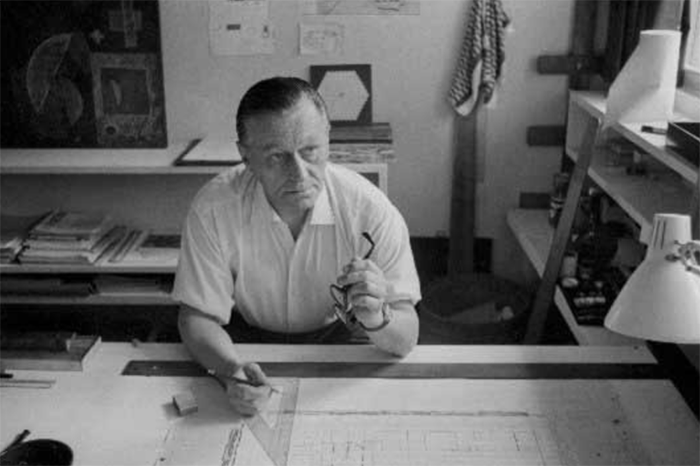
A major intellectual and creative force in this period—and one often not recognized internationally—was Aulis Blomstedt. Although he did not design many buildings, Blomstedt had a strong influence on Finnish architecture and is often viewed as the significant counterpoint to Aalto. More than any of his contemporaries, Blomstedt’s important influence can be seen both in his work as well as in his theoretical writings and presentations. Without question, he was the foremost theoretician in Finnish architecture during the postwar period. Though his work and writings, he aimed to develop an objective theory of architecture that could be verified through practice, with simplicity, austerity, and abstraction becoming the essentials in his designs. His terraced Ketju housing complex in Tapiola (1954) and Worker’s Institute Addition in Helsinki (1959) are essays indicating his rigorous process of thinking and doing, as are a series of abstract graphic and installation pieces he developed for studying proportion and dimension. In addition to practicing, Blomstedt was a professor at the Helsinki University of Technology, and his influence is seen in the works of his students, Kristian Gullichsen, Juhani Pallasmaa, Erkki Kairamo, and Kirmo Mikkola, among others, that were executed since the 1970s.
Like his contemporaries, Blomstedt received a classical education in architecture at the Helsinki Institute of Technology, and a number of his student projects are indicative of this. The work is sympathetic with the “Nordic Classicism” found throughout Scandinavia architecture during the 1920s. He made a study tour to Italy in 1927. By the time of his graduation in 1930, his work embraced the transition to functionalism that had occurred in Finland during the late 1920s: His diploma project—“A Circus for Helsinki”—bears witness to this change. The firms for which he worked immediately following graduation practiced in the classical style.
During his tenure as chief architect for the Finnish Ministry of Defense, he executed projects such as the Air Force School Hospital in Kauhava (1934) and the Aerodrome No. 6, Staff Headquarters and Barracks buildings in Imatra (1936), among others. These works demonstrate a modesty and practicality, yet are also good examples of functionalist design.
In 1942, following the Russo-Finnish War, The Finnish Association of Architects set up a reconstruction office to address the rebuilding issues facing Finland, as well as relocation problems resulting from the war (120,000 homes were destroyed or abandoned and over 400,000 citizens were resettled from territory ceded to the Soviet Union). Blomstedt worked on the development of standardized plans and prefabricated building designs with Viljo Revell, Kaj Englund, Aarne Hytönen, Yrjö Lindegren, Olli Pöyry, and Erkki Koiso-Kanttile. In this environment, Blomstedt laid the foundation for the postwar debate on aesthetic principles and social applications of modular industrial systems used for housing complexes. This work also had a powerful influence on the development of Finnish building standards immediately after the war.
Blomstedt opened his architectural practice in 1944 and was soon engaged in designing numerous housing complexes and dwellings, among other works, throughout Finland. Over his entire career, Blomstedt, like a number of his contemporaries, was an active architectural competition entrant (the architects for Finnish public buildings are selected through an open competition process). His numerous entries always combined a strong theoretical foundation with practical problem solving and planning techniques.
By the early 1950s, Finland was active in developing new towns in the forest areas near existing cities. One of the most important initial projects was Tapiola, an internationally recognized development, outside of Helsinki. In 1952 Blomstedt joined Aarne Ervi, Viljo Revell, Markus Tavio, and the town planner, Otto-I.Meurman, on the first phase of the plan for Tapiola. Several of Blomstedt’s best housing projects were designed for Tapiola, including the harmonious group of three chain houses and three apartment blocks on adjacent sides of a street. With their alternating red brick and white stucco facades, the Ketju terraced row houses have two-story living quarters linked by a variable intermediate section that was designed as reserve space for future uses or needs. The apartment blocks designed for the other side of the street (but were not built) would have reinforce the streetscape, acting as a compositional foil to the row housing. Works in Tapiola include the Finnish Artists Society terraced housing (1955), the Riistapolku housing complex (1957–60), and the Helikko housing complex (1961–62), among many other types of housing projects. Much of Blomstedt’s body of work resides in Tapiola.
Without question, the extension to the Helsinki Finnish Worker’s Institute is Blomstedt’s most important work. Adding on to Gunnar Taucher’s 1927 classical work, Blomstedt derives the dimensions of his new building from the classical proportions of the original. This results in achieving a harmony between the new and the old through massing and proportions in the facades. Three times the size of the older building, the addition does not disturb the urban context of the original but is sensitively sited behind it. Blomstedt skillfully exploits the significant level change occurring between the streets that border the site. The new building is placed parallel to the existing one in a new excavated courtyard space. A rock wall clad in colored concrete slabs provides an effective boundary to the back of the court, and the new main entrance is located within the courtyard. Further, there are painterly and architectural qualities in the addition and its spaces that directly reference the Dutch De Stijl movement.
Blomstedt was also a theoretician, however, and from the 1940s onward, he focused on clarifying architecture through intellectual speculations. Modular and proportional discipline was Blomstedt’s foundation, for he sought to develop a universal system derived from human measurements and dimensional harmony. The crystallization of his research was “Canon 60,” a system of dimensions and proportions in which the principals of mathematical and musical harmony were applied to building. In achieving this, he was able to extend his classical training into contemporary architecture, continuing one of the oldest traditions in Western architecture—using the principles of harmonic proportions— into current practice.
Austerity and simplicity were essentials of Blomstedt’s work. But his austerity and simplicity is not for the simple-minded, who would miss the subtle and poetic realizations in his work. Like that of the classical and Renaissance architects before him, Blomstedt’s architecture is an architecture for both the mind and the senses.
WILLIAM C.MILLER
Sennott R.S. Encyclopedia of twentieth century architecture, Vol.1. Fitzroy Dearborn., 2005.
|