|
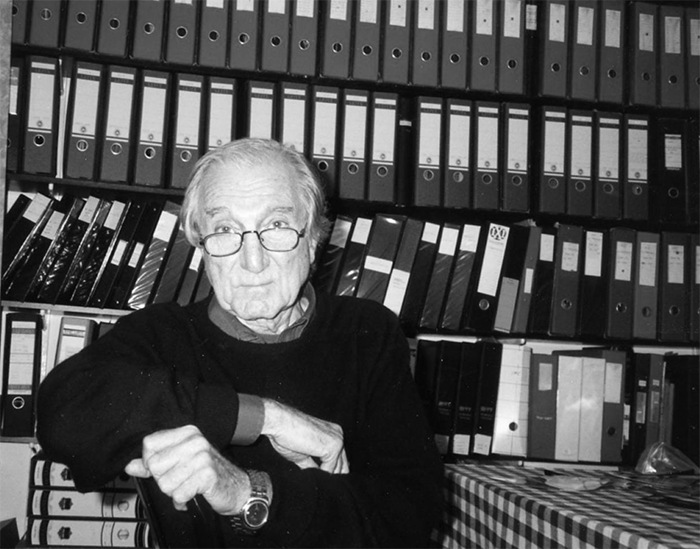
| RIFAT CHADIRJI |
| |
| |
|
| |
| |
 |
|
Name |
|
Rifat Chadirji |
| |
|
|
|
| |
Born |
|
December 6, 1926 |
| |
|
|
|
| |
Died |
|
April 10, 2020 |
| |
|
|
|
| |
Nationality |
|
Iraq |
| |
|
|
|
| |
School |
|
|
| |
|
|
|
| |
Official website |
|
|
| |
|
|
| |
| BIOGRAPHY |
|
|
|
|
| |
|
The driving force behind Rifat Chadirji’s work has been his attempt to reconcile
contemporary social needs with new technology. His search for a regional modernism found expression in cement-concrete buildings and in his plans for Baghdad.
In the Iraq of the 1950s, a flowering of the arts included intensive discussions among architects, artists, writers, and intellectuals about the need for appropriate artistic expressions, influenced by both European ideas and local traditions. The architects Wilson and Mason, who practiced in Iraq in the 1940s and whose buildings interpreted local architecture employing indigenous master masons, also shaped Chadirji’s ideas about regionalism. This approach stagnated somewhat after World War II, when new technologies that bypassed the contribution of the indigenous building industry were introduced. Architects such as Le Corbusier, Walter Gropius, and Frank Lloyd Wright visited Iraq in the 1960s, encouraging the local Iraqi architects to find their own expression of modern architecture. As a consequence, Chadirji sought to achieve a synthesis between traditional forms and materials and modern technology and building types. He studied local environmental features such as courtyards, screen walls, and natural ventilation. However, until the late 1960s his buildings were clearly functionalist and were determined by structural considerations and modern materials, as evidenced in his Monument to the Unknown Soldier (1959) and in his Tobacco Monopoly Offices and Warehouse (1969), both in Baghdad.
Chadirji articulated his ideas concerning a modernism informed by tradition in his written works, theories that can be seen in his villa for H.H.Hamood (1972), designed as a dramatic series of parallel vaults. As Chadirji noted, it was not until the early 1970s that he reached the view that the connection between form and structure was not inevitable. This realization led the architect to increased freedom of construction and the plastic possibilities of building form.
This sense of plasticity and a graphic approach to buildings characterize the facades of his buildings, as demonstrated in his published portfolio of etchings and drawings for the Federation of Industries and for the Ministry of Municipal and Rural Affairs. His buildings are characterized in plan by parallel walls and in elevation by facades of solid planes with indented openings, often with protruding tall, thin, arched windows and curving corners. The concrete buildings were usually designed to be faced in brick or, in other countries of the Middle East, in stone. Together with Mohamed Makiya, Chadirji’s buildings influenced much of the architecture in the Arab Middle East in the 1970s and early 1980s.
In his analysis of built form, Chadirji led the way in the Middle East to
reevaluate architecture’s role in culture and politics. The effects of his contributions have been long lasting and include his vision of rapidly changing architectural forms as mediators between social needs and prevailing technology. The failure to come to terms with this, he postulated, partly explained the collapse of architecture seen in Iraq after 1945. Second, Chadirji saw the relationship between local traditional building and international modernism as one in which an “authentic regionalism” based on an abstraction of tradition and modernity could emerge. Third, in the 1960s, Chadirji was early to recognize the potential importance of the computer to design and urban planning such that computer technologies would enable the inhabitants of buildings and neighborhoods to participate in the design process. Chadirji’s contribution to the urban built form of Baghdad has been remarkable, despite a turbulent political relationship with the authorities. In the late 1970s he was forced to abandon his practice when the Iraqi government imprisoned him. Surprisingly, in 1980 that same government appointed him counsellor to the mayor of Baghdad, with responsibility for an ambitious scheme for urban rehabilitation and development. This project was completed in 1983 for the international meeting of Non-Aligned Nations; it included a master plan, a citywide landscaping scheme, infrastructure development, urban conservation and urban design projects, housing, and commercial works. Proposals for building codes, conservation law, and economic development projects were all in his domain, and for two years he was one of the most powerful bureaucrats in the country. Chadirji left Baghdad for the United States in late 1982 and subsequently completed his most significant book, Concepts and In fluences (1986), and continued his research in the interrelationships among architectural theory and phenomena in physics and biology. The Chadirji Research Center in the United Kingdom is a major source of information about Iraq and includes an extensive archive of photographs from his father and his own detailed survey of Arab peoples and their physical world.
HASAN-UDDIN KHAN
Sennott R.S. Encyclopedia of twentieth century architecture, Vol.1. Fitzroy Dearborn., 2005.
|
| |
| |
| |
| |
| |
| |
| |
| TIMELINE |
|
|
|
|
| |
|
1926 Born in Baghdad, Iraq, December;
1946-52 Studied at the Hammersmith School of Arts and Crafts, London; earned a Diploma of Architecture;
1952-72 Founder and partner of Iraq Consult;
1954 Married Balquis Sharara;
1954-57 Director of buildings, Waqf;
1957-58 Director of buildings, Public Works, Department of Health and Education;
1958-59 Director of buildings, Ministry of Planning;
1960-63 Director of buildings, Ministry of Housing, Planning Department;
1964 Recipient of the Bronze Medal, Barcelona International Furniture Design;
1965-80 Returned to private practice;
1966-75 Subject of over a dozen exhibitions in the Middle East and Africa;
1978 "Modern Arab Architecture" exhibition at the Royal Institute of British Architects, London;
1980-82 Appointed counsellor to the mayor of Baghdad;
1982 Retired from practice;
1982 Honorary Fellow, Royal Institute of British Architects;
1983 Arrived in the United States (Harvard University); Loeb Fellow;
1984-86 Visiting Scholar at the Graduate School of Design, Harvard University;
1985-92 Visiting Scholar, Philosophy of Education Research Center;
1986 Aga Khan Award for Architecture, Chairman’s Award;
1986-92 Visiting Scholar at the Aga Khan Program for Islamic Architecture, MIT;
1987 Honorary Fellow, American Institute of Architects;
1987-92 Visiting Scholar at the Graduate School of Education, Harvard University;
1989-94 Visiting Scholar at the Bartlett School, University College London;
1990 Established the Chadirji Research Center, Kingston-upon-Thames;
April 10, 2020 Died in London, England. |
| |
| |
| |
| |
| |
| |
| |
| FURTHER READING |
|
|
|
|
| |
|
Selected Publications
A Collection of Twelve Etchings, London: privately published, 1985
Portrait of a Father, London: privately published, 1985
Taha Street and Hammersmith, Beirut: privately published, 1985
Concepts and Influences: Towards a Regionalised International Architecture, London: KPI, 1986
The Ukhaidir and the Crystal Palace, Kingston-upon-Thames: CRC, 1991
Further Reading
“Architect of Baghdad: Rifat Chadirji” in Middle East Construction, Surrey, England: Sutton, 1984
Bofill, Ricardo, and Charles Knevit, “The Architecture of Rifat Chadirji: An Appraisal,” Process Architecture (Tokyo) (May 1985)
Khan, Hasan-Uddin, “Regional Modernism: Rifat Chadirji’s Portfolio of Etchings,” Mimar: Architecture in Development (Singapore) 14 (October-December 1984)
Khan, Hasan-Uddin, The Middle East, Volume 5 of World Architecture: A Critical Mosaic 1900–2000, K. Frampton, Series Editor, Vienna: Springer, 2000
Kultermann, Udo, Architekten der Dritten Welt, Cologne: DuMont Buchverlag, 1980
Kultermann, Udo, “Contemporary Arab Architecture: The Architects of Iraq,” Mimar: Architecture in Development (Singapore) 6 (July-September 1982)
Kultermann, Udo, Contemporary Architecture in the Arab States, New York: McGraw-Hill, 1999
“Middle Eastern Realities at RIBA,” in Building Design (London) 19 (January 1983)
Ali, M., “Rifat Chadirji,” Domus (Milan) (December 1983)
Serageldin, Ismail (editor), “Chairman’s Award: Rifat Chadirji,” in Space for Freedom, London: Butterworth Architecture, 1989
MORE BOOKS |
| |
| |
| |
| |
| |
| |
| |
| RELATED |
|
|
|
|
| |
|
|
| |
|