|
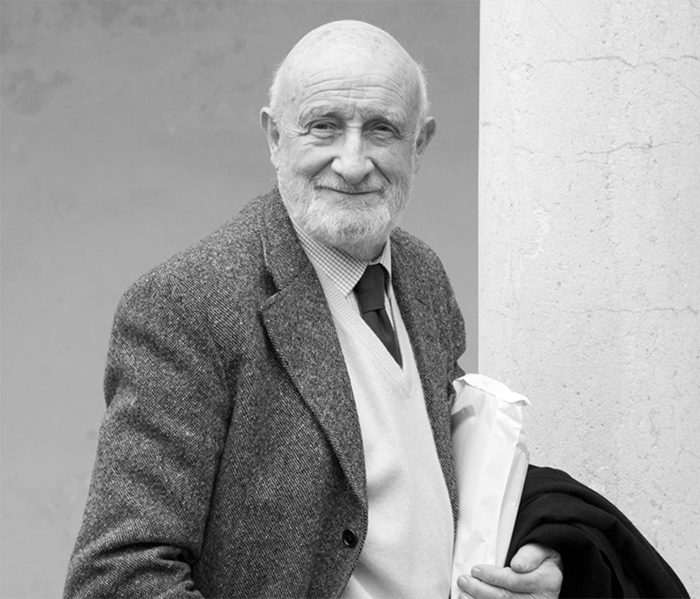
| VITTORIO GREGOTTI |
| |
| |
|
| |
| |
 |
|
Name |
|
Vittorio Gregotti |
| |
|
|
|
| |
Born |
|
10 August 1927 |
| |
|
|
|
| |
Died |
|
15 March 2020 |
| |
|
|
|
| |
Nationality |
|
Italy |
| |
|
|
|
| |
School |
|
|
| |
|
|
|
| |
Official website |
|
|
| |
|
|
| |
| BIOGRAPHY |
|
|
|
|
| |
|
Born in Novara, Italy in 1927, Vittorio Gregotti graduated from the architecture faculty of Milan Polytechnic in 1952 and worked on the editorial board of Casabella magazine from 1953 to 1955. He was chief editor from 1955 to 1960, with Aldo Rossi and Gae Aulenti among the editors, and was managing editor from 1982 to 1995. Gregotti also worked for Ernesto Rogers at BBPR (Belgioioso, Banfi, Peressutti, Rogers). Like Gae Aulenti, Gregotti began his career in a professional environment in Milan that combined architecture with industrial design and other design arts. Gregotti’s early work included designs for exhibition posters, book covers, showrooms, offices, and boutiques, but he is best known for hundreds of significant architectural projects, including housing complexes, supermarkets, department stores, and college campuses.
The 1950s and 1960s were a period of economic boom in Milan, with the large influx of workers providing a need for new residential housing projects. Gregotti met this demand for housing. During the 1970s, his work expanded to projects for factories and research centers. Later, in the 1980s, he also designed large stadium complexes. During the 1990s, his office designed everything from cruise ships to city plans. During the 1970s and 1980s, Gregotti became one of Italy’s leading architects and most influential theorists, participating with great influence in two important institutions, the Venice Biennale and the Milan Triennale. He has written several books on architecture throughout his career, including Il territorio dell’architettura (1966; The Territory of Architecture), L'architettura dell'espressionismo (1967; The Architecture of Expressionism), New Directions in Italian Architecture (1968), Questioni di architettura (1986), Cinque dialoghi necessari (1990; Five Necessary Dialogues), Dentro l’Architettura (1991; Inside Architecture, translated into English in 1996), and La città visibile (1993; The Visible City). Kenneth Frampton called Inside Architecture “the most important book by the most important architect, critic, and intellectual writing today.”
As an important educator, Gregotti has been professor of architectural composition at the University Institute of Architecture in Venice, professor at the University of Palermo, and visiting professor in the United States at Harvard University, Princeton University, the Massachusetts Institute of Technology, and the University of Pennsylvania. He influenced architectural education and theory in Italy during the 1970s and 1980s. His work has been the subject of important essays by Joseph Rykwert, Kenneth Frampton, and Manfredo Tafuri. It was also the subject of a monograph published in Italy by Manfredo Tafuri in 1982 and of one published in the United States by Joseph Rykwert in 1995.
Gregotti’s earliest projects included the Room of the Kaleidoscope (1963) at the XIII Triennale in Milan and cooperative housing projects on Via Montegani and Via Palmanova. The exhibition and showroom designs, such as those of Gae Aulenti, reflected the times in complex and experimental compositions Decorative and Industrial Arts with underlying geometric bases. For Gregotti, as he describes in his essay in Joseph Rykwert’s Vittorio Gregotti and Associates, geometry “plays a role in restoring meaning to the original and fundamental gesture of placing, arranging...”
His large-scale housing projects combined an inventive use of materials in formal, geometric compositional exercises. The materials included glass, iron, brick, stone, terra-cotta, and ceramic tiles. The same combination was applied to projects for office buildings in Novara and Milan from the 1960s through the 1980s.
Throughout northern Italy and other European countries in the 1970s and 1980s, Gregotti designed office and factory complexes and research centers. The construction of the buildings follows the nature of the materials, the interior of the buildings creates a dialogue with the exterior, and the design takes into account the history of the site. As Gregotti writes, “Materials come from a context.” However, the form of the buildings always marks a clear distinction with its surroundings; there is a professed distinction between the natural and artificial in architecture. Such a distinction is maintained throughout Gregotti’s career, beginning with the showroom and industrial designs.
Gregotti also makes a clear distinction between what he calls “instrumentality” and “meaning,” which constitutes his definition of “post-social hyper-modernity.” The form and function of the building as they are realized in 20th-century social and economic conditions are divorced from “any narrative concept of the human experience.” Gregotti professes to practice a kind of pure avant-garde formalism that is removed from “sociopolitical and scientific progress.”
Inside Architecture, Gregotti’s first book to be translated into English, examines theories of modernism in the wake of the deterioration of the natural and built environment caused by mass culture and public institutions. During the 1980s, Gregotti’s office designed sports complexes such as the Olympic Stadium in Barcelona, the Luigi Ferraris Stadium in Genoa, and the Sports Complex in Nîmes, and developed town-planning projects for Florence, Arezzo, Brescia, Turin, Milan, Novara, and Vicenza. Gregotti said of the stadium that it is “a cult place for mass society and at the same time the space where imitations of its personal and collective conflicts are played out” (Rykwert 1995). In the end, his buildings are structures of profound communication, servicing the needs of the 20th century and after.
John Hendrix
Sennott R.S. Encyclopedia of twentieth century architecture, Vol.2. Fitzroy Dearborn., 2005.
|
| |
| |
| |
| |
| |
| |
| |
| TIMELINE |
|
|
|
|
| |
|
1927 Born in Novara, Italy, 10 August;
1948-52 Attended Milan Polytechnic, School of Architecture;
1952 Degree in architecture;
1952-67 Partner, with Lodovico Meneghetti and Giotto Stoppino, Architetti Associati, Milan;
1952-60 Associate editor, Casabella, Milan;
1962-64 Editor, Edilizia Moderna monographs, Milan;
1963-65 Architectural editor, Il Verri, Milan;
1968-74 Private practice, Milan;
1968-71 Architectural consultant, La Rinascente Stores Group, Milan;
1974-present Partner, with Pierluigi Cerri and Augusto Cagnardi, Gregotti Associati, Milan;
1974-76 Director, visual arts section, Biennale di Venezia, Venice;
1974-present Coeditor, Locus, Venice;
1979-present Director, Rassegna, Milan;
1982-95 Director, Casabella, Milan;
1978-present Professor of architectural composition, University Institute of Architecture, Venice;
15 March 2020 Died in Milan, Lombardy, Italy. |
| |
| |
| |
| |
| |
| |
| |
| FURTHER READING |
|
|
|
|
| |
|
Selected Publications
Il territorio dell’architettura, 1966
L’architettura dell’espressionismo, 1967
New Directions in Italian Architecture, translated by Giuseppina Salvadori, 1968
Il disegno del prodotto industriale, Italia 1860–1980, 1982
Questioni di architettura, 1986
Cinque dialoghi necessari: Five Necessary Dialogues (bilingual Italian-English edition), translated by C. Evans, 1990
Dentro l’architettura, 1991; as Inside Architecture, translated by Peter Wong and Francesca Zaccheo, 1996
La città visibile, 1993
Further Reading
Colao, Paolo, and Giovanni Vragraz (editors), Gregotti Associati, 1973–1988, Milan: Electa, 1990
Crotti, Sergio, Vittorio Gregotti, Bologna: Zanichelli, 1986
Frampton, Kenneth, “Città senza baudiere,” in Domus, no. 609, 1980
Matsui, Hiromichi (editor), Gregotti Associates, New York: Van Nostrand Reinhold, 1984
Rota, Italo (editor), The Project for Calabria University and Other Architectural Works by Vittorio Gregotti; Il Progetto per L’Università delle Calabrie e altre Architetture (bilingual English-Italian edition), Milan: Electa, 1979
Rykwert, Joseph, Vittorio Gregotti and Associates, New York: Rizzoli, 1995
Tafuri, Manfredo, Vittorio Gregotti, "Architectural Narratives: progetti e architetture," Milan: Electa, 1982; as Vittorio Gregotti, "Adventures of the Object" Buildings and Projects, New York: Rizzoli, 1982
MORE BOOKS |
| |
| |
| |
| |
| |
| |
| |
| RELATED |
|
|
|
|
| |
|
|
| |
|