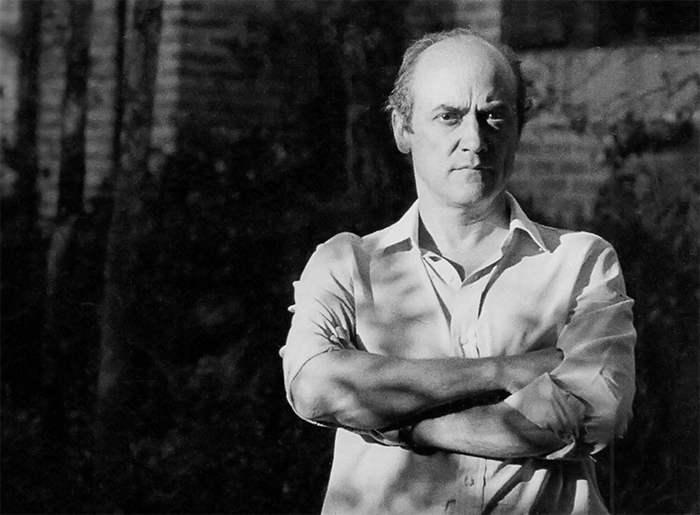
Joaquim Guedes's work is fundamental for understanding Brazilian architecture in the second half of the 20th century. Departing from the rationalism, or Brutalism, of the so-called Escola Paulista (São Paulo's school) in the 1950s, Guedes developed a unique response to the challenges of Brazilian modern architecture, one that is much closer to local demands and tectonic responses. Guedes understands "architectural design as the art of building" (Camargo, 2000).
Born in 1932, the first of 15 siblings, Guedes graduated in 1954 from the University of São Paulo, where he was influenced by Le Corbusier’s method (but not its formal solutions) and Aalto’s materiality. Aalto would continue to be a strong reference in Guedes’s works, as were his professors—pioneers of the Escola Paulista—Vilanova Artigas, Oswaldo Bratke, and Eduardo Kneese de Mello. With them, Guedes shared the belief in tectonics as a base for a coherent architecture.
Having the opportunity to work on all scales, from objects to renovations, hospitals, and entire cities, Guedes is striking in his objectivity and rationality. Opposed to anything superfluous, Guedes has always criticized Brazilian modern architecture of the 1950s and 1960s for its exaggerated formalism. For him, the submission to social programs, technology, economy, and human activities is most important and comes before expressionism and personal creation.
Guedes’s work is also outstanding for its rigorous detailing (not a stronghold of Brazilian Modernism), which pushes his work to a higher level. Rigor and detailing have been trademarks of Guedes as a professor as well. Teaching at the School of Architecture of the University of São Paulo since 1958, Guedes has been a strong influence throughout the last 30 years. He also taught in Strasbourg (France) between 1970 and 1973. His incisive rational process can be summarized in his own words: “The more I doubt, inquire, and criticize, the more I feel closer to knowledge and truth” (Camargo, 2000).
Working with his wife, Liliana, from 1954 to 1978, Guedes’s architectural talent manifested itself very early on. He was only 24 years old when, in 1956, his entry for the Brasília Plan competition broke with the Charter of Athens. Still debated and studied today, his proposal for Brasília presented a city based on quotidian experiences, able to grow and expand with the pace of Brazilian modernization and consequent urbanization.
In 1957, he designed the J. Guedes house (for his father) on a difficult site (30 by 150 ft) for a large family. In this house, the principles of his later work—rationality and tectonics—were already laid out. Shortly after the J. Guedes house (1958), he designed the Cunha Lima house, which made him famous and won the prize at the VII São Paulo Bienal. At the Cunha Lima house, the exposed reinforced concrete structure that was the trademark of the Paulista School is reinterpreted with an emphasis on the economy of means and maximization of spaces for social life. For Guedes, architecture has always been a rational and economic way to materialize spaces for the needs of society. In the Cunha Lima house, as is common in all his buildings, the structural solution is very important, and the economy of columns increases the flexibility of interior spaces.
The same structural emphasis would occur in his own house (Liliana and Joaquim Guedes house, 1968), where the large slabs continue outside the plan and work as a shading device. In this house, the outstanding detailing is fully harmonized with the overall plan, and the exposed reinforced concrete slabs are humanized by the wooden fenestration, subordinated to the structure.
In the 1970s, Guedes had the opportunity to design and build entire cities in the Brazilian backlands and the Amazon jungle. The cities of Carajás (1973), Marabá (1973), and Barcarena (1980) in the Amazonian state of Pará were designed as part of a major mining project for which Guedes worked from the beginning, influencing even the path of the railway that connects the project to the port, 400 miles away. Many hundreds of miles from the major cities of Belém and Brasília, the design of the new city plans included complex logistics of transportation and labor—a task suited to Guedes’s rationality.
In the design and construction of the city of Caraíba (1976) in Bahia’s backlands, Guedes faced a completely different task. Caraíba is located in a very dry region of the Brazilian sertão (dry savanna), where the challenge was to provide shade and protect the city from the hot winds. Guedes solved this problem with small shaded spaces instead of large plazas, and his high respect for traditional local building methods guided him toward very simple façades, whose elegance adds a delicate touch to the harsh life of the sertanejos.
Guedes’s focus on economy instead of aesthetic expressionism leads him to think of Brazilian slums, for instance, not as a problem but as a solution, because they reveal the amazing capacity that people have to build and overcome daily problems.
Structure, economy, rationality, and emphasis on quotidian life might be the major forces behind Guedes’s architecture, but they are not enough to explain the strength of his major works. To those qualities, we must add the extremely developed sensibility of a humanist.
Fernando Lara
Sennott R.S. Encyclopedia of twentieth century architecture, Vol.2 (G-O). Fitzroy Dearborn., 2005.
|