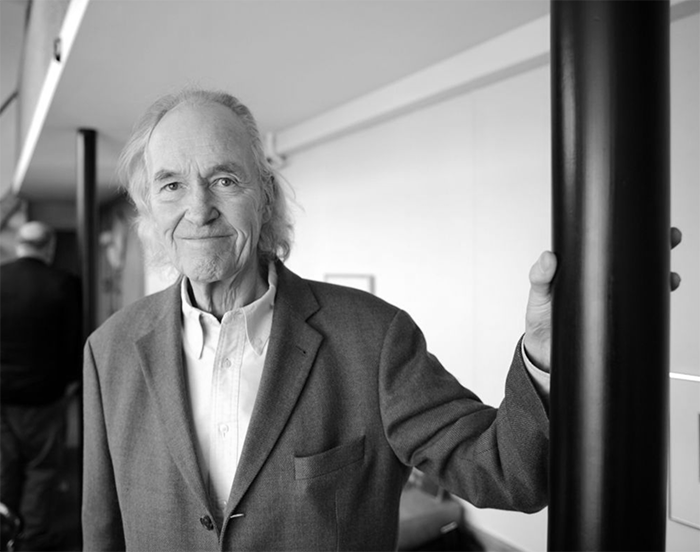
Practicing for over 40 years, Kristian Gullichsen is one of a few surviving second-generation modernists in Finland today. As a student in the 1950s, he worked as an intern in the offices of Alvar Aalto and Heikki and Kaija Siren. These two firms were the most significant players on the Finnish architecture scene at that time, winning most of the architectural competitions.
Gullichsen’s designs demonstrate his interest in the work of Le Corbusier and range from a mass-produced vacation house prototype of minimalist elegance and simplicity (Module 225, designed with Pallasmaa, 1969) to a singular, primitive stone house at Grasse, France, for his mother (1972). In the case of the Module 225, the debt is to Le Corbusier’s modular steel system, and in the latter, to the French architect’s filtering of Mediterranean building themes such as masonry walls, vaults, and cylindrical towers. The Module 225 system is a brilliant prefabricated wood column-and-beam structure, approximately eight-foot square, with infilling panels, designed for assembly on any site. It is also evidence of structural discipline, an important ethical theme in Finnish architecture of the 1960s. The house at Grasse, on the other hand, is site-specific, built into a hill of stone terraces with olive trees. Composed of repetitive bays like the Module 225, the stone house opens and closes itself to the sun with sliding barn doors.
Other housing designed by the firm—Gullichsen Kairamo Vormala—explores remarkably different themes of lightness, transparency, and wall as a light membrane. This appears to be the influence of Erkki Kairamo, whose semi-detached houses and apartment blocks in the suburb of Espoo, built from 1971–90, reveal De Stijl-inspired planar compositions. Sliding screens, circular stairs, glass skins, and tiled surfaces enliven and give scale to the façades.
Linking the two types of housing production is an interest in proportion and number, likely passed on to them by the revered Helsinki University of Technology teacher Aulis Blomstedt. These and other design themes emerge in buildings done for industry. One finds in such works as the Varkaus Paper Mill (1985) and Marimekko Textile Factory (Helsinki, 1978) a celebration of structure, function (smokestacks, ducts, and fire escapes), and durable industrial materials.
The firm’s exquisitely proportioned and detailed industrial complexes find a parallel in an urbane project for Helsinki’s shopping district: an addition to the Stockmann Department Store (1989). Together, Gullichsen, Kairamo, and Vormala reinterpreted two significant features of Aalto’s nearby downtown work: the internal atrium of Aalto’s Academic Bookstore and the repetitive square-bay façade of his Enso-Gutzeit Office Building (1962). The focal point of the Stockmann addition is an irregularly shaped atrium topped with a domed skylight. Externally, taut glass block screens supported by stainless steel frames stretch between stone columns, creating a rich, layered façade for the lower floors.
When approaching religious or civic architecture, Gullichsen returns to the theme of the wall. It is a hallmark of three fine works, characterizing his brick Malmi Church (Helsinki, 1980), reminiscent of Scandinavian medieval churches with walled courtyards, and of the late churches of Sigurd Lewerentz, the Kauniainen Parish Center (Kauniainen, Finland, 1983), and Pieksämäki Civic Center (Pieksämäki, Finland, 1989). Gullichsen’s skill as a site designer emerges in his response to an urban condition, a hillside, and a lakefront park, respectively. In each case, an entry court establishes the procession into the building, adjusting the scale of the experience from the outside to the inside.
The moves are those of a skilled planner, well-versed in both Aalto and Le Corbusier, in the free plan and the enclosed room. References to ancient and modern ways of inhabiting the landscape comfortably coexist in these buildings. The grounded hearth and the light-studded ceiling are both present. It is also the fusion of the vernacular and international in Gullichsen’s work that gives it, and the best of Scandinavian architecture, resonance beyond the Nordic countries.
Kate Nesbitt
Sennott R.S. Encyclopedia of twentieth century architecture, Vol.2 (G-O). Fitzroy Dearborn., 2005.
|