| |
|
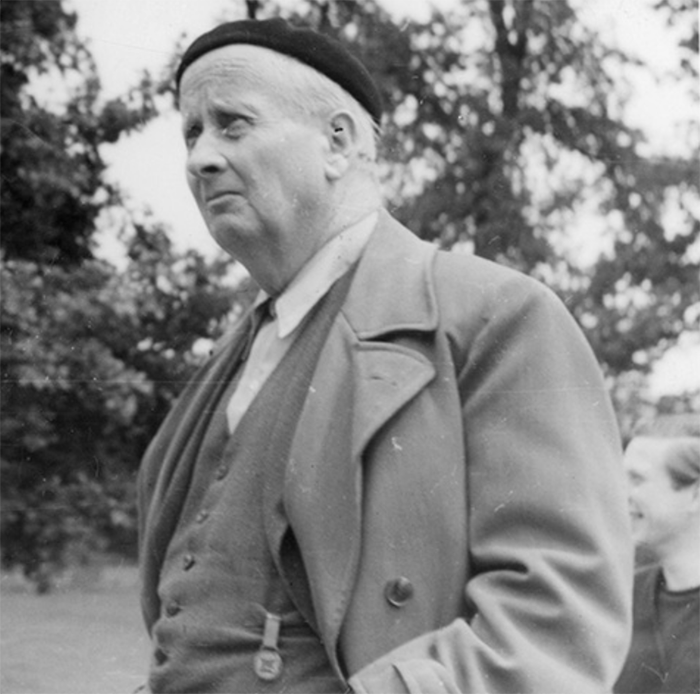
A significant contributor to the discourse surrounding modern architecture, Hugo Häring built relatively few of his designs over the course of his architectural career. This was due to several factors, chief among them the context in which he found himself—Germany during the years prior to, during, and following World War I. Although the buildings that Häring realized are key examples of a significant, if somewhat marginalized, strain of Modern architecture, it is his writings and theoretical pronouncements that constitute his greatest legacy.
Becoming a key member of Germany’s art and architectural avant-garde immediately following World War I, Häring and his contemporaries—a generation of architects that included, among others, the Taut brothers, Erich Mendelsohn, Hans Scharoun, Hans Poelzig, Ludwig Mies van der Rohe, Hermann Finsterlin, Walter Gropius, and Le Corbusier—articulated the manifold aspirations of modern architecture. Häring’s vision, what Peter Blundell-Jones refers to as “constructed organicism,” sought a spiritual dimension in architecture, asserting the dual significance of Gestalt and Geist. Gestalt, a term that denotes “form imbued with meaning or significance” (Blundell-Jones), and Geist (Spirit in the sense of “the organizing force of mind”) are concepts he emphasized repeatedly in his writings. Häring’s ideas and focus on program as the generator of architectural form were distinct from the Typisierung (standardization, normative form) advocated by many of his peers (Hannes Meyer, Walter Gropius, and Ludwig Hilberseimer among them). Two essays in particular, Strukturprobleme des Bauens (Structural Problems of Buildings) of 1931 (rev. 1946), a tract that looks at the underlying orders of building, and Über das Geheimnis der Gestalt (Concerning the Secret or Mystery of Gestalt), his last complete essay, frame his essential thoughts on architecture. However, these essays are supplemented by his building designs and collected writings, all of which are critical in comprehending the nuances of his ideas.
Shared by many of the architects collected around the Arbeitsrat, Novembergruppe, and Der Ring, Häring’s ideas trace their origins to the early writings of Goethe, writings that stand as the seminal works of German Romanticism. Also embedded in Häring’s conceptual apparatus are ideas closely associated with German nature mysticism, a theological perspective that undergirds German Romanticism. The embrace of these ideas—formulated through repeated attempts to clarify and distinguish his positions from his contemporaries—became more apparent as Häring’s architectural career progressed.
Häring was born in Biberach, a town south of Stuttgart, on 22 May 1882. Like most of his colleagues, who would come of age immediately after World War I, Häring was born into a world that was becoming more open and more standardized. Germany, a country that had lagged economically behind much of Western Europe, experienced an infusion of new ideas and new influences immediately following Bismarck’s successful unification of the northern and southern halves of the German state. Häring’s father was a highly respected cabinetmaker who maintained a workshop on the premises of his family home. Not accidentally, Häring exhibited a decided preference for the use of wood and handcraft detail throughout the course of his career.
After completing high school, Häring enrolled in a formal course of study, entering the architectural program at the Technische Hochschule in Stuttgart in 1899. At the time, design studies were very conservative, with various historical styles (Gothic, Classical, and early Renaissance) representing the range of architectural styles permitted within the academy. For many of Germany’s architects at the time, Baukunst (the art of building) reigned as the ideal, and students were subsequently taught the mechanics of building in construction courses, statics and structures, and geometry. Freehand drawing was also taught, although the use of individual artistic expression was restricted. Häring evidently reacted to the insistent pedantry and limitations imposed by his faculty, disdaining from using the word Architektur throughout his career. Yet the impact of the terms associated with Baukunst, as distinct from the academically burdened Architektur, cannot be underestimated, either; Baukunst, with its emphasis on structural systems, new technologies and materials, and vernacular building, provided the foundation for departure from academic rules and principles. Open-minded architects, Häring among them, used the term to signal their departure from academic tradition.
After a brief foray to Dresden just after the turn of the century, Häring returned to Stuttgart and began to study under one of Germany’s earliest advocates of Modern architecture, the German architect Theodor Fischer. Although Fischer’s progressive curriculum encouraged students to study the accepted classical idiom, it was from a critical perspective. Embracing the concept of Baukunst, he also suggested that his students endeavor to look at vernacular precedents, such as farms and industrial buildings. Along with his students, Fischer’s research into vernacular architecture enabled him to formulate a concern for the circumstances of context, organization, and function, an approach that would have a profound impact on the development of “the organic Modernist tradition” (Blundell-Jones). Fischer’s promotion of alternatives to the academic tradition in turn suggested that architects probe technological development and social change in their search for the meaning and significance of architecture.
During the early years of his architectural practice, from roughly 1904 to 1914, Häring, like many progressively minded architects of his generation, struggled to obtain work. Neoclassicism remained the accepted mode in both the academy and professional practice, and the persistent resort to tradition by most of Europe’s established architects and their clients, however derivative and tired, was broken only by the catastrophe of World War I. For most young architects, the war served to sideline the activities of practice, which up to that time had been taken up by failed competition submissions and limited professional exposure. Although already in his 30s, Häring was called to duty, serving as a soldier for a year before finally being tapped for service as an architect in East Prussia. Situated within a contested and heavily damaged area of Germany caught between Russian, Polish, and German claims, large parts of East Prussia (now in northern Poland) were in need of rebuilding, if only to further Germany’s assertion of ownership.
After the war, Häring became an active participant in Germany’s avant-garde architectural movements, working alongside Mies van der Rohe and other influential architects. He was involved in Der Ring, a progressive architectural group, and his work continued to challenge the dominant formalist approaches of the time. However, due to political developments in Germany, Häring’s influence diminished, and his organic functionalist ideas were marginalized by the rise of scientific rationalism and standardization in architecture.
Although Häring built relatively few structures, his most well-known work, Gut Garkau (1922–1928), remains a seminal example of his organic architectural philosophy. His contributions to social housing during the Weimar Republic also highlight his commitment to human-centered architecture. His later years saw his ideas largely overshadowed by mainstream modernist trends, but contemporary architectural debates have increasingly recognized the significance of his theories on organic architecture and functionalism.
Häring passed away on 17 May 1958 after a long illness. While he remains a lesser-known figure in the history of modern architecture, his writings and theoretical contributions continue to influence contemporary discussions on sustainability, organic architecture, and regionalism.
Elizabeth Burns Gamard
Sennott R.S. Encyclopedia of twentieth century architecture, Vol.2 (G-O). Fitzroy Dearborn., 2005.
|