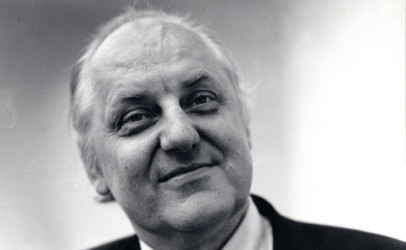
Hans Hollein is an architect, artist, teacher, exhibition designer, curator, and a designer of furniture and silverware. After graduating from the Vienna Art Academy in 1956, he traveled in the United States on a scholarship and continued his studies at the Illinois Institute of Technology (IIT) in Chicago, receiving a master of architecture degree from Berkeley in 1960. During these years, he was able to study with Ludwig Mies van der Rohe, Frank Lloyd Wright, Richard Neutra, and other famous architects. After working in Australia, South America, Sweden, and Germany, he returned to Vienna and established a practice in 1964.
Together with Walter Pichler, Hollein issued a manifesto of “absolute architecture” in 1963, declaring that “architecture is not the satisfaction of the needs of the mediocre or the environment for the petty happiness of the masses... Architecture is an affair of the elite” (Burkhardt and Manker, 2002, 35). Despite such grand aspirations, Hollein’s first commission in 1965 was rather modest, the design of the Retti Candleshop in the center of Vienna. Though the project was small, he received the $25,000 Reynolds Memorial Award and achieved international fame.
In the 1960s, Hollein was a prominent figure in the lively Viennese scene, which also included Friedrich St. Florian, Raimund Abraham, Coop Himmelb(l)au, and the theorist Günter Feuerstein. In his two-dimensional collages, Hollein developed a paper architecture in line with pop art, transforming banal objects, such as spark plugs or airplane carriers, into architecture through scale changes and incongruent combinations. Declaring that everything is architecture, he suggested in 1967 that a perception-altering drug would also be architecture; in the same year, Ron Herron of the Archigram announced the same idea as the “Enviro-Pill.”
In 1970, Hollein won praise for his first commission in New York, the Richard Feigen Gallery. Other commissions for elite shops followed, including two jewelry stores for Schullin (1974 and 1982) in Vienna. These designs represent a mannerist version of late modern architecture. With the intention of creating a facade with a strong image, Hollein used marble and chromed steel in sensuous shapes that carried anthropomorphic, often sexual, connotations and occasionally contained veiled allusions to death.
By the mid-1970s, Hollein emerged as a leading Postmodern architect in Europe. The interior he designed for the Austrian Tourist Office in Vienna (1978, demolished) features all the crucial aspects of Postmodern architecture, as defined by Charles Jencks in his seminal book in 1975, in particular the principles of metaphor and multiple coding. For a layman, the birds hanging from the ceiling would function as a metaphor for airplane travel, the Rolls-Royce radiator grills of the ticket counters as a clear sign for money, and the peculiar metal palm trees in the interior as a promise of exotic beaches. A connoisseur, however, would recognize the palm trees as a reference to John Nash’s Royal Pavilion in Brighton (1815-22), just as he would trace the origins of a small metal pavilion in the Tourist Office back to the Mughal pavilions in Fatehpur Sikri and the glass ceiling of the Office to the Postal Savings Bank (1912) in Vienna by Otto Wagner.
Even more significant an achievement was Hollein’s design for the Abteiberg Municipal Museum Mönchengladbach, Germany (competition in 1976, completed in 1982). Like the interior of the Tourist Office, the exterior of the museum is a collage of classical and Modern styles and building types: a miniature skyscraper, industrial sheds, a steel bridge, two symmetrical classical pavilions. Like in James Stirling’s Staatsgalerie in Stuttgart, the different codes of architecture are not resolved to any synthetic totality but they coexist in tension, underscoring the heterogeneity of contemporary society. In the interior of the museum, however, the pop attitude to collage and assemblage is no longer in evidence. Rather, the interiors are designed with modest restraint and a sensitive use of light to provide the best possible exhibition spaces for the works of art.
In Hollein’s Museum of Modern Art in Frankfurt (1983-91), the gallery spaces are even more precisely determined according to the needs of each individual work in the permanent collection, with the consequence that the museum may be less ideal to present other works. Because of the tight urban setting, the facades are more restrained and less heterogeneous than in Mönchengladbach.
In 1985, Hollein received the Pritzker Prize, establishing his reputation as one of the foremost architects in the world. The same year, he started designing the Haas Haus, a small shopping center in the most precious location in Vienna, opposite St. Stephen’s Cathedral. The design is a summary of Hollein’s most successful designs over the years, a cornucopia of chromed facades, curved mirror glass, fountains, bridges, staircases, all tied together by an architectural promenade that recreates the mountain hikes loved by Austrians. In the nineties, Hollein had achieved the goals of his first manifesto, becoming the architect of the elite.
Like his fellow Pritzker Prize winner, Frank Gehry, Hollein has also made designs for spectacular new Guggenheim museums, one in Vienna and another in Salzburg. Especially the Salzburg project (1990) could well function in the same way as Gehry’s Bilbao, as a spectacular mass attraction by a star architect. The design realizes some of the promises of Hollein’s first manifesto: though not soaring in the heights, the museum penetrates deep into the mountain next to the Salzburg castle, creating an intriguing multilevel cave. Stylistically, Hollein has not changed dramatically. More recently, Hollein has reduced the ornament and began to experiment with complex curved surfaces, as in his design for the Austrian embassy in Berlin.
Sennott R.S. Encyclopedia of twentieth century architecture, Vol.2 (G-O). Fitzroy Dearborn., 2005. |