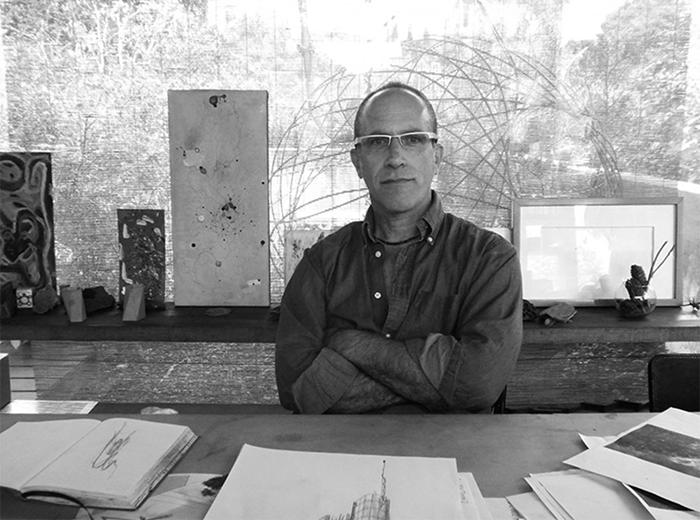
Alberto Kalach was born in Mexico City in 1960. He studied architecture at the Iberoamericana University, graduating in 1981. He later attended Cornell University (1983-85). From 1991 to 1997, he worked in partnership with Daniel Alvarez.
Kalach is interested primarily in weaving his architecture into the urban landscape and context of the city. He belongs to a generation of contemporary architects whose works reflect an international modernist language that subtly alludes to traditional form. His references include Le Corbusier, Ludwig Mies van der Rohe, Luis Barragán, Louis Kahn, and the work of the Spanish and Italian rationalists. Although small in scale, his buildings carefully relate to the urban context and the landscape and spatially express structure and materials.
The development of the patio and garden as gathering places in Mexican architecture is a principal recurring theme in Kalach’s residential design. Adapted well to climate and form, the patio is used in several of his early works. His three cubelike houses (1990) in Fuente Mercurio, Tecamachalco, Mexico City, are similar in scheme and are arranged to articulate the entrance and generate a common patio. The geometric relationship between the patios and gardens offers different perspective views while varying planes of light enrich the spatial relationships between the interior and exterior.
The significance of landscape, site, and memory is explored in several of Kalach’s houses built in the 1990s. These works interpret the topographical elements of landform and existing vegetation and recognize ephemeral components, such as natural light and regional landscape character. In the house (1994) in Palmira, Cuernavaca, all rooms are surrounded by gardens, and the core of the house is focused on the patio. Long walls echo Barragán’s aesthetic while two concrete towers evoke Louis Kahn’s interest in expressing bold architectural elements.
The House and Garden (1994) in Valle del Bravo, Mexico, consists of four simple platforms that are related topographically to the site. The platforms offer the opportunity to view the forest from different perspectives. The house utilizes a small room as a connecting link to the outside world of the street. The site’s organizational structure creates a journey from the road, through the gate, and into the house itself. The journey orchestrates leisure garden activities, such as dining or sitting on a swing. Exposed brick, concrete, and wood are organized into precise geometric grids to interact with the existing organic forms of the landscape.
Kalach further explored these concepts in the Negro House (1997) in Contadero, Mexico City. This project is designed as a series of five structures built into a steep slope. The structures are anchored into the ground to minimize tree root damage and to avoid site disturbance. Rainwater is channeled from the patios and the roof to the foundations, where it is collected and stored in cisterns. Materials such as concrete, glass, and steel are combined with an on-site stone called tepetate. This house emphasizes the transformative role that occurs when architecture interacts with a site and exemplifies Kalach’s interest in creating a sustainable intervention between nature and everyday human activity.
Kalach designed and built several apartment projects throughout Mexico City, including the Holbein Building (1991) in Mixoac, the Rodin Apartment Complex (1993) in Mexico City, and the Fresas Building (1993) and the Adolf Building (1996) in Colonia del Valle. All these projects unify permanent and ephemeral components of the urban fabric and refer to a modernist or Le Corbusian use of materials and typologies.
Kalach’s design for a hardware store (1991), built 50 kilometers from Mexico City in the industrial city of Toluca, represents his use of simple everyday materials to create sophisticated elements and details. The scheme, which is a small warehouse intended to store and sell iron products, consists of one building inside another. A centralized office, designed in the form of a ship, is contained within an external envelope of concrete panels that have been covered with iron sheets. The roof structure is a light barrel vault constructed of galvanized sheet iron. The roof is separated from the concrete-and-brick walls, giving the whole structure a sense of exquisite lightness and beauty.
Kalach’s geometric rigor is exemplified in the Monte Sinai Kindergarten (1992) in Tecamachalco State, Mexico. The project’s program called for increasing the number of classrooms. The project was conceived as a series of austere pavilions connected to the existing school by a bridge. The strict geometry is accentuated by terraced gardens and patios that are enclosed by stone walls, ramps, and stairs.
The importance of topography to Kalach is exemplified in the project for the Maguen David Jewish Community Center (1996) in Cuajimalpa State, Mexico, located at the edge of a dramatic ravine on the outskirts of Mexico City. Its pure forms, constructed of reinforced concrete, create an introspective and contemplative atmosphere. The scheme is unified by a distinct physical and spiritual gathering center that connects the synagogue, via a hall of slender columns, to other areas in the complex.
In the design of the Alexander Von Humboldt German School (1996) in Cholula, Puebla State, Mexico, Kalach proposed a completely artificial landscape that is organized on a circular embankment. The powerful scheme is surrounded by dense vegetation that separates the school from the immediate surroundings yet preserves the magnificent view of the distant mountains. Classrooms occupy the center of the circular scheme.
Since 1997, Kalach has been a member of the Taller Ciudad de México (City of Mexico Studio). This team proposed a feasibility study to determine how to reverse the desiccation of Texcoco Lake in Mexico City. The study, in collaboration with Gonzalez de León, proposes the use of waste and rainwater to increase the size of the lakes in the metropolitan area of the Mexican capital. The plan will expand the surfaces of lakes in the city from 1,000 hectares in 1998 to 13,800 by 2008. By proposing a low-density plan for development within the area, the plan is intended to benefit the environment and attract tourism. The proposal reflects the political and social nature of architectural practice in Latin America. It suggests a strong relationship between urban renewal and environmental mutations and strongly reflects current architectural trends in Mexico.
Kalach’s work has received significant critical attention as a result of his delicate detailing, subtle referencing to older cultures, and interest in the relationship between landscape and architecture.
Jose Bernardi
Sennott R.S. Encyclopedia of twentieth century architecture, Vol.2 (G-O). Fitzroy Dearborn., 2005.
|