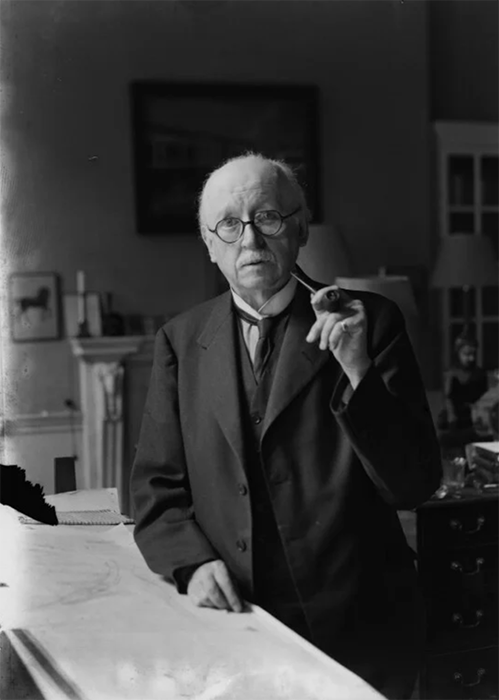
Sir Edwin Landseer Lutyens was one of the most noteworthy English architects of his generation. During the first four decades of the 20th century, he designed a remarkable range of buildings, in a wide variety of styles, interpreted in an inventive and original manner. Despite his position of preeminence as a Grand Manner architect before World War II, he was above all, a domestic architect. While essentially an Edwardian, Lutyens never refused work, and as a result he was able to negotiate the architectural and social complexities of that age.
In 1885, he became a student at the Kensington School of Art, before joining the firm of Ernest George and Peto as an apprentice from late 1887 to early 1889. While there, Lutyens met Herbert Baker who would later become his colleague in New Delhi. Lutyens’s early work showed a responsiveness to George’s love of quality, craftsmanship, and the natural textures of brick, oak, and tile. He was also influenced by Norman Shaw and Philip Webb.
Lutyens began his independent practice with his first important commission in 1889 in Crooksbury, Surrey, with a series of houses that extended the possibilities offered by local vernacular style. The majority were built in Surrey and included Munstead Wood (1896); Godalming for Gertrude Jekyll, a garden designer who had revived the English cottage garden and who provided him with an opportunity to rise rapidly in his profession; Tigbourne Court (1899) in Surrey where he demonstrated an exceptional interpretation of the local vernacular style that highlighted texture and massing.
Lutyens built Deanery Gardens (1901) in Berkshire for Edward Hudson, the owner of Country Life magazine, for whom he also built an office in Covent Garden, London, which was his first project in the Grand Manner. While similar to many of Lutyens’s houses of this period, Deanery Gardens’ origins were the Elizabethan country house, and made it the essential embodiment of Edwardian Romanticism. The huge mullioned window, together with the massive chimneys anchoring the house to the site, are typical Arts and Crafts features, but the originality of the handling seen especially in the linking axes, evokes Frank Lloyd Wright. Lutyens’s houses are carefully choreographed spaces, often arranged around a central fireplace.
By 1900, Lutyens’s eclecticism became more apparent, as at Little Thakeham (1902), with its Tudor exterior and classical hall, and at Marsh Court (1904), which combined both classical and vernacular features.
Responding to contemporary preferences, Lutyens introduced a language that included neoclassical forms: mannerist features at Overstrand Hall (1901) and Homewood (1901) in Knebworth, and neoclassical forms at Papillon Hall (1904). In this instance, the eccentric butterfly plan was determined by the retention of an original house.
By 1903, Lutyens was extolling the “high game” of Palladianism; these classical preferences found their climax at Heathcote (1906) in Ilkley, Yorkshire, which invoked San Micheli. Nashdom (1908), with its whitewashed brick and contrived, understated centre, heralded his neo-Georgian style, whereas The Salutation (1911) provided what is arguably the perfect essay in this genre. The “castle” style was added to his armory, most notably in Overstrand Hall and Red House (1899) in Surrey, which exploited parapets and other conceits. The enlargement of Lindisfarne (1904) on Holy Island, Northumberland, showed Lutyens’s respect for the original Romantic silhouette, and Lambay Castle (1912) in Ireland involved the repair and enlargement of an old house within the confines of a huge circular rampart wall. Castle Drogo represents the most extravagant example of this work; designed in 1910, it is unlikely to be mistaken for an original castle. The subtle configuration of granite walls punctured by windows shows Lutyens’s versatility.
A new mood in Britain followed the accession of Edward VII, and Lutyens was anxious to expand his practice beyond the domestic. Opportunity came with his appointment in 1912, to the Delhi Planning Commission. Despite his disagreements with fellow architect Herbert Baker, together they created one of the finest examples of 20th-century Beaux-Arts town planning. Influenced by the plan for Washington, D.C., and incorporating English garden city principles, New Delhi was centered on the Viceroy’s House (1931).
As a principal architect to the Imperial War Graves Commission, Lutyens designed a series of memorials, most notably The Cenotaph (1920) in London and Thiepval (1929) in France, which rehearsed his geometric, abstracted classicism.
His later works ranged from university buildings to the design for the new Roman Catholic Cathedral in Liverpool. Commercial buildings—including Britannic House (1924), the Midland Bank Headquarters (1939) in London, and the British Embassy (1928) in Washington, D.C.—exemplify his continuation of historicist design principles from the 19th, and into the 20th century.
HILARY J. GRAINGER
Sennott R.S. Encyclopedia of twentieth century architecture, Vol.2 (G-O). Fitzroy Dearborn., 2005.
|