| The pervasiveness of media culture can make Le Corbusier’s dictum that architecture is a patient search seem rather quaint.
Peter Märkli’s increasing renown, however, is built on just such disciplined and steady development. Märkli had, for his generation, an unfashionable interest in buildings regardless of their period or pedigree. In his early work his engagement with Italian architecture’s highly evolved formal complexities is clear, as is his understanding of its juxtaposition of such basic elements as the wall and openings and of its strategies of balance and tension. His work from this period typically has a clear distinction between the front, which is often figurative, and the sides and back. There is a strong play on axiality and symmetry, often skewed by the careful placement of a sculpture or column. Form and façade often dictate the organization of the interior. As Märkli says, ‘I wasn’t looking for a style but for a means of expression. Since I was culturally at level zero, this expression could only be something very basic.’
His best-known work to date is undoubtedly La Conjunta, a small museum to display the sculptures of Hans Josephsohn. It is a long, silent building placed in a vineyard next to a railway embankment, a motorway and a riverbed in the stony landscape of Ticino. The architecture is driven by a profound understanding of the sculptures, which are highly plastic and combine essentially figurative elements. They express mass rather than surface and tackle issues of the perception of weight.
The building perfectly demonstrates how his engagement with the fundamentals of architecture has developed. It is almost pure architecture, a concrete spatial container without insulation or services. Its form seems to be the direct result of its space as it steps in section in response to developments in the art. The plan is organized around an axis that runs off-centre through three long spaces with four small rooms off the last one. It is toplit. Märkli is here working with the most elemental architectural devices only, namely proportion, space, light, materiality and programme. The raw concrete bears every trace of its fabrication. The museum is not, however, an exemplar of a now fashionable minimalism nor does it assert the moral implications once associated with this term. Rather, it simply strips out everything that is unnecessary to the task at hand.
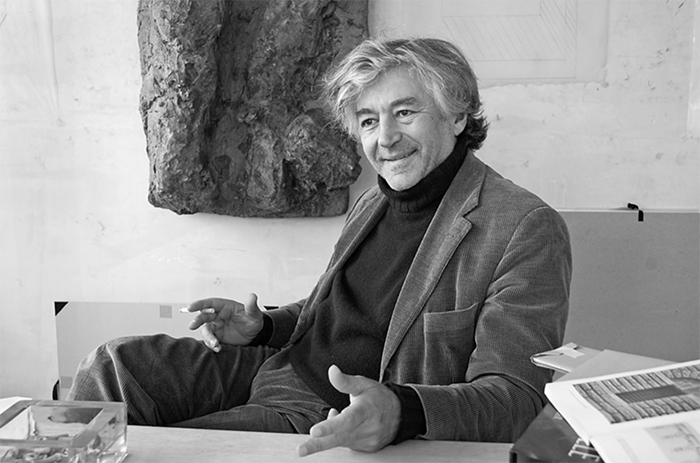
La Conjunta is also important because of Märkli’s personal relationship with the sculptor. He first went as a student to meet Josephsohn after reading a review of his work, seeking intellectual stimulation outside ETH Zurich. Josephsohn became something of a mentor to Märkli, who has incorporated his work into many of his buildings and who has the sculptor’s pieces in his office and at home. The other important influence from his student days, which confirms him as something of an outsider, was the important Graubünden architect Rudolf Olgiati, who synthesized regional characteristics such as volume and mass with Corbusian modernism. Märkli describes his own influences as traditional principles and the legacy of classical modernism.
Märkli’s profound engagement with architecture and attempt to assimilate and combine what he has seen has led him from classical devices to more topographical, contextual and plastic concerns. The house in Ehrlenbach is seminal, for it uses concrete both as mass and as planes. Houses must first and foremost erect walls and define a space without shutting the world out completely. In the typically unspectacular social and physical landscape of the suburbs, however, it is hard to find a language with which to do this. In Ehrlenbach the concrete walls define a first territory, while glass walls on two sides just inside them enclose the domestic realm. This play between mass and transparency is made even clearer when the concrete walls that provide privacy for the glazed living spaces are coloured pink and treated as screens. The house is rectilinear and its language indeed reduced. But it is also strongly plastic, with its interplays of light and shadow, transparency and opacity, inside and outside.
The single-family house in Azmoos shows Märkli’s fundamental interests developing into increasing sophistication. The building, which sits on a plain, looks symmetrical and T-shaped from one side, but the form is actually a more plastic one of solids and voids, positives and negatives. The entrance façade has a single squarish window placed almost in the centre, with a cantilevered upper storey the entire length. At ground level it is divided almost evenly between the void of the garage and the solid of the house. Märkli gives the house just enough axiality and symmetry to impart a sense of it without fully achieving it.
The first floor is private, with rooms organized off a long corridor that can be used for any number of functions. On the top floor the form pushes out in both directions and the plan is freer though it still retains a sense of individual rooms. The master bedroom is gently separated from the living area; the kitchen, typically for Märkli, is glazed to make it part of the living space. The staircase does not hug an exterior wall but becomes space-defining. The terrace, which on the lower floor is long, on this floor claws out some of the interior to become both long and deep, covered and open, defined by an opaque and a glazed wall, a rich spatial experience and a play of inside and outside. Because the rooms on this floor are taller than below they are also deeper. The grey and green irregular checkerboard pattern on lime plaster further softens the perception of the form, confuses the house’s scale and shifts the wall away from any notions of naturalism. This formal and spatial manipulation does not feel at all mannered.
The single-family house in Hünenberg is based on organizational principles similar to the one in Azmoos, but its form is dictated by the hillside on which it sits. The way we actually live is reflected in the wide asphalt drive bringing the road right up to the house. The subsequent entrance sequence is, however, more indirect as one slides first sideways under a cantilever towards a white wall, through a metal door and then up a switchback stair to the living area on the topmost floor, which contains five rooms, including a large bedroom. Glass block and a glazed kitchen, the kitchen and study not quite aligned with each other and the latter with a sliding partition to the sitting room all help break down the identity of the rooms. The sitting room is stretched across the house, with one side facing the valley and the other leading to an outdoor room defined by two massive walls and the house’s roof. There is a visual connection from the valley on one side of the house through the sitting room and the outdoor room across the narrow terrace that runs the length of the house along the hill at the back. Binding the house to the earth is the dark umber pigment of its lime plaster. The floors are covered in large red concrete slabs 2 × 2 metres with 1.5 cm joints between them to give them a decorative aspect.
The school in Oerlikon on the edge of Zurich is by far Märkli’s largest commission to date, but formally adopts the same themes he has been working on for twenty-five years. The brief is for a kindergarten, primary and secondary schools, sports hall, library and dining area. Planning regulations stipulate that new buildings conform to the existing height and block pattern, but because this is a former industrial area the site and the masses are quite large. The problem of the plan’s consequent depth is solved by dispersing the programme into different buildings with generous amounts of glazing that are then gathered on a concrete plinth. A large outdoor space can be shared by all groups. Classes are grouped by year and each part of the school has its own territory. Two or three classrooms are clustered in a pedagogical experiment where teachers share responsibility for them. There are no corridors since the means of egress in the case of fire is directly from each classroom. The common area in front of them can thus be fully glazed and assume multiple functions. The same windows are used throughout.
Although Märkli built little in the first ten years of his career he was far from idle – observing, learning, drawing. He works both from his own studio and in collaboration with the architect Gody Kühnis. Märkli’s is an architecture of resistance that insists it is still an art and has inherent, unmediated value.
Spier, Steven, Swiss Made, New Architecture from Switzerland, Thames & Hudson, 2003 |