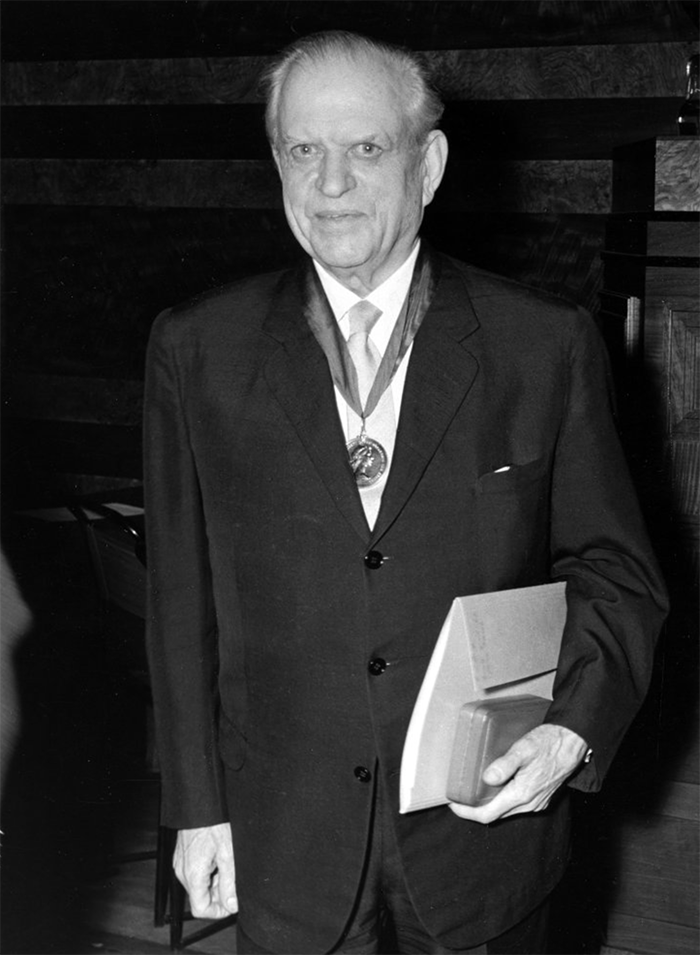
| Sven Markelius was one of the most influential 20th-century architects in Sweden. Although Markelius maintained an independent practice from as early as 1910, he also held a number of influential public positions throughout his life, such as head of carpentry for the Swedish National Committee for Building Industry Standardization Design Department (1920), member of the National Board of Public Building’s Research Department (1938–44), and director of the Stockholm City Planning Department (1944–54). The range of interest indicated by these positions was reflected in his work in a number of areas, including architecture, interior design, furniture and textile design, and town planning.
Markelius had the opportunity to travel extensively throughout northern Europe in the late 1920s and early 1930s, and this experience clearly influenced his views on architecture. In 1927, he was awarded a travel grant that took him to Germany, France, Belgium, and Holland. While in Germany, Markelius traveled to Dessau, where he met Walter Gropius and visited the recently completed Bauhaus buildings and the housing under construction at Dessau-Törten. Markelius also visited the Weissenhofsiedlung exhibition in Stuttgart, where he was exposed to the work of Le Corbusier. His interest in the ideals of the Modern movement as they were being expressed in continental Europe was clearly reflected in his attendance at the Congrès Internationaux d’Architecture Moderne (CIAM) meetings in Frankfurt (1929) and Berlin (1931).
His travels would profoundly affect Markelius, as evidenced by the 1925 competition for the Helsingborg Concert Hall. One of the most important works of 20th-century Swedish architecture, this building represents the transition from a reliance on classical elements to the simple volumetric expression characteristic of the Modern movement, which was to become known as “functionalism” throughout Scandinavia. Markelius was initially awarded third place in the competition behind the well-established architects Lars Israel Wahlman and Ragnar Östberg. However, because the municipal authorities considered the proposals for the initial competition to be cost prohibitive, a second competition was held, and Markelius was awarded first place along with the building commission. Both the initial proposal and the subsequent winning entry by Markelius were decidedly classical; however, although the original plan and its complex entry sequence was not significantly altered, the exterior of the final building was characterized by the clearly delineated volumes, expanses of glass, and pure white walls that Markelius had encountered during his travels between the time of the initial competition and the completion of the concert hall in 1932.
Markelius played a significant role in introducing the ideals of the Modern movement to Sweden not only through his buildings but also through his lectures, articles, and participation in the influential 1930 Stockholm Exhibition. Markelius made a number of contributions, including sharing joint authorship for acceptera, the manifesto that accompanied the exhibition, and his built work that comprised pavilions and kiosks (Svenska Skärgårdsförbundet, A.-B. Aftonbladet) and prototypes for rental apartments and private houses. A number of other important buildings date from the 1930s, including the Student’s Building (1930, with Uno Åhrén) at the Royal College of Technology, the “collective” apartment block (1935) on Johan Ericssongatan, and the Stockholm Building Association Building (1937).
Markelius was also involved in both small- and large-scale town-planning projects including the Master Plan for the 1925 Bygge och Bo Exhibition, the Linköping Community Center (1946–53), and the Stockholm Community Center and Theatre (1945–60). As director of the Stockholm City Planning Department in 1944, Markelius strongly influenced planning in and around Stockholm. Perhaps his most significant contribution was the “new town” of Vällingby, which was envisioned as a suburban extension of the capital. As early as 1945, Markelius developed a schematic plan and a set of principles for the development of the area based on a concentrated center surrounded by a large strip of parks containing schools, day care facilities, and playgrounds.
While still serving as the director of the Stockholm City Planning Department, Markelius was appointed to the United Nations Board of Design, which was assembled in 1947 to advise on the design of the UN Headquarters in New York. This association led to the commission to design the Economic and Social Council Chamber (1951–52). Work on the UN Headquarters led to exposure beyond the borders of Sweden, and as a result Markelius was invited to serve as a guest professor at a number of American institutions, including Yale University, the Massachusetts Institute of Technology, the University of California, Berkeley, and Cornell University. After his tenure with the Stockholm City Planning Department, he went on to complete a number of commissions that included a high-rise building (1963) in Stockholm’s Hötorgcity area and the Sweden House (1969).
Kevin Mitchell
Sennott R.S. Encyclopedia of twentieth century architecture, Vol.2. Fitzroy Dearborn., 2005.
|