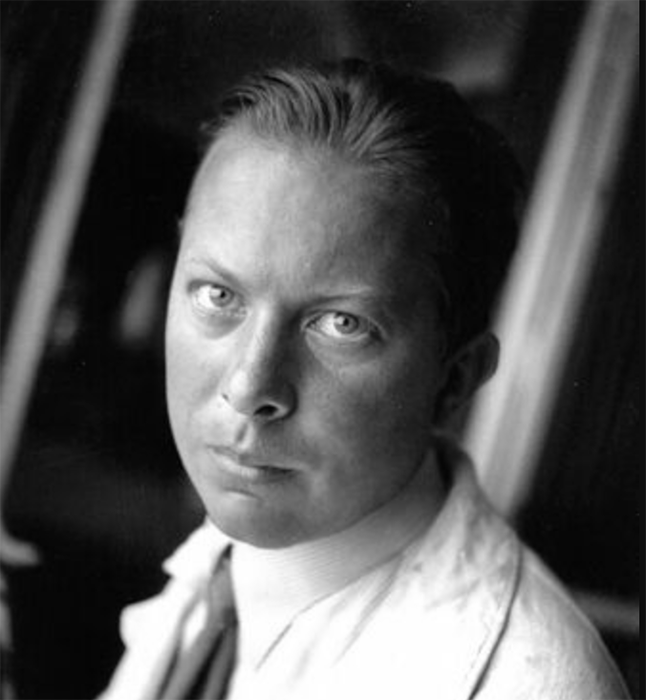
Farkas Molnár was an outstanding figure of the European avant-garde movement. After two years of graphic art studies at the Academy of Fine Arts in Budapest, he enrolled in the Architectural School of the Technical University in Budapest in 1917. Because of his involvement in leftist political actions, he had to leave Hungary after the fall of the Republic of Councils in 1920. After a study tour in Italy, he became a Bauhaus student in Weimar, Germany, in 1921. He took the graphic arts course of Johannes Itten.
In 1922, the Bauhaus published a set of lithographs by Molnár and his friend Henrik Stefán in the album Italia 1921 (Italy 1921). Soon, he became involved in theater art and architectural design, working in Oskar Schlemmer’s workshop and in Walter Gropius’s architectural practice with his Hungarian friend Fred Forbát, who joined the Bauhaus before his arrival. Influenced by lectures given by Theo van Doesburg, he organized the KURI group (1922) to unite avant-garde artistic efforts in constructive art and functionalist architecture. The name of the group came from the title of its manifesto, the initials of the German words konstruktiv (constructive), utilitär (utilitarian), rational, and international.
Molnár’s Red Cube project (1923) was an early attempt to realize his ideas in architecture: a two-story family house with a flat roof, minimal footing, and flexible room connections in the interior. The house was connected to the garden by a pergola. It was planned for the housing estate Am Horn and was shown at the Bauhaus Exhibition in Weimar (1923). With its radical geometrical reduction, the design represented a new direction in architecture and was the starting point for Molnár’s later villa projects. He experimented with mobile partitions and new possibilities of room connections in his U-Theater project (1923) as well. He published the book Die Bühne im Bauhaus (1925; The Stage in the Bauhaus) in collaboration with Oskar Schlemmer and László Moholy-Nagy in the series of Bauhausbücher (Bauhaus Books). From 1923 on, his designs and articles appeared in the publications of Hungarian avant-garde (MA, Munka, 100%, and Tér és Forma), introducing and propagating constructivist art and functionalist architecture.
In 1925, when the Bauhaus moved to Dessau, Molnár returned to Budapest and continued his studies in architecture at the Technical University, graduating in 1928. He became a leading figure of the functionalist movement in Hungary. His aesthetic views were closer to those of Le Corbusier than to those of the Neues Bauen in Germany. He proposed standardized, mass-produced housing with affordable minimal apartments and communal spaces based on a new social structure in which the traditional family would lose its importance. All his friends were on the political Left. They connected the goal of a new architecture with questions of political and social changes.
In 1929, Molnár participated at the Congrès Internationaux d’Architecture Moderne (CIAM), which focused on the minimum dwelling in Frankfurt. He became a member of the Comité International pour la Réalisation des Problèmes d’Architecture Contemporaine (CIRPAC) and organized the Hungarian CIAM group, whose most important members were József Fischer, Pál Ligeti, Máté Major, Fred Forbát, György Rácz, and Gábor Preisich. The group met regularly in Budapest until 1938. In the fall of 1931, the group showed the utopian KOLHÁZ project, a collective house for 800 people in the Household and Interior Design Exhibition in Budapest. In 1932, Molnár introduced his similarly utopian KOLVÁROS project, a schematic design of a collective city in the Tamás Gallery, Budapest. The social criticism of the third CIAM exhibition, House, City, Society (1932, Iparcsarnok, Budapest), was even more radical, confronting the existing unhealthy housing situation of poor people in Budapest with healthy social housing for low-income people, a vision of modern architecture.
Molnár worked between 1928 and 1931 in Pál Ligeti’s office, and together they realized the first modern functionalist building in Hungary, the Delej Villa at 11 Mihály Street (1929) in Budapest. Molnár’s own apartment of minimal footing (52 square meters) was also in the villa. In the interior, he achieved a high grade of flexibility by sliding partitions. In furniture design, he used new materials, such as plastic or Bakelite, and exclusive materials, such as ebony. Furniture, apartment, building, city, and region design were all logical components in his systematic thinking.
From 1931 on, Molnár worked on his own, occasionally collaborating with members of the CIAM group. He built a number of private villas for middle-class intellectuals who were open to new ideas, but he never received any commission for a public building. The villa at 2/a Lejt? Street (1932) in Budapest was built for one family. It has a cubic volume enlarged by two half cylinders, the smaller of which contains the staircase and covers exactly one-fourth of one side of the building, and the larger of which extends the living room on the first floor; the large roof terrace, accessible from the sleeping rooms on the second floor, covers exactly half the next side of the building. The four-story apartment house at 4/b Lotz Károly Street (1933) in Budapest has a compact volume as well with a flat roof and horizontal stripes of windows and balconies. Molnár’s new two-story apartment was also to be found in this villa. The sliding walls were made possible by a new “dynamic space connection,” as László Moholy-Nagy described it. The idea of identical and connectible cells for man and woman had already appeared in the Red Cube project. Now the idea was elaborated in detail. The color scheme for the walls, the textiles, and the furniture was carefully planned.
Molnár frequently used his own constructivist as well as other artists’ figurative decorations in the entrance areas of his villas (apartment house at Pasaréti Street, Budapest, 1936; villa at Trombitás Street, Budapest, 1936). The light elegance of the villa at 7/a Csévi köz (1935, with József Fischer) in Budapest made the most of the usual reinforced-concrete structures of Molnár’s buildings. He occasionally worked with Béla Sámsondi Kiss, an inventive engineer of reinforced-concrete structures. Molnár’s idea of the collective house became partly realized in the block of employee apartments for the OTI Worker Hospital (1936, with József Fischer) in Pestújhely.
In 1937 Molnár was elected the secretary of the CIAM-OST, but a year later, under growing political pressure, the CIAM group dissolved. Molnár abandoned his leftist ideas and moved in the opposite direction. The villa at 8 Mese Street (1937) in Budapest indicated that his architectural principles changed as well. He became interested in the aesthetics of Hungarian peasant architecture and started to use building forms and materials (high-pitched roof and rubble stone) that were never accepted by orthodox modernists. His last project, the Church of the Holy Land, was designed in 1938 and was between 1940–49 partly finished. It had a large oval plan and was to be covered with a concrete shell. In the interior, Molnár planned to accommodate replicas of the holy sites in Jerusalem. Molnár died when his home was hit by a bomb during the siege of Budapest in 1945.
Katalin Moravánszky-Gyöngy and Ákos Moravánszky
Sennott R.S. Encyclopedia of twentieth century architecture, Vol.2 (G-O). Fitzroy Dearborn., 2005.
|