|
| CHARLOTTE PERRIAND |
| |
| |
|
| |
| |
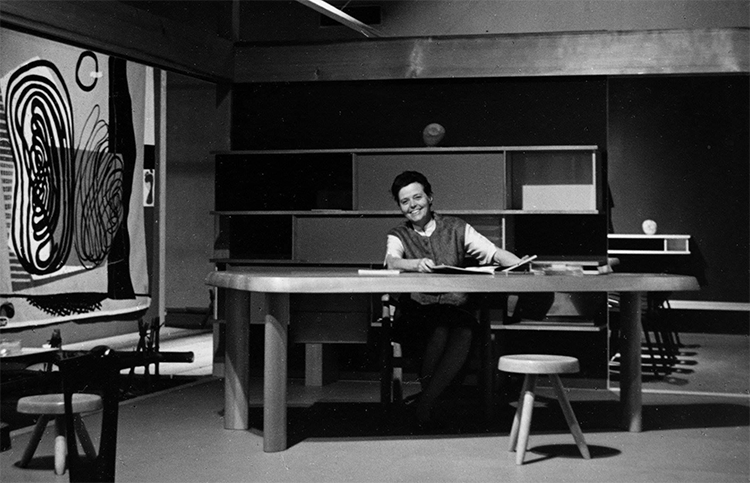 |
|
Name |
|
Charlotte Perriand |
| |
|
|
|
| |
Born |
|
October 24, 1903 |
| |
|
|
|
| |
Died |
|
October 27, 1999 |
| |
|
|
|
| |
Nationality |
|
France |
| |
|
|
|
| |
Movement / Style |
|
|
| |
|
|
|
| |
Official website |
|
|
| |
|
|
| |
| BIOGRAPHY |
|
|
|
|
| |
|
Charlotte Perriand, typically remembered as Le Corbusier’s privileged assistant,
remains not only one of the most significant figures of French modernism but also one of the most influential French interior designers. Her artistic activity spans over three quarters of the 20th century. Trained between 1920 and 1925 at the École Centrale des Arts Décoratifs under traditional French décorateurs committed to an Art Deco concept of modernity, her first exhibition as an independent professional took place at the 1926 Salon d’Automne, where she presented a coin de salon in a conventional French art décoratif manner. Her radical turn toward machine-derived furniture, however, occurred at the 1927 Salon d’Automne with a bar sous le toit, which brought her instant notoriety. She was almost immediately invited to join Le Corbusier and Pierre Jeanneret’s office and was soon to become, at age 25, their main furniture and interior designer. In association with Le Corbusier and Pierre Jeanneret, she furnished the villa Laroche in 1928, the villa Church at Villed’Avray in 1929, the Swiss pavilion at the Cité Universitaire in 1932, and the Cité Refuge of the Salvation Army in 1932.
Her early modernist work, oriented primarily to demonstrating the viability of industrial materials and forms for elite purposes, was characterized by lightweight furniture made of bicycle tubes enhanced with leather seats and a wealth of highly reflective, chrome-plated and glazed surfaces evoking the glittery automobile wheels, windshields, fenders, and hoods that were taking over the metropolitan landscape. Early on, Perriand’s interest in mechanical metaphors broadened to include movement and transformability, as her dining chairs began to rotate on ball bearings, similar to those she wore around her neck; her tables expanded or shrank along rolling, rubber surfaces.
Although adopting Le Corbusier’s concept of furniture as “home equipment,” Perriand’s contribution both to the Le Corbusier-Jeanneret office repertoire and to Le Corbusier’s own development in respect to interior design was considerable. She brought to the office a distinctly new orientation, associated with a novel sense of the art de vivre.
Through a more personal and expressive rendition of modernism, Perriand introduced an understanding for “total design” enhanced with lavish comfort and whimsical sophistication. Perriand’s radical, comprehensive aesthetic approach to modern interiors was complemented by Le Corbusier’s programmatic concept of équipement as opposed to decoration. This self-proclaimed functionalist approach to interior design dominated the first common exhibition of the Perriand-Le Corbusier-Jeanneret trio at the 1929 Salon d’Automne. The exhibits presented under Thonet’s sponsorship were dedicated to the Equipement de l’habitation: des casiers, des sièges, des tables—all characterized by standardization and modular deployment, resulting in what became known as the Le Corbusian concept of objet type. A characteristic example of such type-object in Perriand’s production was her 1928 rotating dining chair—erroneously attributed to Le Corbusier—that she re-used over the years in different contexts.
Passionately involved with radical leftist groups among artists, Perriand joined in 1932 the Association des Ecrivains et Artistes Révolutionaires (AEAR), sponsored by the Communist Party, and participated in the activities of the Maison de la Culture led by Louis Aragon. She viewed this activity as a logical extension of her role in the 1930 creation of the Union des Artistes Modernes (UAM).
I
nformed by her social and political commitments, which included two trips to the Soviet Union and projects for the Front Populaire government, in 1936 Perriand presented at the Third Housing Exhibition of the Salon des Arts Ménagers inexpensive, mass-produced home fittings, such as her innovative chaise pliable et empilable. She combined with her own furniture standard Flambo metal shelving that could meet the needs of a small worker’s apartment necessarily oriented toward multifunctional, transformable spaces. Along with her new interest in affordable, industrially produced house equipment, she increasingly turned to an art brut in which wood and natural forms replaced metal, and artisanal objects took over designs emblematic of the machine.
Consistent with a newfound essentialism, Perriand explored further through photography the aesthetic potential of “accidental” forms, whether natural or industrial. Her first, 1938 tables en forme, replaced furniture boasting mechanical motion with static objects shaped to fit the movement of the human body, thus providing metaphors for her new organicism.
In 1940, three months before the Nazi invasion of France, Perriand accepted Japan’s invitation to assume the position formerly held by Bruno Taut as industrial design adviser to the government. Japan’s efforts at modernization without jeopardizing its intricate cultural heritage met successfully with Perriand’s own efforts to achieve a seamless symbiosis between the industrial and the artisanal, the fabricated and the natural. She found in the everyday life of the Japanese house some principles that she had tried to apply in her work with Le Corbusier: the influence of the environment on modes of inhabitation and the liberation of the interior space through the absorption of household equipment into the walls of the dwelling. This concept emulated the Zen Buddhist understanding of the Void as “stimulating emptiness” rather than sterile absence. Perriand reinvented for Western needs the relationship between space and motion by adapting to modern life the Japanese view that harmonious human movement is possible only within emptiness. Her exhibitions for the Takashimaya department stores played a significant role in adapting Western modern techniques to fit the Japanese traditional spirit and were just the beginning of a series of similar exhibitions held simultaneously in France and Japan after the war.
Ultimately, Perriand’s contact with Japan and its distinctive classicism—recognized as germane to Western modernism at least since Frank Lloyd Wright and French Japonisme—helped purify her own art brut into a postwar sophistication reminiscent, in some respects, of her early modernist phase. Her 1950 adaptation of the chaise longue, in which bent bamboo stems replaced the metallic tubular supports, is an example of this transformation. In general, the Japanese lesson emerged in her work through the reintroduction of simple, plain wood; sliding translucent panels that open widely on natural environments; low, horizontal furniture; and transformable modular storing devices. An example of such interiors were her kitchens for Le Corbusier’s Unite d’habitation in Marseille or the so-called street interiors of Air France lobbies around the world that encompassed both the exclusive and the mass produced and remain examples of the best French design of the postwar era. Never severing her cultural ties to Japan, in 1993 she designed a teahouse for UNESCO in Paris. In December 1997, at age 94, she came for the first time to the United States, where she received the Brooklyn Museum of Art’s Modernism Design Award for Lifetime Achievements.
DANILO UDOVICKI-SELB
Sennott R.S. Encyclopedia of twentieth century architecture, Vol.3 (P-Z). Fitzroy Dearborn., 2005. |
| |
| |
| |
| |
| |
| |
| |
| TIMELINE |
|
|
|
|
| |
|
1903 Born in Paris, 24 October;
1920–25 Studied design at the École de l’Union Centrale des Arts Décoratifs, Paris;
1924–26 Attended life classes of Bernard Boutet de Monvel and André Lhote at the Académie de la Grande Chaumière, Paris;
1927 Began private practice in Paris; established a studio at Place Saint-Sulpice; became a member of the Salon des Artistes Décorateurs;
1927–30 Maintained a studio at Place Saint-Sulpice, Paris;
1927–37 Associate in charge of furniture and fittings, studio of Le Corbusier and Pierre Jeanneret, Paris;
1928 Became a member of CIAM;
1930 Established a studio on Boulevard de Montparnasse, Paris; became a founding member of the Union des Artistes Modernes, Paris;
1930–74 Member of the editorial board of L’Architecture d’Aujourd’hui;
1931 Member of the Association des Étudiantes et Artistes Révolutionnaires, Paris;
1937–40 Worked with Jean Prouvé, Pierre Jeanneret and George Blanchon, Paris;
1940 Established an office for prefabricated building research, Rue Las Cases, Paris;
1940–41 Industrial Design Consultant to the Japanese Ministry of Commerce and Industry, Tokyo;
1941–44 Independent designer in Tokyo;
1943 Married Jacques Martin; had one child;
1943–46 Worked in Indochina;
1953–56 Worked in Tokyo;
1962–68 Worked in Tokyo;
1966–68 Consultant to the École Régionale des Beaux-Arts et des Arts Appliqués, Besançon, France;
1969–76 Worked in Rio de Janeiro and Latin America;
1978 Received the Gold Medal of the French Academy of Architecture; appointed Commandeur of the Ordre National du Mérite;
1981 Appointed Chevalier of the Ordre des Arts et des Lettres;
1983 Appointed Chevalier of the Légion d’Honneur;
1983–84 President of the jury, International Office Furniture Competition, Paris;
1999 Died. |
| |
| |
| |
| |
| |
| |
| |
| FURTHER READING |
|
|
|
|
| |
|
Selected Publications
“Monologue in a London Flat,” Architect and Building News (October 1930)
“Habitation familiale: son développement économique et social,” L’architecture d’aujourd’hui, 6/1 (January 1935)
“L’art d’habiter,” Techniques et architecture, 9–10 (1950) (special issue edited by Perriand)
“Japon: une tradition vivante,” L’architecture d’aujourd’hui, 65 (May 1956) (special issue edited by Perriand)
“La maison japonaise,” Aujourd’hui: art et architecture, 12 (April 1957)
Charlotte Perriand: une vie de création, 1997
Further Reading
“The Apartment Interior,” Architectural Record, 80 (October 1936)
“Charlotte Perriand, la plus célèbre décoratrice de France,” La tribune de Lausanne (16 February 1964)
Charlotte Perriand: Un art de vivre (exhib. cat.), Paris: Musée des Arts Décoratifs, and Flammarion, 1985
Henriot, Gabriel, “Le XVIIIe salon des artistes décorateurs au Grand Palais,” Mobilier et décoration, 8 (1928)
Holme, C. Geoffrey, Decorative Art: The Studio Year Book, London: Studio, 1931 (see especially the essay by Maurice Dufrène, “Interior Decoration in Europe and America”)
Le Corbusier, Charlotte Perriand, Pierre Jeanneret: la machine à s’asseoir (exhib. cat.), Rome: De Luca, 1976
“Le Home du Jeune homme,” L’architecture d’aujourd’hui, 6/10 (October 1935)
McLeod, Mary, “Charlotte Perriand: Her First Decade as a Designer,” Architectural Association Files, 15 (1987)
Mihailovic, Cécile, “Entre le rêve et l’objet,” in Créer un produit, Paris: Centre de Création Industrielle, Centre Georges Pompidou, 1983
“Rencontre avec Charlotte Perriand,” Modulo, 46 (July–August–September 1977)
Renous, Pascal, Portraits de décorateurs, Dourdan, France: Vial, 1969
Sakakura, J. and Charlotte Perriand, Contact with Japanese Art: Selection, Tradition, Creation, Tokyo: Kujiokayama, 1941
Sert, José-Luis, “Charlotte Perriand,” Aujourd’hui: art et architecture, 7 (March 1956)
Winternitz, Lonia, “Einwohnraum: von Le Corbusier in Zusammenarbeit mit Pierre Jeanneret und Charlotte Perriand,” Innen-Dekoration, 41/6 (June 1930)
MORE BOOKS |
| |
| |
| |
| |
| |
| |
| |
| RELATED |
|
|
|
|
| |
|
LE CORBUSIER; FRANCE; |
|