An old modest house, located at No. 4 Karunova Street in the Trnovo district to the
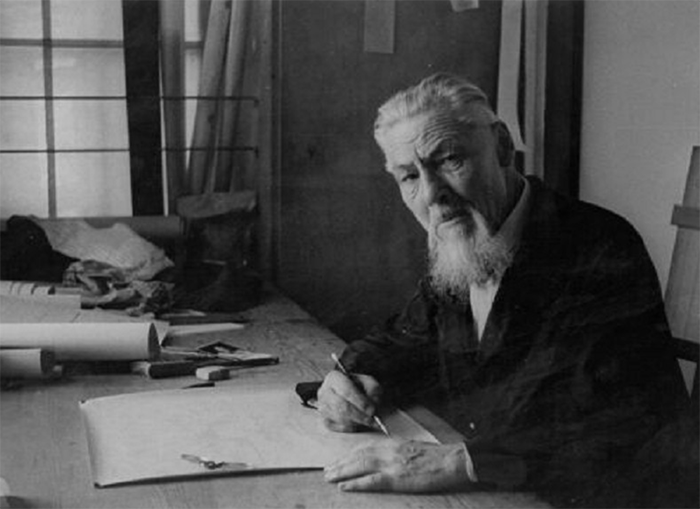
northeast of Ljubljana’s core, has remained as Jože PLEČNIK’s modest legacy; he was undoubtedly one of the most significant 20th-century Slovenian architects and a prominent pioneer of modern architecture in Central Europe.
PLEČNIK’s house is characterized by frugality and an elegant, albeit monastic, ambience. The search for an identity for Slovenian architecture; the fascination with folk traditions; craftsmanship; the interest in the classical world, particularly the Renaissance and Mannerist periods; and a devotion to the sacred are among the themes that characterize PLEČNIK’s oeuvre.
His architectural career unfolds from the last quarter of the 19th century to the mid- 20th century. Vienna, Prague, and Ljubljana became the geographic areas of the architect’s activities, each one coloring a phase of his production. In 1891 PLEČNIK’s father passed away, a circumstance that contributed to PLEČNIK’s decision to move to Vienna as opposed to returning to Ljubljana to take over his father’s woodworking workshop.
The following year, with assistance from the architect Leopold Theyer, who procured him employment with the firm K.K.Hof-Bau und Kunsttischelerei J.W.Müller, PLEČNIK finally moved to Vienna. His arrival in the capital of the Austro-Hungarian Empire was timely as it coincided with the transformation of the imperial city into one of the centers of world architecture. The architectural and urban efforts of Otto Wagner and several of his followers were decisive contributions to the transformation of this city’s infrastructure and physiognomy. In 1894 PLEČNIK met Wagner, who accepted him as a student at the Academy of Fine Arts. This was a definitive period in the formation of the future architect, who became a devoted adherent of Wagner’s ideals. Wagner gave primacy to technique over form and to innovation over tradition and emphasized a positive Rationalist position, thus anticipating many of the critical themes developed later as part of the Modern movement.
In 1898 PLEČNIK graduated third in his class after Josef Hoffman and Jan Kotera. His efforts earned him a bursary that allowed him, from 1898 to 1899, to travel to Italy with short incursions into France and Spain. Although the death of his mother prompted the young architect to put an abrupt end to this Grand Tour, the rich extant correspondence and drawings from the period show PLEČNIK as a very sensitive and keen observer of architecture and art.
PLEČNIK’s Viennese period, marked by an initial devotion to Wagner’s rational aesthetic, also reflects the architect’s involvement with the Vienna Secession movement, founded in 1897 by architects Joseph Hoffman and Joseph Maria Olbrich and painter Gustav Klimt. PLEČNIK worked on projects for the Secession, which included designs for contemporary furniture and household furnishings. His first important commission, the Zacherl House (1903-05) in central Vienna, dates from this epoch. Undoubtedly the architect’s early masterpiece, the Zacherl House is innovative in the use of concrete technology for the structural support.
PLEČNIK’s interest in sacred art, a theme that would pervasively appear throughout the architect’s career, also emerged during the early years of the 20th century. His Church of the Holy Spirit in Ottakring (1910-13), the first reinforced-concrete church in Vienna, is an excellent example of the expressive use of materials.
The second period of PLEČNIK’s professional career began in Prague in 1911. With the help of his friend Jan Kotera, he was appointed to a teaching position at the Prague School of Applied Arts. PLEČNIK’s stay in the Czech city, which included many visits to Vienna until the outbreak of World War I, permitted him to distance himself from the strong German nationalism then emerging in Vienna and to concentrate on the study of Slavic art, a theme that would shape his later work.
The search for Wagner’s replacement as a director of the Academy of Fine Arts in Vienna during the early 1910s gave PLEČNIK the hope for a return to the city that he considered his home. Although PLEČNIK was the faculty’s choice for the post, the students protested the appointment, and after two years the position was given to Léopold Bauer instead. Disillusioned by this turn of events, PLEČNIK discarded any plans to return to Vienna.
The second decade of the century saw PLEČNIK actively involved in teaching in Prague. This phase was distinguished by a lack of built production that was nonetheless counteracted by a return to a preoccupation with craft—particularly metalworking— through his teaching activities. During this period, the architect often traveled to Slovenia, beginning a process of reacquaintance with his family and native land that greatly contributed to his desire to return to Ljubljana.
In the early 1920s, PLEČNIK concluded his academic activities at the Prague School of Applied Arts and returned to Slovenia, where he began teaching activities at the Polytechnic School of Ljubljana. However, before his departure for Slovenia, he received the offer from the newly elected president of the Czech republic, Tomás Masaryk, to become the architect of the Prague Castle. This important commission, through which Masaryk intended to transform Prague’s highly visible historical royal compound into the architectural symbol of the new democracy, became PLEČNIK’s obsession throughout a great part of this period. He returned to Prague each year until 1935—the year Masaryk abdicated—to supervise the work. Other significant buildings from this period include his restoration of the Presi-dent’s summer residence in Lány (1921-23) and the Sacred Heart Church in Prague (1928-32).
Ljubljana marks the last, and undoubtedly most productive, period in the architect’s career. After the return to his homeland, PLEČNIK devoted himself to an architectural and cultural campaign that produced significant buildings raging from sacred architecture to institutional projects and urban interventions, transforming the architectural fabric of that city. The buildings from this phase clearly express the architect’s search for a national Slovenian language, idiosyncratic nonetheless, but craftily executed and based on Mediterranean rather than Nordic precedence. This period includes the Church of Saint Francis of Assisi, Siska (1925-31); Saint Michael’s Church, Barje (1937-38); and the renovation of the Chamber of Commerce, Craft, and Industry (1925-27), the Headquarters of the Vzanjemna Insurance Company (1928-30), the National University Library (1936-41), and the Central Funerary complex at the Zale Cemetery (1938) in Ljubljana. The Ljubljana oeuvre epitomizes the syncretic amalgam of themes and motives, influenced by classic, neoclassic, and vernacular imagery that persistently nourished the production of PLEČNIK—without doubt one of the significant, yet overlooked, figures of modern architecture.
RICARDO CASTRO
Sennott R.S. Encyclopedia of twentieth century architecture, Vol.3. Fitzroy Dearborn., 2005.
|