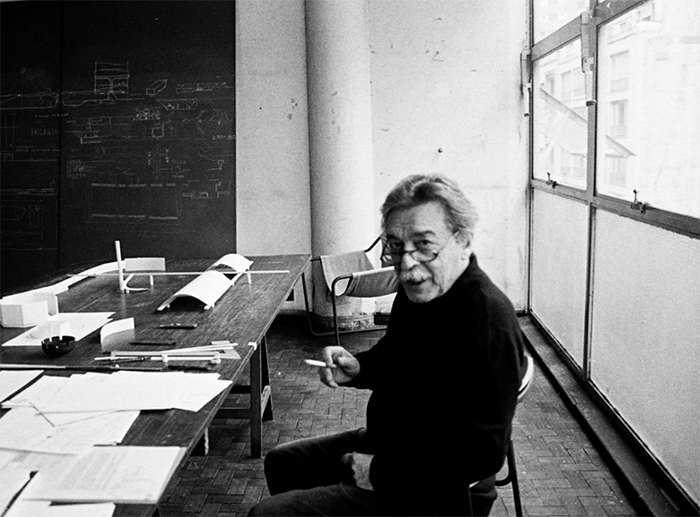
The work of Paulo Mendes da Rocha represents an
extreme position, exemplary in its coherence. Without allowing
himself to be influenced by fashionable modes, Mendes da
Rocha has applied himself to developing a constant line; set-
ting out from a fascination with engineering and technology,
he has recreated a basic space configured by the structural
form.
This almost heroic type of approach has frequently mani-
fested itself in the Brazilian context. The first generation of
moderns, which came of age in the forties with such outstand-
ing architects as Lucio Costa (1902) and Oscar Niemeyer
(1907), was succeeded by contemporary figures of the intens-
ity of Lina Bo Bardi (1915-1992) and Paulo Mendes da Rocha
(1928). Their achievements have been produced in an
immense country that has provided the architecture of the
20th century with talents of the highest calibre: from estab-
lished masters such as João Vilanova Artigas, Rino Levi and
Affonso Eduardo Reidy to such less familiar figures as the
Roberto brothers, João Filgueiras Lima or the partnership of
Claudio Araújo and Carlos Fayet, without overlooking the
exceptional contribution most important landscape architect
of the 20th century: Roberto Burle Marx.
Confidence in the modern project
The work of Paulo Mendes da Rocha is an unambiguous
expression of confidence in a modern project that is still con-
sidered to be insufficiently implanted in the cities of Brazil. A
modern project that is based on a mastery of technical know-
ledge, on a conceptual intensity, on the mechanism of abstrac-
tion, on a concern with insertion in the urban fabric and on a
clear social commitment. The interventions carried out by the
masters of the Modern Movement, in particular Mies van der
Rohe and Le Corbusier, have been rigorously reinterpreted on
the basis of an ascetic and insistent effort of abstraction.
Unquestionably, Le Corbusier’s engagement with Brazil had a
radical impact on Mendes da Rocha, and on several gener-
ations of Brazilian architects.
Essentially self-referential, Paulo Mendes da Rocha has
remained impervious to those postmodern critiques that have
premised a fragmentary universe which can find a way out
only by looking to history. In his work, there prevails with all its
energy a confidence in the single gesture that gives rise to an
architectonic structure capable of regenerating the chaotic
and disjointed urban context of Brazil’s modern cities. As in
the Obus plan for Algiers drawn up in a series of versions by
Le Corbusier between 1930 and 1934, the objective is to
maintain the capacity for articulation and regeneration by
means of modern architecture.
The basis for achieving an architecture with these possi-
bilities is to be found in the mastery of technology, in the cre-
ation of a new monumentality through the careful use of rein-
forced concrete and steel technologies. A love of the material-
ity, solidity, presence and texture of materials that is charac-
teristic of minimalist architecture. A mastery that Paulo
Mendes da Rocha and his partner João Eduardo de Gennaro
demonstrated with unequivocal clarity even in their first pro-
ject the gymnasium for the Clube Atlético Paulistano in São
Paulo (1957): a great rectangular platform with a spectacular
flattened cupola, circular in plan, virtually suspended in the air.
The so-called Paulist school
Although a local reading of Paulist or São Paulo architec-
ture can legitimately arrive at great precision and rigour, a
more distanced view, from the perspective of the international
panorama, can offer —in spite of its inevitable simplifica-
tions— some idea of the overall achievement in terms of com-
mon characteristics that are not easily discerned in close prox-
imity.
In Paulo Mendes da Rocha’s work, there is a pure and
inseparable chemical synthesis of different references: his own
tenaciously held poetics, the involvement in the revolutionary
formal thinking of the Paulist school, and the concurrence with
the most minimalist referents that have appeared on the inter-
national scene in the course of the 20th century, from Mies to
the late coincidence with Tadao Ando, by way of the distant
memory of British Brutalism.
Within this catalogue of influences, it is evident that João
Vilanova Artigas opened the way for several generations of
São Paulo architects. An architecture with a particular sense
of social responsibility, with a commitment to establishing a
new urban order on the scale of the modern man and woman,
materialized in large structures of unadorned reinforced con-
crete. These generate in their interior great roofed spaces
which, if they lack functional definition, potentiate the life of the
community and human contact, and manifest a similar capac-
ity to create diaphanous domestic spaces, Spartan in their
configuration.
Paulo Mendes da Rocha's work asks to be understood in
this cultural and formal environment in which architects such
as Oswaldo Arthur Bratke, Joaquim Guedes, Sérgio Ferro and
Ruy Ohtake actively participated. At all events, the architecture
of this Paulist school, based on forms closed on the exterior,
on “sandwich" spaces derived from Mies that take the form of
boxes raised on pilotis, with interior courtyards and gardens
and concrete furniture, has been taken to its limits by Mendes
da Rocha.
A relationship has been remarked between the Paulist
school and the “Brutalist” architecture identified in the fifties
by the British critic Reyner Banham. In fact, the origins of this
category can be traced to a jocular comment in a London pub.
Banham described this architecture as Brutalist not only on
account of its uncompromising directness, with the concrete,
the structure and the services all exposed, but because Peter
Smithson’s profile reminded him of the Roman Brutus.
It is not simply the case that the vicissitudes of the
Paulist architecture of these years are far removed from such
anecdotes; the spatial, cultural and material experience was
quite different. The buildings that the young Mendes da
Rocha, Guedes, Ferro, Ohtake and others were producing
—with their introverted structure and exuberant gardens in the
interior or at the base— have little in common in terms of the
scale, the dramatization of the structure by means of great
blind surfaces and gigantic openings and the totally unitary
open-plan interior space as in the examples by Alison and
Peter Smithson or Bakema and Van der Broek presented by
Reyner Banham in his book Brutalism in Architecture (1966).
They coincide, certainly, in their free and brutalist reinterpreta-
tion of models drawn from Mies and Le Corbusier, and also in
their opposition to the option of a realist and figurative tenden-
cy in contemporary architecture. Curiously, the point at which
Paulist and Brutalist architecture come closest to one another
is in some of the early works by the Swiss architects Atelier 5.
The Alder house (1958), for example, with its cubic forms of
reinforced concrete on pilotis, or the Halen residential estate
(1961) with its repetitive forms that create human spaces
conducive to social contact; both of these projects also have
precedents in Tadao Ando’s work.
Brazil’s younger generation
In terms of the international panorama, the inherent qual-
ity of —and the critical acclaim earned by— Lina Bo Bardi and
Paulo Mendes da Rocha’s work has restored to Brazilian
architecture the leading role and the fragrance it enjoyed in
the forties. In terms of prestige and universality, the Cariocans
have made way for the Paulist architects.
If Oscar Niemeyer’s architecture signalled the introduc-
tion of irrational, poetic, expressive, exuberant and formalist
elements into the rationalist language of the master, Le
Corbusier, the work of Paulo Mendes da Rocha in contrast
pursues a greater rationality, more systematic, more essential,
more reduced. If Costa and Niemeyer moved away from the
solidity and frontality of Le Corbusier’s architecture in a search
for forms that were more tangential, transparent, fluid and
expressive, João Vilanova Artigas, Paulo Mendes da Rocha
and the Paulist school have followed the opposite course,
directed towards weight and mass, although this is maintained
in a position of uneasy equilibrium. On the other hand, they
are united by a common conception of the building as
autonomous object, as sculpture. There is also a shared confi-
dence in the capacity of the architectonic object to endow the
site with a new value. In this respect, Mendes da Rocha con-
siders himself to be as close to Vilanova Artigas as to
Niemeyer. And although Niemeyer is generally willing to sacri-
fice structural logic to formal desires, while Mendes da Rocha
regards the form as the result of structural rigour, there are
exceptions to this rule. For example, the FORMA shop in São
Paulo consists of a box raised up on two systems of rein-
forced concrete walls, with a facade of sheet metal and glass
suspended with great sophistication from this wall system by
means of a complex and somewhat abstruse series of anchors
that is only rendered intelligible in the interior.
Lina Bo Bardi and Paulo Mendes da Rocha have also
pursued diametrically opposed courses, the expression of two
different ways of understanding modern architecture. Whereas
Lina Bo Bardi became progressively contextualist, incorpor-
ating figurative elements from popular art, increasingly making
use of iconologies, Paulo Mendes da Rocha has concentrated
on his own self-referential line, excluding all that does not cor-
respond to the essential structure of the space.
An extremely coherent body of work
Two clearly apparent factors in Paulo Mendes da
Rocha’s work reveal his tenacious insistence on the same
group of concepts.
In his first projects the technology, understood in the
ideal sense imparted by the master Mies van der Rohe, was
subordinated to the new monumentality of the forms. More
recent works such as the Antonio Gerassi house in São Paulo
(1989) directly utilize precast sections of reinforced concrete
and prestressed concrete. Here the technology can already be
understood in a real sense, and a cultured project is perfectly
capable of including mass-produced prefabricated elements
taken straight from the manufacturer’s catalogue.
In the two museums that Mendes da Rocha has
designed, the same supremely forceful idea is expanded on.
The unbuilt project for the Museum of Contemporary Art in the
Universidade de São Paulo (1975, in conjunction with Jorge
Wilhein and Leo Tomchinsky) consists of a gigantic box of
prefabricated reinforced concrete entirely supported on two
central rows of six pillars each, with a lighter independent
structure for the facades. The projecting structure is in some
ways reminiscent of Le Corbusier’s Chandigarh, and the
museum is essentially conceived as a giant sculpture and a
covered plaza. It is almost as if the Faculty of Architecture and
Urbanism in São Paulo, designed in 1961 by João Vilanova
Artigas, had been endowed with the gift of flight, hanging sus-
pended in the air. Because in Mendes da Rocha’s work the
initial organicism of Vilanova Artigas is a continuing presence
in this aspiration, this desire for natural liberty, in a remarkable
relationship with the scale of the human body situated in the
landscape, scanning the horizon.
The Brazilian Museum of Sculpture in São Paulo (1988-
1994) is based on a gigantic portico of reinforced concrete
that bestows significance on the place. This magnificent port-
ico gives access to a subterranean museum in which Mendes
da Rocha leads us to the very essence of a sculpture mus-
eum. The colossal reinforced concrete portico is itself a "sculp-
ture” and provides the key to the interpretation of its contents.
It is at the same time a hollow structure that houses in its anti-
space interstices the lighting systems for the open space. The
museum is thus to be read in the same way as the very first
museums, a cave filled with treasure, a mediaeval crypt or an
archaeological excavation. The museum as it was in its origins,
a great chest buried in the earth in which precious objects
were kept safe. This insistent search for the foundational
space, for the essential structure, for the primal archetype
constructed with the most refined and polished technology
and materiality leads us to the great single space of the under-
ground museum, understood as a raw, Protean form, as yet
undefined.
If the project for the Museum of Contemporary Art at the
Universidade de São Paulo was an ideal prototype, the
Museum of Sculpture is a more concrete form, produced for a
point of urban convergence in São Paulo, transformed into
sculpture, into a covered public plaza and an archetypal
museum space.
Montaner, Josep Maria, Mendes da Rocha, GG, 1996 |