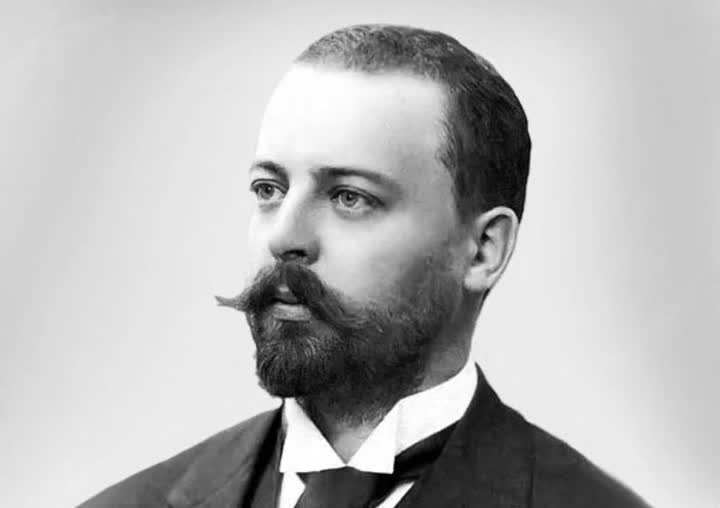
Among Russian architects at the turn of the 20th century, Fedor Shekhtel is unique not
only in the range of accomplishment over some three decades but also in the degree to which his work embodied the cultural aspirations of his era. As no other architect, Shekhtel enlarged and gave coherent expression to the creative possibilities of the modern style, yet after 1908 he retreated from modernism to a reworking of traditional forms in Russian architecture.
Shekhtel was born and raised in a middle-class environment in the Volga town of Saratov. His father was a civil engineer of German extraction, and his mother, Maria, came from a distinguished merchant family, the Zhegins, whose connections extended into the merchant elite of Moscow. After the death of his father, Shekhtel moved with his family to Moscow around 1875. Having spent a year (1876–77) in the third class at Moscow’s School of Painting, Sculpture, and Architecture, he began private work that combined his love for architecture and theater with the design of sets for impresarios such as Mikhail Lentovskii.
During the 1880s, Shekhtel served his apprenticeship in the offices of Alexander Kaminskii and Konstantin Terskii, architects for Moscow’s merchant elite in the 1870s. By the end of the 1880s, Shekhtel had designed and built his first independent projects, including the exuberantly eclectic mansion for S.P. von Dervis (1889) at the estate of Kiritsy near Riazan. In 1894, Shekhtel received certification as a “technician-builder” for his design of a large neo-Gothic townhouse for Zinaida Morozova, wife of the industrialist Savva Morozov. The design, which dates from 1893, was some three years in construction; and although both the interior and the exterior display the ostentatious striving for effect typical of that time, Shekhtel also used the style to explore the dynamic relation between interior space and its projection in the design of the exterior.
From this use of Gothic stylization as a path to structural innovation, Shekhtel moved to a radically modern idiom in his house for Stepan Riabushinskii (1902) near the Nikita Gates in central Moscow. Begun in 1900, the Riabushinskii house displays a stylistic affinity with houses designed by Olbrich at the Matildenhöhe community, yet it also incorporates the emphasis on decorative arts pioneered at Abramtsevo, the Arts and Crafts colony established in the 1870s on the country estate of railroad magnate Savva Mamontov. Shekhtel defined the exterior as a play of contrasting elements, angular and sinuous, precise in line and complex in decorative form. In designing the interior of the house, Shekhtel approached the limits of the free-form possibilities of the modern style. The central space, extending the entire height of the structure and containing the main stairway, serves as a core around which most of the rooms are grouped. The stairway itself is one of the most theatrical moments in Russian modernism, a frozen wave of polished gray aggregate cascading from the upper story to the bottom landing. His other major residence of the period, designed in 1901 for Alexandra Derozhinskaia, wife of a wealthy Moscow industrialist, represents a rejection of elaborate decoration in favor of a monumental definition of mass and space.
In public architecture, Shekhtel defined some of Moscow’s most important spaces with buildings such as the Moscow Art Theater (1902), with its superb interior detailing, and the rebuilding of the Yaroslavl Railway Station (1902), with traditional decorative elements in a modernized interpretation known as the “neo-Russian” style. This style was prefigured by Shekhtel’s designs for large wooden pavilions at the 1901 Glasgow Exposition.
In commercial architecture at the turn of the 20th century, Shekhtel developed the multi-storied arch, with spandrel beams and plate glass, as a defining tectonic element in two commercial structures: the headquarters for the Kuznetsov porcelain firm (1898–99) and the Arshinov Store in Kitai-gorod (1899), with its facade of glazed green brick. A more picturesque approach was adopted in his “chateau” style for the main office of the A.A.Levenson Printing Works on Mamontov Lane (1900), behind which was a printing plant in a modern, functional design.
On a much larger scale, Shekhtel’s building for the Moscow Insurance Society on Old Square (1901) represents a shift from the Renaissance detail and arched facades of his earlier commercial buildings to an orthogonal, grid framework of brick and reinforced concrete. Although the Insurance Society building—more commonly known as “Boiars’ Court,” named after the hotel situated in the building—retains a number of stucco decorative devices, the rationalism of its design signaled the beginning of the modern era in Moscow’s financial district.
The clearest expression of the new rationalist approach in Shekhtel’s work occurred in commercial buildings such as the Riabushinskii Brothers Bank (1903) in the center of Moscow’s financial district and the office and printing works (1907) of the Riabushinskii newspaper Utro Rossii (Russia’s Morning). The main facades of both consisted of a plate-glass grid with a surface of high-quality pressed brick and no ornament, although the corners are rounded and articulated—a characteristic feature of Shekhtel’s large commercial projects, such as the building for the Moscow Merchants’ Society (1909) and the Shamshin apartment building (1909).
In the final phase of his career, Shekhtel turned to new interpretations of retrospective styles, such as the neoclassical revival for his own house in Moscow (1909) and the museum dedicated to his close friend Anton Chekhov in Taganrog (1910). His design for the Old Believers Church (1910) in Balakovo (Samara province) is a sensitive fusion of traditional motifs within a modern structure.
In the union of modern form and function that characterized the main body of this work, Shekhtel suggested the spirit of a new economic order in Moscow. Although that order, as well as his professional practice, collapsed in the aftermath of war and revolution, Shekhtel remained in Moscow with his family and continued to teach until his death in 1926. A cautious revival of his legacy began in the 1960s, and he is now considered one of the leading cultural figures of Russia’s “Silver Age.”
WILLIAM C. BRUMFIELD
Sennott R.S. Encyclopedia of twentieth century architecture, Vol.3 (P-Z). Fitzroy Dearborn., 2005. |