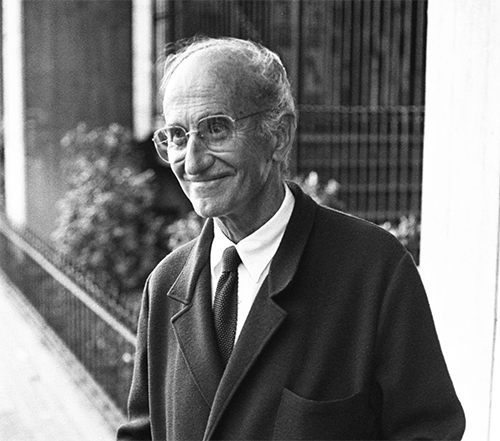
Alejandro de la Sota is the maestro of many late 20th-century Spanish architects. On
the one hand, he was an influential teacher at the school of architecture in Madrid from 1956 to 1972. On the other, he was a master builder whose projects set an example to be followed by his many disciples. It is unfortunate that his influence did not extend beyond the boundaries of Spain. He was recognized internationally only in the 1980s. Born in the Galician region in the northwestern part of Spain in 1913, he graduated from the school of architecture at the Polytechnic of Madrid in 1941. From 1942 to 1949, he worked for a central government housing and relocation agency, creating a series of rural housing developments for post-civil war Spain. Although the groupings relied on a rational plan and the repetition of forms, he adorned the houses with elements of vernacular architecture. With the exception of this first job, all his subsequent architecture was clearly modernist and characterized by its simplicity, rationalism, and abstract geometry. A follower of the Modern movement, de la Sota’s building always seemed understated, although his genius was ever present. De la Sota, who suffered from Parkinson’s disease in his final years, died in Madrid in 1996.
In the buildings, projects, and furniture designs of de la Sota, the primary idea is paramount. The final design is the result of a process that eliminates, little by little, extraneous and unrefined aspects. In the end, what is left is pure, concentrated, but also poetic. The generating idea of a project does not always come from the same source. In some cases, it may be the structure, the site, a technological aspect, or a programmatic intention. Functional and technical concerns become the architectural language. The tectonic quality of the building is always present, as de la Sota’s works make constant references to the materials of which they are constructed. Each project seems to start fresh from the new situation at hand. Once de la Sota remarked that there is no reason to do the same thing over and over again. He expressed the idea that each project should present a new challenge and a new opportunity for exploration. De la Sota practiced architecture for about 50 years, maintaining an atelier type of approach. His body of work, both built and unbuilt projects, is part of the rich heritage of Spanish architecture of the end of the 20th century.
In 1955, a single-family house was built in Madrid on Doctor Arce Street. The site exerted its influence on the final form. The required setbacks from the property lines encouraged a compact structure on the widest part of the side. The house, on a busy street, looks inward. The windows to the street facade are few and small. The facade toward the garden is the exact opposite, with its large windows creating a transparency between interior and exterior. The entire house is made of brick with uneven surfaces that catch the changing natural light. The plan is simple; the staircase, with its gentle curve, seems to push out the exterior wall of the house, creating a bulge in the facade.
The Civil Government Offices in Tarragona (1957), really the central government building in the province during Franco’s regime, shows clearly the architect’s evolving vocabulary. The building, for representation, administration, and housing, is the union of three blocks, each used for one purpose: The entrance is pushed underneath the main podium, which itself comprises the main government floors. The top of the podium forms a terrace that dominates the square in front. It also creates a break between the building used for government functions and the official residences located in the cube above. A modular system of 18 by 18 feet is the underlying principle of the composition. The residential cube is exactly three modules by three modules. The clear use of geometry and the play between voids and solids call to mind Le Corbusier and Mies van der Rohe. Terragni’s name also surfaces with a comparison made to the Casa del Fascio. The main building material is cut and polished local marble.
The Maravillas Gymnasium (1965) had to respond to a very difficult site with limited financial resources. The narrow, trapezoidal site, about 90 feet wide, has a steep slope of about 36 feet. The solution is one of fitting the building into the void and occupying the entire site. An ingenious structural solution using 60-foot trusses set at right angles to the street span the gymnasium. On the upper level, the 18-foot spaces between the trusses are used for classrooms. Below is the gymnasium, with the benches on one side and light from the windows above flowing into the other. The materials used are few and grant an idea of the thin skin enclosing the space, which becomes lighter and lighter as one goes up. At the lower level, the building faces a busy street and therefore has a rather closed facade at street level with brick. Higher up is glass, which seems to fold back and finally on top, surrounding the play space, is a wire fence.
The Post Office and Telecommunications Building (1984) in Leon, Spain, can be thought of as a functional building employing state-of-the-art technology. It is apparently a simple cube that allows work to be carried out efficiently while admitting that changes in use can occur over time. The structure is simple, and the interior is filled with light. The materials echo the intention of the building. It is clad in Robertson panels and uses glass, stainless steel, and straightforward fixtures.
The projects of de la Sota, from the early works, such as the TABSA Aeronautical Plant (1957) near Madrid, to his final ones, such the University Library (1993) in Santiago de Compostela, although always loyal to modernism, can also be seen as a quest for purity, order, and simplicity.
MARTHA THORNE
Sennott R.S. Encyclopedia of twentieth century architecture, Vol.3 (P-Z). Fitzroy Dearborn., 2005. |