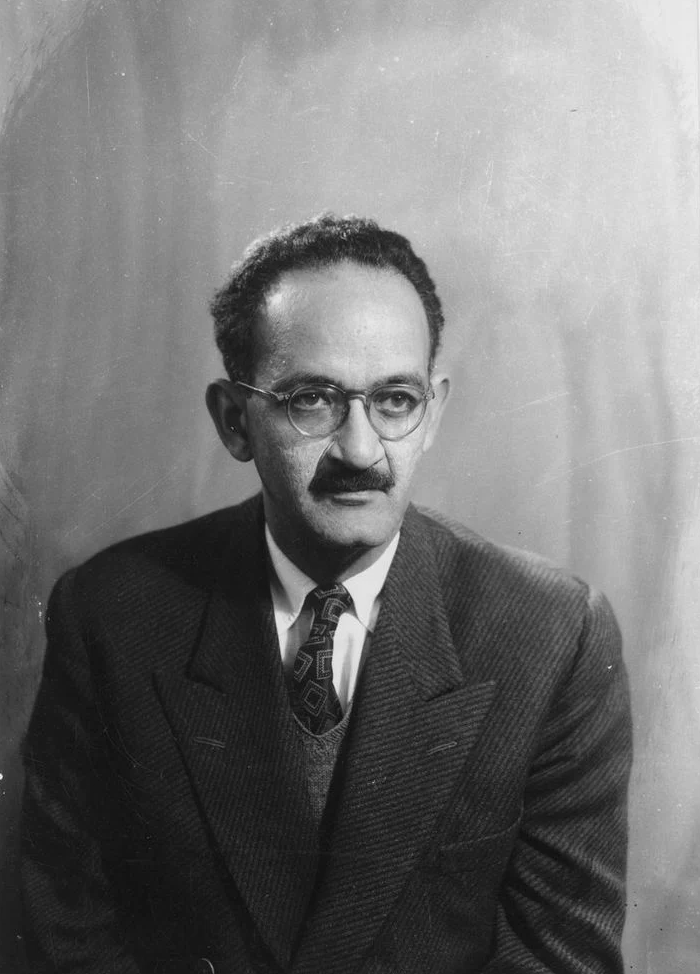
Ramses Wissa Wassef was born into a prominent and cultured Francophile Coptic
(Egyptian Christian) family in Cairo. His father was an influential member of the nationalist Wafd Party and one of the founders of the École des Beaux-Arts in Cairo, which opened, in the teeth of opposition from the office of the British consul-general in Egypt, in 1908. Wissa Wassef completed his education in France and studied architecture at the École des Beaux-Arts in Paris, where he received his diploma in 1935. His diploma project, “The Potter’s House in Old Cairo,” already revealed his interest in and knowledge of the traditional crafts of his homeland.
On returning to Egypt in 1936, Wissa Wassef was appointed professor of the art and history of architecture in the Department of Architecture of the School of Fine Arts, Cairo. The Department of Architecture at the School of Fine Arts, in Zamalek on Gezira Island between the two arms of the Nile near Cairo, was the first modern school of architecture to be founded in Egypt. Presently incorporated in the University of Helwan (Zamalek Campus), the school continues the arts-and-crafts tradition pioneered by Hassam Fathy and Wissa Wassef.
Wissa Wassef had followed Hassan Fathy as head of the Department of Architecture at the School of Fine Arts, and both men shared a passion for the traditional vernacular architecture of their native land. Field study visits into the rural areas of the Nile delta and of Lower and Upper Egypt were annual events for students of the School of Architecture under their direction; and for both men, the traditional architecture of Nubia, the southernmost region of Egypt above and around the Aswan Dam, became and remained a perennial source of inspiration. Wissa Wassef was primarily a teacher, fired by the desire to communicate his love and profound knowledge of architecture and of arts and crafts generally not only to his architecture students but also to children. He stated, “I had this vague conviction that every human being was born an artist, but that his gifts could be brought out only if artistic creation were encouraged by the practising of a craft from early childhood” (see de Stefano, n.d.).
In 1941 Wissa Wassef was commissioned by a social welfare organization to design a small primary school in the Coptic quarter of Old Cairo. This provided him with the opportunity to test his conviction, and he persuaded the management committee to let him teach weaving to the children after school. He chose weaving, a craft about which he knew very little, as the first craft to teach young children because he believed that the simple techniques could be easily learned and that the craft process would enable children to develop and express their innate creativity through producing colorful visual images. His pupils, children from the humblest homes, were producing work that gave them both great satisfaction and a potential source of income, and so within a few years he resolved to build his own school and craft training center where he could realize his vision of a cooperative of artist-craftsmen, living and working in the local community. His wife, Sophie Habib Gorgy, was a sculptor and shared his enthusiasm and his vision. In 1951, they purchased a small plot of land on the outskirts of the village of Harraniya, a few miles south of Giza on the west bank of the Nile, and began to build the school that was eventually to bear his name, the Ramses Wissa Wassef Arts Centre. He devoted the greater part of the rest of his life, especially after his retirement from the School of Fine Arts in 1969, to its completion.
Although primarily a teacher, Wissa Wassef was a sensitive and accomplished architect, and his built works are many and varied. Apart from the Arts Centre at Harraniya, his best-known works are the Mahmoud Mokhtar Sculpture Museum (1962– 64) in Cairo, the Church of al-Mar’ashali in Zamalek, Cairo, and the Virgin Mary Church in Cairo. He designed and built several houses for private clients, including the Ina Magar Country Home (1969), Adam Hennen Residence (1968), the Mohi Houssin Residence (1970), and his own house in Agouza. In 1968, Wissa Wassef incorporated traditional Nubian structures in the design of El-Dar Restaurant in Giza, Egypt, that he built of mud brick with vault and dome technology.
In 1961, he was awarded a National Prize for the Arts for the stained-glass windows he designed and made for the National Festival Hall in Cairo and in 1964 a National Prize for the Arts for the design of the Mahmoud Mokhtar Sculpture Museum.
ANTHONY D.C.HYLAND
Sennott R.S. Encyclopedia of twentieth century architecture, Vol.3. Fitzroy Dearborn., 2005.
|