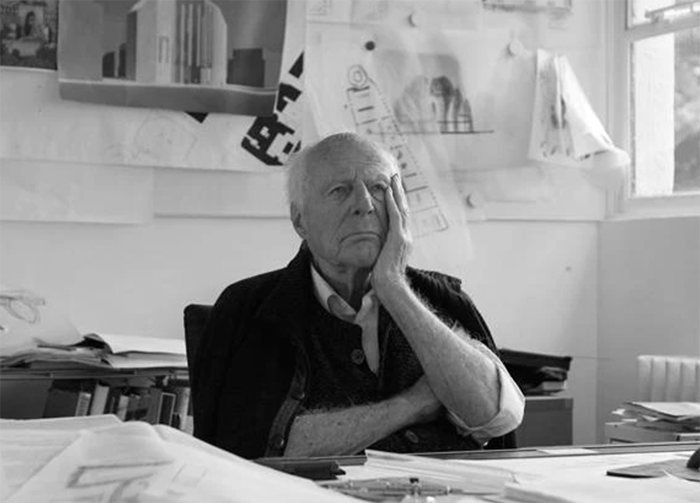
Gottfried Böhm’s architecture ranges from the Expressionistic to the experimental. His
early sculptural concrete buildings from the 1960s and 1970s and his vast steel-and-glass secular buildings of the 1980s and 1990s find few, if any, parallels in other countries. Böhm’s buildings clearly have a sculptural approach that is seen in the treatment of the outside form and woven throughout the building, manipulating interior spaces through the formation of structural elements and details. Böhm always followed his own style and method of creating architecture. His buildings range from small-scale to large-scale projects, and his architecture embraces the simple and the complex by using diverse building materials that range from reinforced concrete and steel to glass and brick.
The son of the famous church builder Dominikus Böhm (1880–1955), Böhm gained his reputation through his early churches. In the 1960s, his architecture blended existing historic city fabrics, integrating his creation into this network of private and public zones while also interacting with its environment in form, materiality, and color.
From 1942 to 1946, Böhm studied architecture under Adolf Abel and Hans Döllgast, among others, at the Technische Hochschule (technical university) in Munich. He received his diploma in 1946 and continued his studies in sculpture under Josef Henselmann at the Akademie der Bildenden Künste (Academy of Fine Arts) in Munich. His education in both architecture and sculpture significantly influenced his work, as is clearly seen in his monumental concrete structures of the 1960s and 1970s.
In 1951 Böhm went to the United States to work for the architectural office of Brother Cajetan Baumann in New York. While there, he visited Ludwig Mies van der Rohe twice in Chicago and Walter Gropius once at Harvard University.
Although fascinated by the technical perfection of Mies’s buildings, Böhm’s main influence came from his father. From 1952 until 1955, he collaborated with his father on multiple church designs, a few single-family homes, a cinema, and projects (1951) for the Wallraff-Richartz Museum in Cologne. The influence of Mies on their single-family homes is evident in the Kendler House (1953) in Junkersdorf-Cologne, which clearly corresponds with Mies’s row house Elmshurst III (1951). Böhm’s Chapel of St. Kolumba (1950) used rendered shells attached to structural ironwork, creating a sculptural transitory appearance, as in his father’s Benedictine Abbey (1922) in Vaals. These influences on his architecture were clearly evident in his early independent projects.
After the death of his father, Böhm took over the existing projects in the office, transforming the typology of his father’s works, as exemplified in the Church of the Sacred Heart (1960) in Schildgen and the church project (1959) for Bernkastel-Kues. From the end of the 1950s to the end of the 1960s, Böhm’s architecture developed sculpturally and departed from earlier influences. His individualized definition of architecture was characterized by extreme plasticity and dynamic forms. His was an architecture that defined masses with contrasting form and light. Böhm strayed from strict classical geometric forms to free-flowing asymmetrical compositions, which suggest crystal-shaped compositions in reinforced concrete.
The Church of St. Gertrud (1960–66) in Cologne and the Parish Church of the Resurrection of Christ and a youth center (1970) in Cologne-Melaten mark a movement toward his unique sculptural style, culminating in his two masterpieces: the Town Hall (1962–71) in Bergisch Gladbach-Bensberg and the pilgrimage church of Mary, Queen of Peace (1963–72), in Velbert-Neviges. These highly acclaimed projects drew on his father’s architecture and German Expressionism of the early 20th century.
Böhm used highly advanced concrete technology to construct in the manner prophesied by Bruno Taut, Mies, Hans Poelzig, Max Taut, Hans Scharoun, and others. The town hall in Bensberg functions as a “city crown,” inspired by Bruno Taut’s Expressionist vision of the center of cultural-religious life in the city. In the 1970s, the demand for churches decreased, and secular buildings formed the majority of the structures built by Böhm. The complex formwork for his concrete buildings became too expensive for public buildings. The office changed its design strategy to a more strict orthogonal typology following the ideas of system-based building, influenced by both the cluster buildings of Aldo van Eyck and Herman Hertzberger and Peter Cook’s Archigram and its “Plug-in City.”
In the 1970s, steel dominated in the exterior of Böhm’s buildings. These new influences and materials are clearly present in the pilgrimage church of Our Lady of the Victory (1972–76) in Opfenbach-Wigratzbad, the town hall and cultural center (1970–77) in Bocholt, and the renovation and new building of Castle Saarbrücken (1977–78, 1981–89).
After his neo-Expressionist period of the 1960s and 1970s, Böhm pursued a more sumptuous strategy. His baroque-like spaces tended toward vastness in volume within mazes of axial symmetry. One design feature of the Böhm office seems to recur over and over again; namely, the basilica-based building with nave and two aisles in secular structures, as seen in the Züblin office building (1981–85) in Stuttgart and the Hotel Maritim (1989) in Cologne. In these projects, parallel office wings are arranged side to side on a central hall that has a semipublic character and that is used for hosting events, such as exhibitions and concerts.
In the later 1990s, Böhm’s architecture developed away from the restraints of symmetry and axial logic. The projects become more fragmented and split into more layers as he used suspended shell-roof construction, as demonstrated in his design for the Philharmonic Hall (1997) in Luxembourg. His Peek & Cloppenburg department store (1995) in Berlin demonstrates his will of form giving, with clear origins in sculpture.
MONIKA EVELYN KÖCK
Sennott R.S. Encyclopedia of twentieth century architecture, Vol.1. Fitzroy Dearborn., 2005.
|