| |
|
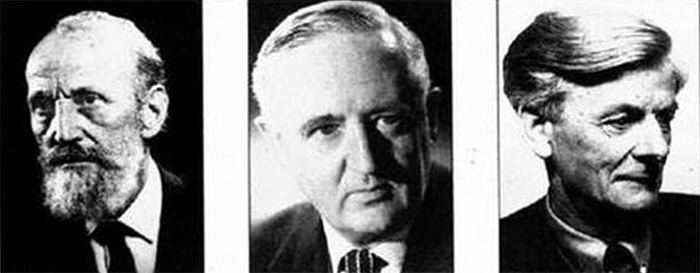
The London-based architectural firm Connell, Ward, and Lucas was founded in 1933
by two architects from New Zealand—Amyas Connell (1901–80) and Basil Ward (1902– 76)—and one from England—Colin Lucas (1906–84). Connell and Ward arrived in England in the 1920s and studied at the Bartlett School of Architecture, University of London; in 1926 both won prizes to study architecture in Rome. Lucas studied at the University of Cambridge and in 1928 formed a building company whose main goal was to experiment with concrete construction. Although the partnership lasted only six years and was disbanded in 1939, it was nonetheless one of the leading modernist firms active in Britain during the 1930s, and the architects were important, vocal proponents of modern architecture.
Before forming the partnership, the three were already known in architectural circles for innovative projects. Connell designed High and Over (1928–31), a home for the art historian and archaeologist Bernard Ashmole, who later became the director of the British Museum in London. Located on a 12-acre site in Buckinghamshire, High and Over is often considered the first significant modern house built in England. Local residents protested that its white-walled exterior, ribbon windows, and Y plan were incongruous in the rural setting. In 1930 Lucas designed the first reinforced-concrete house in England, Bourne End in Buckinghamshire. Bourne End’s extensive glazing, unornamented surfaces, and flat roof show a strong identification with the modernist language of the International Style. With Connell in 1932, Ward designed New Farm in Surrey, a home with an open, spacious plan whose structural system was modeled on Le Corbusier’s Dom-ino Houses.
In 1933 Connell, Ward, and Lucas not only officially established their partnership but each became a founding member of the MARS (Modern Architectural Research) Group, the British branch of CIAM (Congrès Internationaux d’Architecture Moderne). The firm’s involvement with MARS is indicative of the architects’ support for the Modern movement in general, as well as their interest in architectural developments on an international scale, innovations in technology and construction, and solutions for mass housing. Despite opposition from the British building industry, the architects consistently developed new building techniques to make the walls of their reinforcedconcrete structures progressively thinner, and they rightly looked at their own work as experimental.
The firm’s commitment to the new architecture, as International Style and modernist works were often described, was immortalized in a 1934 BBC radio debate titled “For and Against Modern Architecture,” when Connell agreed to be challenged on the air by architect Reginald Blomfield. Connell, who had been unknown to the public before the debate, responded boldly to Blomfield’s fierce attacks on the International Style for its foreignness, its overemphasis on function, its lack of an artistic vocabulary, and its break with venerated traditions. Blomfield criticized the use of the flat roof in a thinly veiled attack on French and German modernism derived from Le Corbusier and Walter Gropius’s Bauhaus aesthetics, respectively. A transcript of the debate was made public, Connell emerged as a public figure, and the firm began to receive more commissions.
One of the partnership’s most well known works is a house at 66 Frognal Way (1938) in Hampstead, London. Built for a lawyer and his family in a neighborhood of neo- Georgian villas—one of which was owned by Blomfield—the house celebrated the elements Blomfield despised: unornamented, white exterior walls; ribbon windows; a free plan; and a free facade. Once again basing the structural system on Dom-ino Houses, Connell, Ward, and Lucas used their ample experience with reinforced concrete to puncture the house with gardens, concrete patio slabs on all three levels, a sun deck, and an observation point. A colorful, lush interior, most of whose furnishings the architects designed, is masked by the unadorned street facade. The design of the house, first made public in 1936, resulted in a series of lawsuits precipitated by Blomfield, accusing the architects of destroying the character of the neighborhood. The comparatively unquestioned presence of E.Maxwell Fry’s modernist Sun House (1936) around the corner is most likely testament to Blomfield’s personal hatred of Connell.
Although Connell, Ward, and Lucas is most famous for designing private homes, in 1935 it participated with other MARS members in a competition for public housing. The firm’s entry—reinforced-concrete flats (apartments)—did not win, but in that same year the firm built other blocks of low-cost flats; the first, Kent House, is in the Chalk Farm neighborhood in London, and the second, in Surrey, was designed as an extension of a Regency-style house. The blunt modernist style of this addition was criticized for clashing with the existing, more traditional building.
Despite the firm’s defense of modernism and its controversial works, a 1936 design for the Newport Civic Building, with its overt references to Ragnar Östberg’s Stockholm Town Hall (1909–23), seemed to Connell, Ward, and Lucas’s peers to have betrayed the modernist cause. Several MARS Group members objected to the design’s particular use of brick, its classical symmetry, and its symbolism of function, and the firm was forced to explain and defend the work in front of a MARS meeting. An attempt to officially censure Connell, Ward, and Lucas was abandoned, but from that point on, the three had little interaction with the group, despite remaining members for several more years.
With few commissions at the beginning of World War II, Connell, Ward, and Lucas closed in 1939 and did not reopen after the war. Each of the three architects continued to practice on his own. Connell went to Nairobi, Kenya, and established a new firm, TRIAD. His works include the Aga Khan Platinum Jubilee Hospital (1959) and the Parliament Buildings (1963); he returned to England in 1977. Ward set up a new firm as well, became the Lethaby Professor of Architecture at the Royal College of Art in London, and then led the School of Architecture at the Manchester College of Art. Ward’s firm designed the microbiology building (1960) at Oxford University as well as a store and office block (1967) at the Glasgow Airport. Lucas joined the Housing Division of the London County Council (LCC); under his supervision the LCC designed the important Alton West Estate (1955–59) at Roehampton, a housing scheme inspired by Le Corbusier’s Unite d’Habitation in Marseilles (1946–52).
The work of Connell, Ward, and Lucas is marked by a consistent willingness to experiment with modern materials and forms. Its use of concrete, steel, and glass and its identification with the pared-down elements of modernist works was unusual for the rather conservative architectural climate of England in the 1930s, but it shows the architects to have been imbued with the same spirit as that of first-generation modern architects in continental Europe.
DEBORAH LEWITTES
Sennott R.S. Encyclopedia of twentieth century architecture, Vol.1. Fitzroy Dearborn., 2005.
|
| |
|
Further Reading
The special issue of Architectural Association Journal contains essays by Henry-Russell Hitchcock and others. The two subsequent issues of the journal (December 1956 and January 1957) contain short letters by Peter Smithson and Colin Rowe, commenting on the importance of Connell, Ward, and Lucas.
“Connell, Ward and Lucas,” Architectural Association Journal, 72 (November 1956)
Curtis, William, English Architecture 1930s: The Modern Movement in England 1930–9; Thoughts on the Political Content and Associations of the International Style, Milton Keynes, England: The Open University Press, 1975
Modern Architecture in England, New York: The Museum of Modern Art, 1937
Sharp, Dennis, “British Modern Architecture of the 30s. The Work of Connell, Ward and Lucas,” A+U, 240 (September 1990)
Sharp, Dennis (editor), Connell, Ward and Lucas: Modern Movement Architects in England, 1929–1935, London: Book Art, 1994
Thistlewood, David, and Edward Heeley, “Connell, Ward and Lucas: Towards a Complex Critique,” Journal of Architecture, 2/1 (1997)
MORE BOOKS |