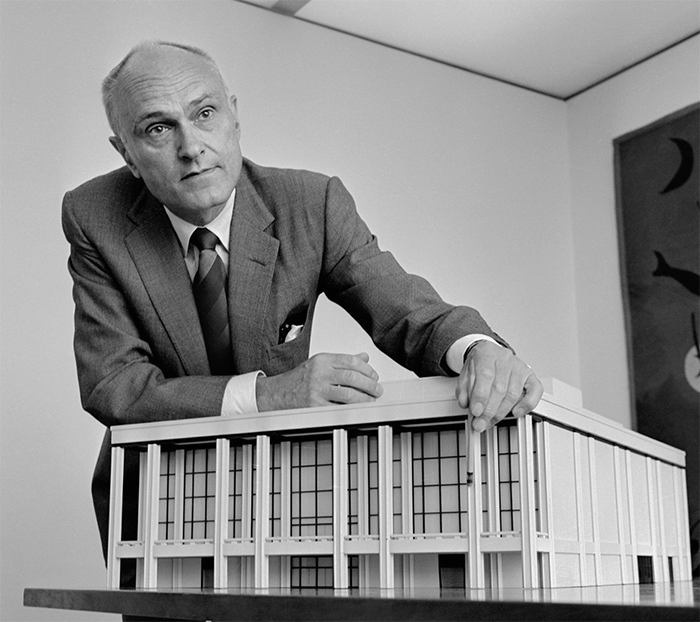
Philip Johnson has been a crucial figure in introducing conservative American clients to avant-garde architectural forms and publicizing these forms in striking ways. He began as an early and important advocate of the architecture of the European Modern movement in the United States through exhibitions, lectures, and juries, in addition to his own built structures. He lived long enough to become one of the best-known and most prolific Postmodern designers of the 1980s. Throughout his career, Johnson emphasized the formal values of architecture above all others, far more so than adherence to any one style or approach. More paradoxically, he has maintained a posture of permanent avant-gardism, attacking the architectural certainties of the moment—admitting all the while that his aim has been to influence the wielders of power as they choose architectural expressions of that power.
Under the influence of young Harvard-trained art historians Henry-Russell Hitchcock, Jr. and Alfred H. Barr, Jr., Johnson quickly became a formidable authority on Western architecture. However, Hitchcock and Barr, as well as Johnson’s brilliant Harvard circle of future Modern-art patrons, persuaded Johnson to put his energies and considerable wealth into education and propaganda for modern architecture.
In 1930, shortly after the 1929 founding of the Museum of Modern Art (MoMA) in New York under Barr’s directorship, Johnson began acting as the museum’s de facto, unpaid curator of architecture. His 1932 exhibition, “Modern Architecture: International Exhibition,” is generally known as the “International Style” show, after the title of the accompanying book by Johnson and Hitchcock. The exhibition followed Barr’s lead in presenting the most extreme and accomplished modernists—Le Corbusier, Ludwig Mies van der Rohe, Walter Gropius, and J.J.P. Oud—as masters of a unified, teachable, inevitable style, for which the MoMA historians invented the label “International.” The exhibition and book were criticized for their frankly formalist stance, but the thoroughness with which Johnson documented and publicized this branch of modernism made MoMA the authority on it for the next 30 years.
Through his MoMA contacts and presence on the Berlin art scene, Johnson became a major figure among the avant-garde’s elite patrons on two continents while still in his 20s. Johnson's most important Berlin acquaintance was Mies van der Rohe, whose presence in American design began under Johnson’s patronage. After the exhibition, Johnson was hired (paying his own salary) as MoMA’s curator of architecture and design. However, the mercurial and impetuous Johnson became attracted to the Hitler movement in Germany and in 1934 left architecture to serve as an activist and publicist for several fascist and radical-right causes.
In 1940, Johnson enrolled in Harvard’s Graduate School of Design, then run by Gropius. His first executed building was a Cambridge house that he built for himself using Mies’ “courthouse” concept; it was offered as his senior thesis in architecture in 1942. In 1947, Johnson curated a seminal eponymous retrospective of Mies’ work, accompanied by a monograph that was the first extended discussion of Mies’ career in any language. The show and book made Mies a major figure in American architecture almost overnight and returned Johnson to the place of influence in architecture that he had occupied before 1934.
In 1949, Johnson erected his first important work: a single-room, steel-framed, glass-walled house for himself on property in New Canaan, Connecticut. The concept derives from Mies’ Farnsworth House in Plano, Illinois, that was in the planning stages at the time. However, Johnson's Glass House departs crucially, if subtly, from its prototype. The Farnsworth project is asymmetrical and seems to float above a floodplain on its white-painted I beams. Johnson’s Glass House is symmetrical, rests on a low brick platform, and is anchored to its hilltop by a chimney cylinder of brick. The black finish and heavy corners of the steel frame imbue the house with a weighty, classical air that works in striking dialogue with the building’s radical transparency. The Glass House is regarded as among the best, possibly the very best, of Johnson’s buildings and is an important monument of the International Style’s acceptance in the United States.
In the early 1950s, Johnson achieved some eminence as a designer of suburban houses in Mies’ manner as well as the beautiful MoMA Sculpture Garden (1953) in New York, inspired by Mies’ 1929 German Pavilion at Barcelona. He was Mies’ partner in the design of the Seagram Building (1959) in New York, a commission that he had obtained for Mies as a MoMA consultant to Seagram heiress Phyllis Lambert. The building’s elegant Four Seasons Restaurant is Johnson’s chief contribution. However, beginning in 1953 with a domed bedroom in his Guest House, Johnson began experimenting with non-International Style elements such as curves, vaults, pilasters, and axes. His approach was to adopt avant-garde forms in more accessible, elegant, or recognizably honorific ways. Johnson often added cerebral, rather stagy references to earlier architecture, ranging from the work of Claude-Nicolas Ledoux to that of obscure German modernists, but he always paid careful attention to materials (frequently luxurious) and details. Johnson’s buildings share a pronounced concern for the plan in both making useful spaces and considering their aesthetic effect on the pedestrian.
In the late 1950s, Johnson began to assert that the verities of the International Style were dead and that change was now architecture's only constant. He soon became identified with the quasi-classical manner with which architects such as Edward Durell Stone and Minoru Yamasaki tried to temper modernist austerity; his New York State Theater (1964) at Lincoln Center is such an example. However, Johnson also played with compositional schemes based on circles and cylinders (for example, the exquisite domed pavilions of the Museum of Pre-Columbian Art, Dumbarton Oaks, Washington, D.C., 1963). The Roofless Church (1960) in New Harmony, Indiana, and several urban parks in Texas show Johnson’s gift for siting abstract forms in open spaces. His most breathtaking exercise in abstract form is despite the excellence of works such as the Transco Tower (1983) in Houston, less-accomplished designs, such as the Times Square redevelopment (1983; unbuilt), with its overpowering scale, seemed to be cynical insults to Postmodernism’s representational and urbanistic concerns.
In 1988, Johnson dropped historicist Postmodernism and involved himself with MoMA’s exhibition, “Deconstructivist Architecture.” This move reinforced Johnson's reputation for cynical power brokering, yet Johnson was correct in noting that stylistic revivalism had begun to wane as a major force in architecture. The use of signature architectural styles (historicist or avant-garde) as high-class commodities is a more lasting legacy from the Postmodern period, which Johnson’s career as an architectural impresario did much to encourage.
Mites Davip SAMSON
Sennott R.S. Encyclopedia of twentieth century architecture, Vol.2 (G-O). Fitzroy Dearborn., 2005. |