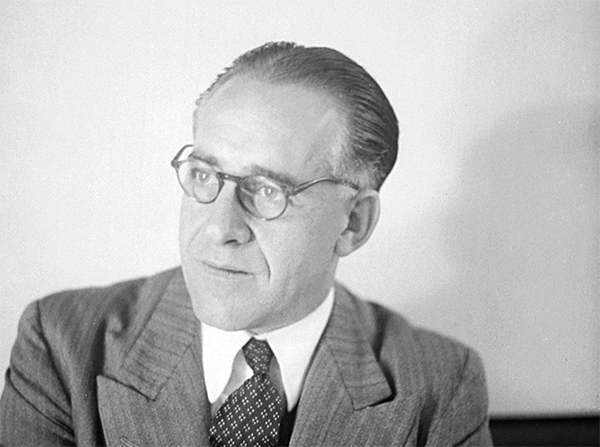
Rino Levi was one of the pioneers of modern architecture in Brazil. His career spanned more than 40 years and made a definitive contribution to the diffusion of modernist ideas within the country.
A son of Italian parents, Levi was born in 1901 in São Paulo, where he studied at the Colégio Dante Alighieri before traveling to Italy to continue his studies. While in Italy, he studied at the Polytechnic School of Milan before moving to the Superior School of Architecture in Rome. This was the first unified school of architecture in Italy, founded with the objective of uniting the academic teaching tradition with a rigorous technical-scientific framework. Levi studied under Marcello Piacentini and graduated in 1926. That same year, he returned to São Paulo, where he remained for the rest of his life, contributing to the architectural configuration of that metropolis.
In the years following 1926, he, along with Russian emigrant Gregori Warchavchik, was one of the few defenders of the renewal of formal and technical architecture in Brazil. However, Levi differed from Warchavchik and did not devote himself to the diffusion of ideals through manifestos but rather focused on building a solid professional career. The influence of Italian architectural culture is notable in Levi's works, and although his ideas refute the imitation of classicism, he did not deny it as a source of inspiration. Another important inheritance from the Italian tradition was his conception of architecture as volume; it is identified as "weight," which combines with the characteristic "lightness" of Brazilian architecture.
Breaking with the local tradition, Levi was the first architect in São Paulo to devote himself exclusively to the architectural project, separating it from the construction process. Throughout his career, he encouraged the recognition of architecture as a profession. This goal is best represented in the technical elaboration of his projects and the manner in which he always researched new materials and different construction techniques. However, he did not attempt to dissociate himself from formal questions and insisted on constant experimentation with various forms, materials, and construction systems. He searched for the most appropriate combinations for each project and never lapsed into formulaic patterns.
In 1932, Levi designed one of the first skyscrapers in São Paulo—the 10-story Columbus Building (Edifício Columbus)—which not only provided structural challenges but also led to careful considerations regarding planning and comfortable accommodations for the residents. In referencing Italian rationalism, the building can be viewed as formally restrained, with flat walls, curved counters, and discrete ornamental details. In this project, we see some of the traits that would mark many of Levi's skyscrapers; these buildings break with the scale of the city while simultaneously valuing the urban streetscape, with careful treatment of corners, ground floors, and entrance halls.
Among Levi's numerous buildings, the office of the Institute of Brazilian Architects (1947), the Prudência e Capitalização Building (1947), the Trussardi Building (1947), and the Plavinil-Eldor Building (1961) were all situated in São Paulo. In these projects, Levi emphasized concerns relating to the climate, avoiding large expanses of glass, which he saw as inadequate for a tropical climate. Instead, he frequently returned to the use of balconies and brises-soleil.
This attention to detail also marked his residential projects and his careful treatment of natural lighting. The residences were usually organized around internal patios and were characterized by their introspective nature; in a sense, they denied the existence of the city. The architect integrated interior environments, articulating living spaces with gardens. His interest in tropical vegetation brought about his long collaboration with Brazilian landscape architect Roberto Burle Marx. Among his residential projects, the architect’s own residence (1944), the Milton Gruper residence (1951), and the house of Clemente Gomes (1963–64) represent his best domestic architecture.
Levi was commissioned to design several movie theaters between 1936 and 1941 and turned his attention to acoustics. Some of his most notable cinema projects include the Art-Palácio (1936), the Cinema Universo (1939), and the Cine Ipiranga (1941), which offered perfect audio and visual environments.
The same care and technical concern assisted Levi in becoming a specialist in complex architectural typologies such as hospitals and factories. In these projects, he developed detailed flow and sectorization studies. This can clearly be seen in his project for the Maternity Building (1945) of the University of São Paulo, which he developed following detailed collaboration with a team of hospital doctors. This building marked the beginning of a series of similar commissions, including the Cancer Hospital (Hospital do Câncer) (1947) and the Hospital Albert Einstein (1958). His hospital architecture culminated in reviews in several international publications and led to an invitation by the Venezuelan government to organize the country’s system of hospital buildings (1959–60). Among his industrial projects, it is fitting to mention the offices and roasting houses of Café Jardim (1943) and the Laboratório Paulista de Biologia (pharmaceutical industry, 1956–59), where he adopted a fragmented solution with isolated buildings for each function.
In his response to Italian design, Levi always considered architecture within the context of the city. For example, his project for Brasília (1957) won third place in the competition. His design explored the theme of a city with many centers and proposed residential sectors as mega-structures (300 m high, 400 m wide, and 18 m deep) that incorporated a sophisticated system of vertical circulation intended to provide for three street levels. His final project was the Civic Center for the city of Santo André, which resembled the Brasília project in its arrangement of the executive, legislative, and judiciary buildings.
Levi actively participated in the Institute of Brazilian Architects and served as president for two consecutive terms (1952–53 and 1953–54).
Levi died in 1965 during an exploratory trip to the interior of Bahia. His professional life included more than 230 completed projects. His office continues today under the control of his partners.
Leonardo B. Castriota
Sennott R.S. Encyclopedia of twentieth century architecture, Vol.2 (G-O). Fitzroy Dearborn., 2005.
|