| |
|
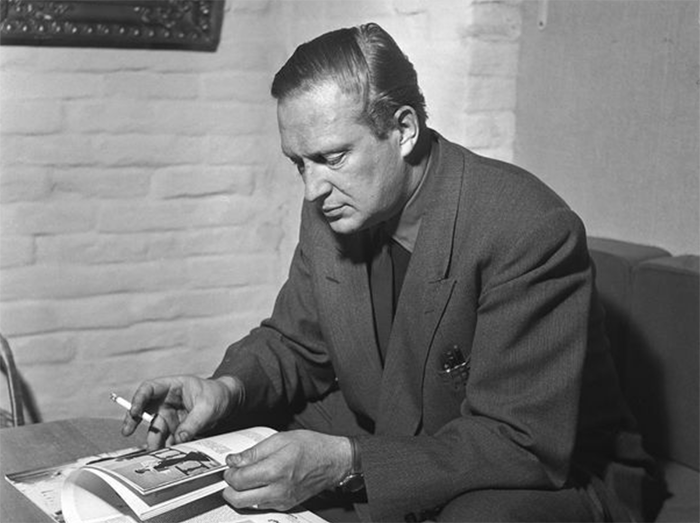
When Viljo Revell was born in 1910 in the Finnish coastal town of Vaasa, his
homeland was nearing the end of almost eight centuries of its being a pawn in the political and economic struggles between Sweden and Russia. The 20th century would prove to be one of Finland’s most tumultuous, and the political and economic climate of the country had an irrefutable impact on the design and construction industry during the period when Viljo Revell practiced architecture.
During the Napoleonic Wars, Russia successfully invaded Finland in 1809 and to appease the Finns established the Grand Duchy of Finland, leaving intact the traditions of the subject nation. Early in the 20th century, attempts to “Russify” Finland resulted in the formation of numerous resistance movements. Furthermore, the unstable political situation in Russia and Europe indirectly deflated the resource and agrarian economy of the entire region. Even though Russia finally accorded to Finland its independence late in 1917, competing domestic interests manifested themselves in the Red and White Armies, which embarked upon a brutal, class-based civil war.
The 1920s saw the brief emergence of an architecture that responded to Finland’s independence, a national romanticism characterized by a prevalence of wooden materials used in Finnish vernacular building. Classicism inspired the symmetrical floor plans and exterior elevations, as well as the building ornament—garlands, medallions, columns, and arched porticoes. However, this style was quickly superseded by the practical economies of the functionalist movement, which was evolving in continental architecture and city planning. Stressing that purpose and function should determine form, these buildings were characterized by a spartan simplicity and utilitarian decoration. By the mid-1920s, Scandinavian journals reviewed the concepts proposed by Le Corbusier, a proponent of this new design philosophy, and innovative young architects visited the Continent to see concrete examples. Admired for its vitality and honesty, its airiness, light, and soundness, functionalism appeared in Finland and Sweden during the late 1920s, just as Viljo Revell was embarking on his architectural education at Helsinki’s Institute of Technology, where he studied until 1937.
Finland’s slow recovery from the repercussions of World War I and the ensuing Civil War was further hampered by the effects of the depressed world economy of the 1930s. Nonetheless, Viljo Revell’s first building was constructed during this period on the site of an abandoned Russian military barracks building in central Helsinki. Initially conceived in 1933 by a five-student team as a temporary bazaar structure, the design was expanded to include a bus coach station and a commercial building with a cinema, restaurants, and shops. To the astonishment of the local architectural community, the city council supported Revell’s proposed new design over that of the city’s own architect. The final project design for the Lasipalatsi Building (1936), or Glass Palace, was completed by a trio of students: Viljo Revell, Niilo Kokko, and Heimo Riihimäki.
The Lasipalatsi Building was definitely outside the bounds of the prevailing classically inspired or Jugend style buildings, and it initially aroused public criticism. A swath of large windows extended along the entire two-story street frontage, wrapping around the curved corners and lending to the white-plastered structure a modern quality that heralded future architectural innovations. Above the main entrance a multistoried glass wall canted out over the street. The state-of-the-art Bio-Rex Cinema was housed in a large cubic form, set well back from the street behind a one-story section with a roof terrace. The complex also contained the HOK restaurant, its 700-person capacity making it the country’s largest public dining facility. Lasipalatsi was constructed according to functionalist precepts: bright and light open spaces with attention given to hygienically smooth textures of the finishing materials. Technical ingenuity was evident in the ferroconcrete structure and in the latest kitchen equipment and cinema projection systems. Brightly colored blinds controlled the sunlight, and neon lights advertised the businesses within. Artisans coordinated the interior decor with the overall building architecture. Separate from the building and to the rear, near the bus loading area, was an iconographic smokestack, clock, and light tower marking the underground heating and power plant for the complex. Designed for a ten-year life span, the Lasipalatsi Building has survived in the hub of the capital city, and it was recently restored in 1998 to reflect the structural, functional, and ideological intentions of its original designers.
The international conflict precipitated by Germany in 1939 resulted in strategically situated Finland being caught in the midst of a battle between the Soviets and Germany. Unwilling to transfer any territories to the Soviets, the Finnish mounted a valiant resistance to their invading troops along the Mannerheim Line. The resultant peace agreement in March 1940 ceded or leased substantial territory to the Soviet Union, forcing the expulsion of all Finnish occupants and land owners. In order to regain these lands, the Finnish government permitted Germany to use Finland as a military staging base for attacks on Norway and the Soviet Union. When the Soviets retaliated in June 1941, Finland felt justified in declaring war on this Western ally. Ensuing diplomatic negotiations proved fruitless, and in 1944 the Soviets regained much of the territory previously lost to Finnish and German troops.
In 1936, Revell had worked briefly in the office of Alvar Aalto, assisting with the Finnish Pavilion for the 1937 Paris International Exhibition. He then designed a small commercial building for his hometown of Vaasa, but the outbreak of war halted the construction industry until the Finnish Association of Architects established a Bureau for Reconstruction in 1942. Revell was named to head this institution, and for the next seven years his energies were devoted to conducting research into the development of standards for new construction materials and techniques, the modular systematization of buildings, and methods for prefabrication. Revell’s first large-scale project did come out of this era, nonetheless. The Romantic style of his vocational school for the Liperi Rehabilitation Centre for War Consumptives (1948) was indicative of the nostalgia that briefly developed after World War II, as Finland renounced modernism and reverted to the Romantic Nationalism that had dominated the early decades of the century.
After entering private practice, Revell’s first successful competition entry was for the Industrial Centre and Teollisuuskeskus Building, also known as the Palace Hotel (1952), overlooking the Helsinki harbor and market. Designed in collaboration with Keijo Petäjä, the Palace Hotel was one of many design projects in which Revell was quite content to share the limelight with others, even those with less experience than himself. His unprejudiced attitudes and his ability to encourage innovative design solutions became a trademark of Revell’s approach to architectural practice, and because of this, he attracted
young and talented newcomers to his studio.
The floor plan for the Palace Hotel forms an asymmetrical “H,” with the rooms
opening off corridors whose widths corresponded with anticipated circulation loads. In a Le Corbusian manner, the mass of the building was elevated on two-story-tall columns, or pilotis. Revell’s logical approach to design was evident in the hotel’s clearly articulated circulation patterns and floor plans. His attention to details, particularly noticeable in the fashionable Grill Restaurant, was evident throughout.
Postwar conditions had a tremendous impact on the Finnish economy, and beginning in the 1950s, the government’s policy of reconciliation and declared state of neutrality saw Finland precariously balanced between the Soviet Union and Western Europe. Revell’s Reconstruction Agency was just one aspect of the social-welfare system that Finland adopted to care for war survivors and to establish a thriving industrial sector in what had previously been an agricultural economy. With the 1953 Housing Production Act, the government embarked on two decades of intensive construction programs to provide subsidized housing for the over 400,000 refugees who had arrived from the Soviet territories. Severely restricted funding often resulted in sterile and boring apartment blocks and row houses, suburban developments, and new towns. Occasionally, some were internationally recognized for the excellent quality of their design, but more often they became bleak dormitory villages for newly uprooted migrants, isolated far from essential services and lifestyle amenities. Revell’s architectural commissions attempted to find suitable solutions for these issues, and his systematic approach enabled him to become a master of conservative, yet innovative, use of space, materials, and energy resources.
In 1952 construction began on Tapiola, the internationally admired garden-city suburb of Helsinki. Revell’s office designed five standardized apartment buildings and a school during the community’s first and second development phases. Typical of government- supported projects of this era, the apartment sizes were strictly limited, and whenever these were exceeded, Revell had to compensate by making other apartments even smaller. For these projects, Revell experimented with using prefabricated elements, at the time a novel application for residential construction in Finland.
Revell was also able to apply his rational approach to smaller scale housing, such as the Kärjensivu Rowhouse (1955), sited on a rocky hillside fronting a bay near Helsinki. To minimize costs and maximize comfort, he selected the row house form, putting all living spaces on the upper level and utility rooms, garage, sauna, and entrance on the ground floor. Movable partitions and modular cupboards enabled occupants to customize the interiors. Radiant floor heating provided evenly distributed warmth at minimum cost. Energy expenses were also addressed by constructing the entire wall overlooking the bay of fixed triple-glazed windows, thus creating Finland’s first glass-walled building.
In conjunction with community and residential projects, Revell’s office applied the systematic process to the design of several schools. The Meilahti Primary School (1953) in Helsinki was designed with Osmo Sipari. Classrooms were arrayed in a sinuous line, part of which curved protectively around an outdoor play area, sheltering the students from the winds and reflecting the sun’s warmth. The school’s design was adapted to the landscape, its plan being clearly separated into distinct functional modules, which along
with the outdoor play areas stepped up the sloping terrain.
The postwar peace treaty negotiated between Finland and the Soviet Union also
included reparations in the form of “goods in kind” to be paid to the Soviet Union until 1952, and in order to meet these obligations, Finland undertook industrial development on a massive scale. Many architectural practices designed factories with workers’ accommodations, and the competition for the Hyvon-Kudeneule hosiery factory and employee housing (1955) near Hanko was won by Viljo Revell and Osmo Lappo. Primary attention was given to planning an efficient assembly process, minimizing energy consumption, and reducing operational costs. Revell specified a combination of prefabricated and cast-in-place reinforced concrete elements, as well as corrugated anodized aluminum sheets for finishing the exterior walls. To visually unify the complex, all buildings contained a limited variety of materials and structural forms. The designs of such industrial complexes were a natural expression of Revell’s functional design talent.
Revell’s work was not confmed to utilitarian projects, however. In 1958, he completed a private commission for the Danish-born entrepreneur and art collector Gunnar Didrichsen—a villa on the Helsinki island of Kuusisaari. Revell used the hilltop site to advantage, creating a two-story wall of triple-glazed windows overlooking the water. The flat roof with its thick parapet extended out over the window walls, but the central portion of the roof was raised, and clerestory windows let natural light flood the central portion of the house. Revell also designed the built-in furnishings and architectural hardware. In the wooded surroundings the Didrichsens installed a sculpture garden that included, at Revell’s request, the Archer by Henry Moore. To house their growing art collection, a new wing was added in 1965, and the villa now functions as the Didrichsen Art Museum, Viljo Revell’s architecture being a major theme.
Given the international renown of Finnish architects Alvar Aalto and Eero Saarinen and the provocative urban development projects, the outside world began to take note of this small northern country. In 1958, Revell was prompted to enter the competition for a new city hall in Toronto, Canada, and from among a field of over 500, the jury selected his proposal. Revell worked in association with the large Canadian modernist firm of John B. Parkin Associates. His design for the Toronto City Hall (1965) included two towers of unequal height rising facing each other above a multistoried plinth. Between the towers, the saucer-shaped council chamber was a discrete element supported on slender piers. The elliptically shaped floor slabs of the office towers cantilevered out from the massive rear walls, creating open floor areas that would provide maximum flexibility for interior layouts. The building group created by these three elements was fronted by an open plaza (Nathan Phillips Square) containing a large reflecting pool spanned by elliptical arches, an elevated walkway around the perimeter, and a massive rendition of Henry Moore’s sculpture, the Archer. As with many publicly funded projects, the issue of cost overruns soon came to the fore, and Revell was constantly forced to compromise his unique design, even after construction was well underway. Massive columns soon interrupted the open interior spaces, the council chamber was supported on an immense concrete cylinder that overwhelmed the interior spaces below, and building finishes were frequently modified. In the view of several critics of the day, Revell’s bold and innovative concept was altered to such a degree that construction of the City Hall should not have proceeded. In spite of the controversy, the Toronto City Hall became a well-loved nexus for the city’s inhabitants, and as an international landmark of Modern architecture, it garnered an international reputation for Viljo Revell. Unfortunately, Revell’s health seriously declined during this period, and close friends ascribed his premature death to the turmoil surrounding this project.
While living in North America, Revell designed a lakeside cottage (1960) for the H.F.Johnsons in northern Wisconsin. The cottage, with its sauna overhanging the water’s edge, was built using traditional, load-bearing timber construction methods. The horizontal emphasis and open planning concepts of modernism provide a counterpoint to the natural materials.
When the World Health Organization held a competition for the design of their new Geneva Administrative Headquarters in 1960, Revell was one of the 15 architects invited to participate. The collaborative entry, submitted by Revell and three other Finnish colleagues, garnered an Honourable Mention. They adhered to modernist principles, elevating the low-rise building above a broad terrace. Recognizing that employees would be from many countries, the designers minimized the use of long, isolating office corridors. They created a triangular-shaped central volume containing an open hall, council chamber, and museum, which connected the three projecting wings.
In 1962, Revell worked on his final project submission with a team of Finnish architects and engineers. Although never constructed, the design of the office tower for Peugeot in Buenos Aires displayed an innovative use of concrete and steel technology. The competition drawings described a pedestrian plaza and massive underground parking garage at the base of the building, surmounted by a skyscraper, which was subdivided into three groups of 12 to 14 floors. Each group was separated by three-story-high concave beams spanning between tapering pairs of structural piers located at each corner of the tower. Each cluster of concrete floor slabs was supported by internal prestressed cables and exterior cable nets, suspended from the centrally located services core and the massive tie beams.
In hindsight, the architectural community has realized that Finland produced several talented designers during the postwar decades although they were, at the time, eclipsed by the greater reputations of Aalto and Saarinen. In achieving national and international recognition, Viljo Revell is considered a leader of this group. Revell did not limit his modernist ideals to a particular genre of architecture, and his designs covered the architectural spectrum from customized luxury homes to mass housing projects, industrial plants, commercial centers, and educational and institutional buildings. Revell’s untimely death in midcareer terminated the ascent of a talented modern architect.
RHODA BELLAMY
Sennott R.S. Encyclopedia of twentieth century architecture, Vol.3. Fitzroy Dearborn., 2005. |
| |
|
Recently published English-language resources devoted to Viljo Revell are limited, so the following list includes an older survey of his work, edited by Ålander Kyösti, and still available in libraries. The more recent work, Heroism and the Everyday, Building Finland in the 1950s, edited by Nikula Riitta, was published as a catalogue for an exhibition describing the work of several architects whose designs contributed to the emergence of Finland’s international architectural reputation—naturally, Viljo Revell is among them. Furthermore, Revell’s work and the manner in which it contributed to the development of Finland is frequently discussed in general surveys of the modernist tradition in the Scandinavian countries. Such historical overviews, as well as discussions of the legacy of earlier 20th-century architectural styles, assist us in understanding the environmental context for Revell’s designs and the contribution that he made toward the architectural landscape that is particular to Finland.
Ålander, Kyösti (editor), Viljo Revell, Works and Projects / Bauten und Projekte, translated by Jonathon Fleming, Fred Fewster, and Kingsley A. Hart, New York: Praeger, 1966
Lane, Barbara Miller, National Romanticism and Modern Architecture in Germany and the Scandinavian Countries, Cambridge and New York: Cambridge University Press, 2000
Nikula, Riitta (editor), Heroism and the Everyday, Building Finland in the 1950s, Helsinki: Museum of Finnish Architecture, 1994
Norri, Marja-Riitta, Elina Standertskjöld, and Wilfried Wang (editors), 20th Century Architecture: Finland, Helsinki: Museum of Finnish Architecture and Frankfurt am Main: Deutsches Architektur-Museum, 2000
Quantrill, Malcolm, Finnish Architecture and the Modernist Tradition, London: E & FN Spon, 1995
MORE BOOKS |