|
| CLORINDO TESTA |
| |
| |
|
| |
| |
 |
|
Name |
|
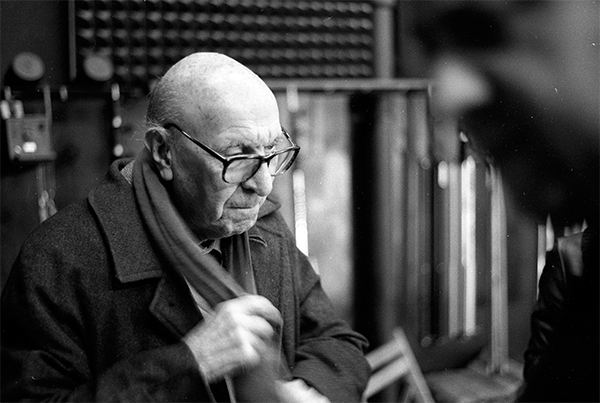
Clorindo Manuel José Testa |
| |
|
|
|
| |
Born |
|
December 10, 1923 |
| |
|
|
|
| |
Died |
|
April 11, 2013 |
| |
|
|
|
| |
Nationality |
|
Argentina |
| |
|
|
|
| |
School |
|
|
| |
|
|
|
| |
Official website |
|
fundacionclorindotesta.org |
| |
|
|
| |
| BIOGRAPHY |
|
|
|
|
| |
|
If one had to identify Le Corbusier’s counterpart in 20th-century Latin America,
Clorindo Testa, a major figure in Argentinean architecture in this period, would almost certainly be the choice. He is not referred to here as a “disciple” or “follower,” but as a similar personality in terms of his constant innovative and creative capacity, his dialectic and changing relationship to the natural and urban surroundings, his passion for painting and drawing, and his interpretation of society and history in his artistic production. He was the son of an Italian immigrant residing in Argentina, who originated from the town of Ceppaloni. He was born in Naples in 1923 and maintained a persistent emotional relationship with Italy (in 1997 he was declared an honorary citizen of Ceppaloni) despite his full identification with the city of Buenos Aires. He pursued a career in engineering, but his artistic vocation (he started drawing at a very early age) led him to the College of Architecture and Urbanism, where he graduated in 1947. He worked for one year in the Master Plan of the City of Buenos Aires (1948), where he met Ernesto N. Rogers, whose criticism of the “rationalist” project for a collection of residences that was being built definitively distanced him from the rigid designs of the Modern movement. With a scholarship from the College of Architecture and Urbanism, he traveled to Europe, extending his tour for almost three years (1949–52). He did not go to Paris, where Le Corbusier was based, nor did he accept Rogers’s offer to work in his Milan studio (BBPR). Painting constituted his principal interest during that period, and he held his first exhibition at the Van Riel Gallery on Florida Street, Buenos Aires (1952).
Associated with the architects Dabinovic, Rossi and Gaido, he obtained various prizes in competitions for public and private works, such as the headquarters of the Argentinean Chamber of Building Contractors (1952), a group of health centers in Misiones (1955), and the Civic Center of Santa Rosa in the province of La Pampa (1956). This ensemble of public buildings, which included the Government House, underwent various successive stages in 1972 (Legislature) and in 1981 (Court and Cultural Center) which illustrate the expressive changes in Testa’s language, from the Le Corbusier-inspired Brutalist orthodoxy of exposed concrete and the transparent facades of the canopies to the free and unprejudiced planimetric and volumetric composition of the 1980s decade, foreshadowing the aesthetic values of “supermodernism.” From then on, he always worked in teams of professionals from different generations, though his dominant presence could still immediately be identified by the originality of the successive artistic languages used. Two works reached international importance, identified as the expression of Latin American creative freedom even by traditionalist critics such as Nikolaus Pevsner: the Bank of London and South America Head Office (1959–66), in collaboration with the SEPRA studio (an Argentinean version of the SOM) and the National Library, a team project also involving Francisco Bullrich and Alicia Gazzaniga (1962–95). Both buildings are configured by gigantic outer structures of reinforced concrete, a Jurassic exoskeleton according to Berkel and Bos. In the first he created an expanded interior space with hanging trays suggesting an interaction between a Roman cathedral and the dynamism of the Carceri de Piranesi. The library, suspended in air by a base that includes a circulation system, substituted Borges’s labyrinth for the image of the Tower of Babel, a metaphor for the integration of universal knowledge.
From the 1960s onward, Testa abandoned Brutalist language and the principle of the autonomy of the “monument,” which still continues in the marine shapes of the Central Naval Hospital (1970), in order to work with the multisignifying components of the urban context. Both the Cultural Center of the City of Buenos Aires (with Jacques Bedel and Luis Benedit 1979) and the Design Center in the Recoleta area (1990–93), integrate free forms and a strong chromatism within the preexisting historical buildings, rescuing the open and unprejudiced discourse of contemporarieity. Simultaneously he was able to introduce in the shopping center’s configuration aesthetic attributes similar to those existing in the neighboring Cultural Center. There emerges a constant assimilation of the particular qualities of the surroundings that generate an architectural response, the undulating coastal landscape of the seaside resort La Perla in Mar del Plata (1985–90) or the mimesis with the neighborhood’s anonymity in the exterior treatment of the La Paz Sgiar Auditorium (1995–96) in the city of Buenos Aires, whose artistic and spatial values unfold in the interior areas.
In the 1970s he reflected the dark social climate created in Argentina by the military dictatorship and the increment in the contradictions inherent to modern urban life in a series of paintings entitled “The Plague in the City” and “The Plague in Ceppaloni,” dramatized by the obsessive use of black and white. In the 1980s chromatism appears in the free forms that identify his artworks and architectural works. It is worth asserting that, despite the spatial and formal control that Testa exerted on his large-scale works—he also carried out urban projects through his participation in the competitions for Puerto Madero (1992), Retiro (1996), and the Acropolis Museum in Athens (1992)—the enigma, the humor, and the unpredictability of his artistic solutions also appear in his designs for smaller residences. This is where architecture, painting, sculpture, and design are unified in the freshness of an achieved poetic synthesis. The Capotesta houses (1983–85) and the Altera art gallery in Pinamar and La Tumbona in Ostende (1985–87) surface as colorful and geometric objets trouvés amid the marine scenery, characterized by the unexpected volumetric “deconstruction” of the original cubic forms. The antithetical dialogue with history reaches its maximum expression with the Ghirardo House in Martínez, Province of Buenos Aires (1992), a Tudor mansion from the 1920s that is penetrated by colorful metallic structures and internally hollowed out with diagonal sliding walls that greatly modify the traditional structure of compartmentalized spaces. Testa thus shows that individual creativity has no end and that the artist’s dialogue with his environment implies a persistent rediscovery of the reality that daily surrounds him.
ROBERTO SEGRE
Sennott R.S. Encyclopedia of twentieth century architecture, Vol.3 (P-Z). Fitzroy Dearborn., 2005.
|
| |
| |
| |
| |
| |
| |
| |
| TIMELINE |
|
|
|
|
| |
|
1923 Born in Naples, Italy (10 December);
1924 Returned to Buenos Aires, Argentina;
1942 Began studying architecture at the University of Buenos Aires;
1947 Graduated as an architect and started working on the Master Plan of Buenos Aires;
1949–1952 Traveled in Europe on a fellowship, focusing on painting;
1952 Began professional career with Dabinovic, Rossi, and Gaido; won first prize for the Argentine Chamber of Building Contractors and the Civic Center of Santa Rosa, La Pampa;
1957 Won Punta del Este Bienal, Uruguay (with Team 5);
1959–1966 In partnership with SEPRA, won first prize and built the Bank of London and South America Head Office in Buenos Aires;
1961 Won the Torcuato di Tella International Prize;
1962 In association with Bullrich and Gazzaniga, won first prize in the National Library competition;
1965 Won Second Latin America Kaiser Bienal, Córdoba;
1970–1983 Built the Central Naval Hospital;
1971–1995 Built the National Library in Buenos Aires;
1972 & 1981 Designed additional buildings for the Civic Center of Santa Rosa, La Pampa;
1976 Inducted into the Buenos Aires Academy of Fine Arts;
1977 Won the Itamaratí Mayor Prize at the XIV São Paulo Bienal;
1979–1980 Designed the Recoleta Cultural Center in Buenos Aires;
1985–1990 Designed La Perla Beach Complex, Mar del Plata;
1987 Received the Trienal Prize “Architect of America” by FAPA;
1990–1993 Designed Buenos Aires Design Center;
1992 Received a Doctorate Honoris Causa from the University of Buenos Aires;
1993–1996 Designed Soka Gakkai International Auditorium, Buenos Aires;
1996 Named Honorary Professor at the Faculty of Architecture, Buenos Aires;
1999 National Museum of Fine Arts, Buenos Aires, held a complete exhibition of his designs; nominated in the final selection for the First Mies van der Rohe Latin American Prize;
2000 Netherlands Institute of Architecture in Rotterdam presented his architectural works in Europe;
April 11, 2013 Died in Buenos Aires, Argentina. |
| |
| |
| |
| |
| |
| |
| |
| FURTHER READING |
|
|
|
|
| |
|
Bayón, Damián, and Paolo Gasparini, The Changing Shape of Latin American Architecture: Conversations with Ten Leading Architects, Chichester and New York: Wiley, 1979
Bullrich, Francisco, New Directions in Latin American Architecture, New York: George Braziller, 1969
Bullrich, Francisco, Arquitectura Latinoamericana 1930–1970, Barcelona: G.Gili, 1970
Cuadra, Manuel, and Alfonso Corona Martínez, Clorindo Testa Architect, Rotterdam: NAI, 2000
Glusberg, Jorge, Architectes argentins, Paris: Institut Français d’Architecture and Centro de Arte y Comunicación, 1980
Glusberg, Jorge, Clorindo Testa. Pintor y arquitecto, Buenos Aires: Summa+ Libros, 1999
Glusberg, Jorge, and Clorindo Testa, Hacia una arquitectura topológica, Buenos Aires: Espacio Editora, 1977
Gutiérrez, Ramón (Coord.), “Clorindo Testa,” in Arquitectura Latinoamericana en el Siglo XX, Milan-Madrid: Jaca Book, Lunwerg, 1998
Koppmann, Ludovico C., “Clorindo Testa,” in Encyclopedia of Latin American & Caribbean Art, edited by Jane Turner, London: Macmillan, 2000
Kultermann, Udo, “Clorindo Testa,” in Architekten der dritten Welt. Zwischen Tradition und Neubeginn, Cologne: Du Mont, 1980
Liernur, Jorge Francisco, “Clorindo Testa: Ilinx,” in America Latina. Architettura, gli ultimi vent’anni, Milan: Electa Editrice, 1990
Llinás, Julio, Clorindo Testa, Buenos Aires: Ediciones Culturales Argentinas, 1962
Segre, Roberto, America Latina fin de milenio. Raíces y perspectivas de su arquitectura, Havana: Editorial de Arte y Literatura, 1999
Segre, Roberto, and Rafael López Rangel, Architettura e territorio nell’America Latina, Milan: Electa Editrice, 1982
MORE BOOKS |
| |
| |
| |
| |
| |
| |
| |
| RELATED |
|
|
|
|
| |
|
ARGENTINA; BRUTALISM; BUENOS AIRES; DECONSTRUCTIVISM; SUPERMODERNISM; |
| |
|