| |
With concrete and steel, glass is one of a triumvirate of materials that modern architects have invested with auratic properties and utopian possibilities. Consequently, the history of glass in 20th-century architecture is a history of exceptions, some of which by dint of aesthetic, technical, or practical merit found their way into common use. The result is that the canon does not always line up easily with what Sigfried Giedion might have called the “anonymous history” of glass.
The glazed vaults of the passenger concourse in McKim, Mead and White’s Penn Station (1905-10) is the last of the ferrovitreous arcades of 19th-century train stations, market halls, and exhibition buildings. Attached to a proper Beaux-Arts building inspired by Roman baths, this was perhaps more an extension of the peculiarly 19th-century convention of separating the formal section of a train station from its functional sections, which were handled in entirely different manners. A more resolved contemporary use of glass can be found in Otto Wagner’s Post Office Savings Bank (1905) in Vienna, with its glazed roof and floor, which borrowed from the Parisian arcades in anticipation of the modern atrium now seen so often in office buildings and hotels.
A more common launching point of the modernist canon, however, is Bruno Taut’s Glass Pavilion at the 1914 Werkbund Exhibition in Cologne. With the bohemian novelist and proselytizer of glass architecture Paul Scheerbart as his collaborator, Taut designed a faceted, multicolored bishop’s hat of a glass dome raised on a drum of glass bricks. The novel exterior gave way on the inside to a circular staircase composed of glass treads and risers that led into a glazed prism, affording just a glimpse into the sort of all-glass architecture that Scheerbart anticipated, most prominently in his Glasarchitektur (1914). Despite the fact that the market halls, train sheds, and exhibition buildings of the 19th century were certainly the immediate models, Taut and Scheerbart leached back to the Gothic cathedral as a source, which Scheerbart called the “prelude to the glass architecture.” As well as reveling in the pure delight of glass, Scheerbart ran through various practical considerations, but he is best known for mysticizing the material. He envisioned a world transformed by glass architecture, which he imbued with certain values and properties, from honesty and cleanliness to a new spirituality.
Scheerbart’s writings and the Glass Pavilion inspired a short-lived correspondence in the late 1910s between a number of Berlin artists and architects, including Walter Gropius and Taut, called the Glass Chain letters (Die gläserne Kette). These letters extended Scheerbart’s glass mysticism through a series of complex crystal metaphors. Lyonel Feininger picked up on the Gothic connection in his well-known cubo-futurist woodcut for the frontispiece of the Bauhaus Manifesto of 1919, a soaring crystal cathedral that came to symbolize the new architecture. Taut went on to sketch a number of glass fantasies. In his Alpine Architektur (1919), he connected peaks of the Alps with dramatic and unbuildable glass cities that prefigured the megastructures of later decades.
Taut’s pavilion is usually paired with Adolf Meyer and Gropius’s model factory, also erected at the 1914 exhibition. Here the use of glass is much closer to later developments in the glass curtain wall. The architects subverted the conventional expectations of glass as a limited perforation in a solid masonry structure. Glass and masonry literally switched roles. Instead of solid side pavilions that would anchor the building visually—and hold the glass in place—Gropius and Meyer wrapped the elegant circular stairwells in a continuous, clear-glass wall. This was more than a game of solids and voids changing places. Glass, often a means of framing an external view or a way of permitting a limited exposure of the interior, here becomes a statement of honesty in architecture: the stairwells, a utilitarian architectural feature that is usually hidden behind masonry, are given pride of place. Glass provides the revelation of a new aesthetic, namely, that structure and construction possess beauty. Little thought was given to the fact that a glass stairwell was a liability in a fire.
To be fair, in the model factory, Gropius and Meyer worked within the generous strictures of exhibition architecture. In 1911-12, they had designed Fagus Werk in Alfeld-an-der-Leine, a factory in which they already had begun to play with the conventional roles of glass and masonry. The architects pushed the boxy grids of glass just beyond the masonry container of piers, projecting glass as the defining element of the wall. Not only did this have the advantage of letting in more light, an important consideration in a factory, but it also reinvented the idea of the wall, freeing it from the structure behind. It was this sort of maneuver that inspired Arthur Korn, a modern architect who was also one of the early apologists for the new glass architecture, to claim “the disappearance of the outside wall.” The “wall is itself the window,” he wrote in Glas im Bau und als Gebrauchsgegenstand (1926; Glass in Modern Architecture, 1968):
“It is the great membrane, full of mystery.” Beyond the titillation of a glass surface, Korn found a new depth in the glass curtain wall. Its clarity yielded the workings of the building; he even hoped to dissolve the interior with glass partitions, matching the changeable realities of modern life and commerce with an equally protean material.
Although glass was slowly being improved in quality during the first two decades of the century, the dream of a glass architecture was decades beyond the state of manufactured glass. Most architects were not caught up in the utopian musings of the avant-garde, yet the period witnessed a wonderful variety of new uses of glass in everyday architecture and the stirrings of a professional dialogue on the modern uses of glass. Outside the modern movement, the needs of industry for ample light and of commerce for an arresting image inspired bold experiments with glass. The Hallidie Building (1917-18) in San Francisco by Willis Polk is an often cited example. Here a glass curtain wall extends more than three feet beyond the structural system of concrete columns and girders. At every third horizontal mullion, Polk cantilevered a structural member from the floor slabs in order to support the glass. An even earlier example that bears mention is Louis S. Curtis’s Boley Building (1908-09) in Kansas City, featuring probably the first continuous, steel-mullioned strip windows, predating Fagus by a few years.
The Boley and Hallidie Buildings are exemplars in a wave of commercial buildings that sprang up in cities across the United States. Yet they, too, are still exceptions. The first third of the 20th century was an age of eclectic design, of Beaux-Arts classicism in the United States, a “free classicism” in England, and a confident, if decadent, historicism throughout the West. Glass followed this historicism. Architects sought glass that would authenticate their designs, and manufacturers did well to supply architects with a range of glasses to suit their catholic range of projects. For example, warbled leaded glass flourished as the appropriate choice for the Collegiate Gothic. Some manufacturers went so far as to re-create historical glasses painstakingly, including ancient Roman glass that was found in archaeological sites. Revival architecture had long inspired the revival of older methods of manufacture. So it was with glass, giving rise to names such as “Colonial" and “Florentine” (two types of ribbed glasses) and “Etruscan” (a rippled glass). These were a world away from Taut’s Glass Pavilion.
At the same time, the demands of new and changing building types stimulated the use of new forms of glass. Wired glass, first developed in the 1870s in Tacony, Pennsylvania, came into wider use in early 20th-century museums and other institutions that required a strong, shatterproof glass to thwart theft and bring in natural light, especially from above. Toughened (or “security”) glass, made by rapidly cooling glass so that it compresses as it congeals, came into use in the late 1920s. It was up to 400 percent stronger than annealed glass and had the advantage of breaking into small pieces with rounded edges. It formed the basis for structural glazing and commercial glass doors and windows, in which strength was necessary.
Plate glass, a French invention of the 17th century, remained expensive and difficult to manufacture quickly. Before World War I, English plate glass was generally deemed the best, followed by French, German, and finally American, which was hampered more by the incredible rise in demand than by technical problems. The dream of a glass architecture, dependent on large expanses of clear glass, was still far ahead of its practical fulfillment. Drawn glass, a mechanical method of creating clear plate, was still in its infancy and undergoing almost constant improvement. In the years around the turn of the century, a number of glass manufacturers experimented with drawing sheets of molten glass evenly through a slit, or débiteuse, and slowly cooling it in an annealing chamber. In the first quarter of the century, various competing patents in Europe and the United States by Colburn, Fourcault, Libbey-Owens, Pittsburgh Plate Glass, and Pilkington slowly perfected this process. However, imperfect drawing and cooling methods—primarily involving glass touching rollers or a surface, or the corruption of the slit with devitrified glass—led to imperfections in the final product.
By 1911, about half of all American window glass was produced by machines, whether by drawing or by older methods. Yet at the same time it was widely believed that mechanically drawn glass would not displace hand-blown methods of creating plate, especially the cylinder method. In this method, a highly skilled glass blower would create a glass ball and, while it was still hot, elongate it by swinging it in circles, all the while keeping it hot enough to prevent devitrification, a feat that required great strength and knowledge of glass. The ends would then be cut away to form a cylinder, and the glass would be cut lengthwise with a diamond or hot iron and flattened in the oven. Naturally, a mechanical method of making plate was highly desirable.
In the 192s, following Henry Ford’s lead, the automobile industry dominated advances in the mechanization of plate glass. To meet the rising demand for clear plate glass for automobiles, Ford created a continuous mechanized process of drawing plate, grinding, and polishing. Manufacturers were slow to adopt the new methods, however. Only in the 1930s was the cylinder method displaced by sheet-drawing machines, making plate more affordable. As late as 1950, most of the sheet glass in the United States was still drawn through the older Fourcault and Colburn methods, but the process had been mechanized, reducing the cost of plate considerably. The consequences of affordable, high-quality plate glass for modern architecture were obvious, as generous spans of plate became less of a luxury. However, the influence might go much deeper. Standardization, especially of the metal-frame window, made the continuous horizontal band easier to achieve; just as important, it made such ribbon windows easier to imagine, the architectural effect in some sense deriving from the very means or image of the assembly line itself.
As early as the 1920s, architects began to explore the various possibilities of plate glass. As a supercooled liquid, whose viscous origins are manifested in the visual ambiguities of its solid form, glass tantalizes, pressing the metaphor of architecture as frozen music. Ludwig Mies van der Rohe is often considered the first modern architect to give this metaphor full sculptural expression. First in his project for an office building in Friedrichstrasse in Berlin (1919-21) and then in his glass-tower project of 1920, Mies emphasized the glass curtain wall. In the latter, he used an undulating, Expressionistic wall of glass—although he later disowned Expressionism—that captivated his contemporaries and inspired glass-clad skyscrapers half a century after he put his initial vision onto paper. Mies completely separated the glass curtain wall from the skeleton of the building, an independence that enabled a new level of abstraction and reinvigorated the facade with aesthetic possibilities. Erich Mendelsohn would exploit similar qualities in his designs for the Schocken department stores in the late 1920s.
In his later German Pavilion at the Barcelona World Exhibition (1929), Mies relied more on the play of surfaces. Here he combined highly polished glass, travertine, green marble and onyx, chromium-plated mullions, and a reflecting pool lined with black glass into a complex play of light reflection and transmission. Stone and water represent the polarities of this ambiguity, the one obdurate and impenetrable, the other malleable and translucent. Glass could be both, and by creating an abstract composition of all three in planar tension, Mies was able to execute one of the first essays in the elegant ambiguity of the glass wall as a surface. At his Tugendhat House (1930), Mies developed many of the ideas first executed in Barcelona, but here the continuous bands of plate came on vertical tracks, making it possible to slide the sections downward, opening the room to the outdoors.
Mies’ experiments with glass tended to be abstract and aesthetic in concern. As projects or exhibition buildings, they could ignore many of the realities of glass. Architects in the 1930s began to study the advantages and drawbacks particular to the glass curtain wall, such as the disadvantage of excessive heat and light transmission. Turning this to his advantage, Le Corbusier realized that he could use the entire room as a light baffle of sorts, modifying light internally as required. In his flats in Geneva (c. 1932) with Pierre Jeanneret, he divided the space horizontally while still bringing the light and warmth of the large window to the entire room. At the same time, the horizontal division acted as a screen, blocking some portion of the heat and light. The basic idea subverted the conventional window. Where earlier architects punctured the wall to bring light or heat to a specific part of a space, Le Corbusier made the entire window a wall and organized the interior structure to suit the lighting and warming needs of the space. Interior space became light baffle.
Turning the exterior wall into window, as Korn had envisioned, brought with it a new flexibility—a term that would become key in modern architecture. Not only did it free the wall from following the dictates of the interior space, allowing for free experiment with the articulation of the glass, but it also engendered an architecture of immense malleability. In theory, the glass wall provided a neutral space that could be subdivided into infinite variations and changed as needed. In practice, this was never as neat as envisioned, and the “greenhouse effect” of the glass wall has only recently met serious solutions.
With flexibility came economy as well. As the thinnest architectural member necessary to shelter people, glass is a space saver. By decreasing the thickness of the wall even by mere inches, one is able to increase square footage significantly in a large building or skyscraper. Given that office space is rented by the square foot, the glass curtain wall increases potential earnings for developers. This idea, developed first in the 1930s, came into play heavily in the postwar period, especially in the United States, where hundreds of glass-clad buildings appeared on American skylines.
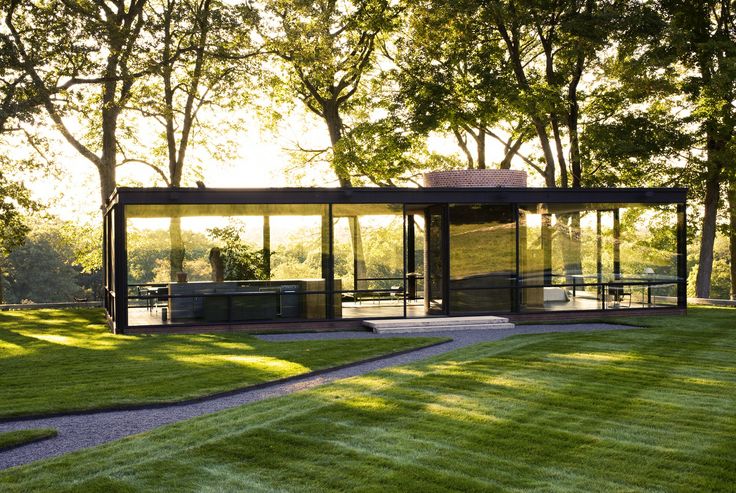
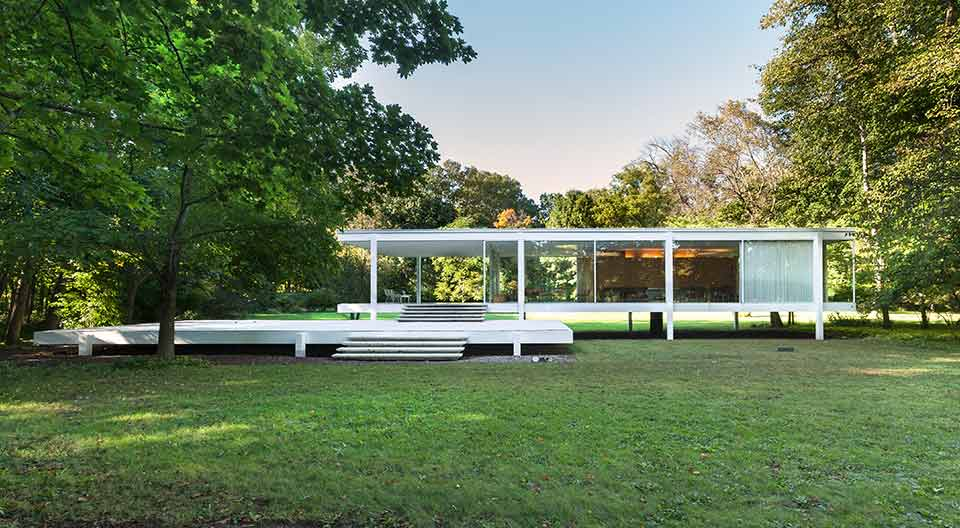
Many architects took up the application of the glass curtain wall to the house, most prominently at Mies’ Farnsworth House (1951) and Philip Johnson’s Glass House (1949), both of which are encased in glass curtains. In both houses, the glass wall is an accomplice to the open plan, reinforcing it visually and functionally. With the barest of internal walls, these houses left the flexibility of the neutral space intact in a tour de force of minimalist living. Much earlier, Harwell Hamilton Harris had created similar effects at his own Fellowship House (1935-37). From the inside, the house reads like a glass house, with the same sense of being able to throw open the walls to the outside that one finds at Tugendhat. However, the use of traditional materials such as wood and the grass matting (practically the only interior decoration) tempered the coldness often associated with glass houses. Despite the fact that it is essentially a glass pavilion floating on wooden piers, its gently sloping shingle roof and reclusive stance on a wooded hillside give it a far different countenance than the Mies and Johnson houses, which are extroverted objects of art floating in open space. However, all three are oddities, inspiring architectural historians more than imitations. The Mies and Johnson houses were also expensive, precluding adoption for the masses, who continued to choose Cape Cod and Colonial designs in which the main display of glass came in a picture window, usually framing the yard from the living room or breakfast room. Although the picture window is an early modern invention, with the availability of cheap plate glass it became a staple, a requisite component of suburban housing, the view itself adding value to the house by giving a sense of spaciousness to otherwise modest accommodations.
Problems with excessive heat transmission led Le Corbusier to attempt to double-glaze the walls, what he called the mur neutralisant" in his Cité de Refuge (1929-33). The architect envisioned heated or cooled air flowing through the space between the glass, in theory neutralizing the air temperature outside. In reality, only one layer of glass was ever built, and the refrigeration plant was omitted, turning the building into a greenhouse. Cité revealed the disadvantages of a glass curtain wall, but the double-glass wall—a 19th-century idea elaborated by Scheerbart—pointed to what is today a standard solution in large glass-clad buildings. Placing two planes of glass together acts as sound insulation, reduces condensation, and is especially good for northern climes as a means of reducing heat loss.
Alvar Aalto’s Paimio Sanatorium (1933) is a good example of double-glazing used for the purported health benefits of light. With fears of tuberculosis haunting much of urban Western society deep into the 20th century, a light and airy architecture held more than aesthetic value. It was deemed healthy, largely in opposition to Victorian architecture, which was thought to be dark and closed to nature. This healthful association with glass took on symbolic value as well: the openness of glass connected society to nature, reversing the process of alienation that many critics pinned on the industrial revolution and its concomitant urbanization. Along these lines, manufacturers developed heat-absorbing glasses to filter out the infrared rays and other glasses that allowed the penetration of ultraviolet rays, which were thought to be salubrious.
Also in the 1930s and 1940s, the development of air conditioning prompted many architects to forecast an architecture that could ignore climatic conditions. The thermal liabilities of glass, it was thought, would be made moot. This dream, which peaked in the 1940s and 1950s—especially in the United States, where energy was cheap—has never come to pass, although subsequent decades have witnessed the proliferation of buildings dependent on expensive and inadequate air cooling and heating systems.
The first in this line was the Lever House (1950-52) by Gordon Bunshaft of Skidmore, Owings and Merrill. It triggered a seemingly endless array of puristic, rectilinear, glass-clad buildings in the postwar decades. The pattern of green heat-absorbing glass (pale green windows and darker blue-green spandrels) created a complex, colorful grid. Lewis Mumford lauded the formal relationships of the cladding for its “sober elegance” but distrusted the building’s reliance on air conditioning and the stubborn formalistic insistence on using the same glass on the southern exposure. However, Mumford also found a political symbolism in the Lever House that shows how glass could transcend mere function. He wrote, “Fragile, exquisite, undaunted by the threat of being melted into a puddle by an atomic bomb, this building is a laughing refutation of‘imperialist warmongering,’ and so it becomes an implicit symbol of hope for a peaceful world.” The same building could thus symbolize two of the defining elements of postwar American society: air conditioning and the threat of nuclear war.
Lever House, greeted as an exception, became the norm. It was joined a few years later by Mies’ Seagram Building (1954-58), its de facto pendant and the archetype for the glass skyscraper in postwar America. Its iridescent selenium pink-gray-bronze glass varies in hue with the time of day and the position of the sun. Mies affixed slim I-beams to the facade as a means of creating scansion, but, depending on the light, the sheer dark glass and its bronze framing and paneling emphasize the mass rather than the skin of the building. The Lever House and the Seagram Building helped generate the fad in tinted glasses that continued through the 1970s. These glasses had the practical advantage of screening solar energy but proved impractical in colder climates and higher latitudes, where retaining the light and warmth of the sun is important. In northern Europe and the northeastern United States, tinted glass was little more than what Michael Wigginton has called “glamour wrap.” In this tradition, one might include Pietro Belluschi’s earlier Equitable Savings and Loan Building (1947-48) in Portland, Oregon; Eero Saarinen’s elegant Bell Telephone Corporate Headquarters (1957-62) in Holmdel, New Jersey; and Roche and Dinkeloo’s Federal Reserve Bank (1969) in New York City. The Bell Telephone Building is exceptional for extending the flexibility of the glass curtain wall, which Saarinen used as a container for what is essentially a series of discrete buildings within.
A technical advance in plate is partly to blame for ending the tinted-glass fashion. In the late 1950s, the English glass manufacturer Pilkington solved the last major problem with drawn plate glass, namely, that it had to be rolled on a surface or drawn through a slit, both of which caused inconsistencies in the glass. Pilkington used molten metal as a float for the molten glass, creating a firm, clean, even surface without grinding and polishing. Pilkington’s method was cheaper and faster and yielded a higher-quality glass; and, although the glass it produced was not as brilliant as fired glass, it slowly displaced earlier methods of drawn plate glass. The one drawback to the method, which now plagues the plate-glass industry, is that it is cumbersome to create colored plate. The company produced a limited range of tinted glasses using its new technique, but not as many as had been the fashion before Pilkington’s process was widely adopted in the 1960s and 1970s.
The reflectivity of glass has also been seen as a means of creating an architecture sensitive to context. I.M. Pei and Associates’ Hancock Tower (1968, 1973) is often taken as an example of “mirror glass,” which has a thin film applied to the finished plate glass. Situated in downtown Boston, the Hancock Tower joined a number of important 19th-century buildings, including H.H. Richardson’s Trinity Church. On the ambiguity of its reflective glass, Keith Bell (1987-88) has written, “The building only appears to ‘exist’ up to about the seventh story, after which it becomes ‘sky.’ By this means, mass and volume are denied.’’ However, this is a highly dubious claim, a case of the faith in glass outstripping its reality. The Hancock Tower, a massive glass high-rise, is not really invisible, and by reflecting Trinity Church it is no more sensitive to its context than a giant, faceted mirror. It does not help matters that some of the glass panels were improperly sealed and without warning popped out of their housing and crashed on the streets below.
Although most major cities can boast of their postmodernist reflective glass skyscrapers, Kohn Pedersen Fox’s green-glass tower in Chicago, at 333 East Wacker Drive (1979-83), exploits its riverbank site and uninterrupted vista with the use of a smooth mirrored glass facade that bends with the Chicago River. In Pittsburgh, Philip Johnson and John Burgee’s PPG Place (1979-84) incorporates a 40-story tower and four other lower buildings around a public plaza that shimmers from the surface’s mirror glass—silver PPG Solarban—produced by Pittsburgh Plate Glass, the largest producer of glass in the world when this complex was constructed.
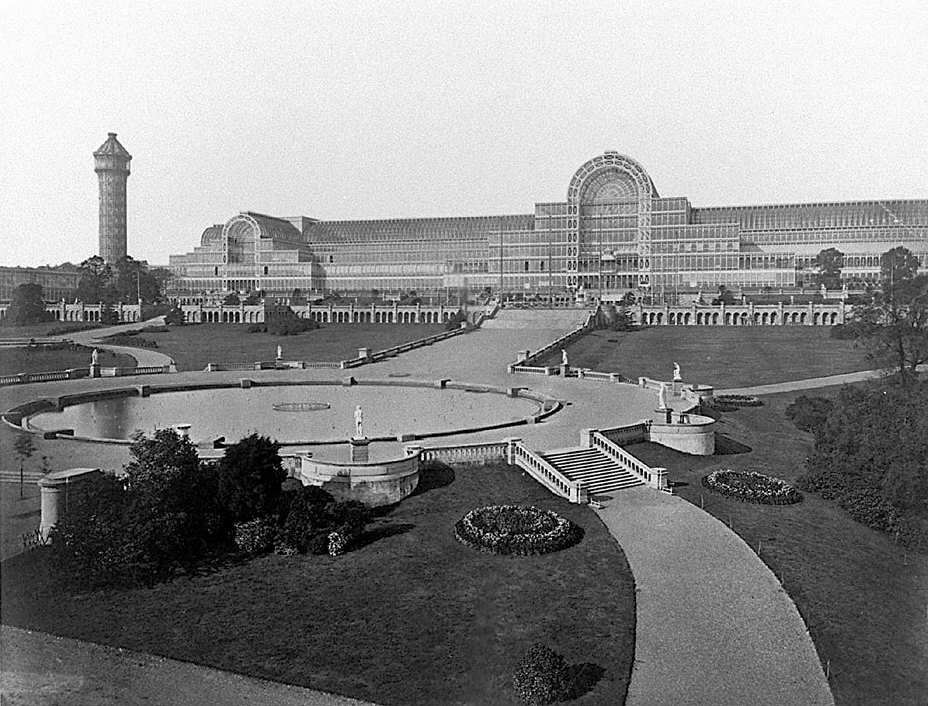
Beginning in the 1970s, the modern glass atrium, a not-so-distant ancestor of the arcades, orangeries, train sheds, and great exhibition buildings of the 19th century, became an increasingly important typology for malls, hotels, and office buildings. In some cases, the arcade is used metaphorically, as in the “Court” at the King of Prussia Mall outside Philadelphia, where an entrance pavilion refers directly to Joseph Paxton’s Great Exhibition Building (1851) in London. John Portman has made his livelihood exploiting the aesthetic, spatial, and symbolic potential of the glass atrium. In a long list of hotels beginning in the late 1960s, Portman employed the atrium’s association with festive public spaces and places of commerce, most notably at the Hyatt Hotel (1967) in Atlanta. The idea has proliferated, and often to ill effect, in the more generic hotel atria of, say, Embassy Suites and the suburban malls (and increasingly urban malls) that spread throughout the United States in the 198s and 1990s. Finally, Pei Cobb Freed and Partners’ Louvre Pyramid (1983-89) in Paris, one of the most powerful architectural symbols in glass to be built near the end of the 20th century, exploits natural light in a way achievable only with vast glass surfaces.
The last quarter of the 20th century witnessed many improvements in glass manufacture. The desire to decrease the supporting structure such as mullions in order to make an even smoother surface has led to new systems of sealing and bolting glass. The strength-to-weight ratio of glass has been greatly improved as well, allowing architects to bolt glass much closer to its edge without structural compromise. Toughened glass and experiments with clips, brackets, knuckles, “patch” fittings, ceramic frits, glass fins, neoprene spacers, and other methods of holding glass in place have inched architects closer to a glazed architecture in which nonvitreous members have been reduced nearly to the magnitude of a staple on a page. For example, the glass curtain of the Willis Faber and Dumas Building (1973-75) in Ipswich, England, by Foster Associates uses toughened glass connected with glass fins and sliding patch fittings, with each pane hanging from the one above. The entire wall is thus in tension, bolted and hung from a mooring at the roofline. The glass curtain is reflective by day and lit up at night, transforming the building into a lantern for the street. The glass fin, a small piece of glass wedged perpendicularly between the plates as a connector, also becomes part of the facade’s proportion and scansion, a staccato of metal and bolts puncturing and punctuating the surface.
With the patch, four panes of glass can be bolted together at their corners. The system has been developed and used without fins at “Les Serres,” Cité des Sciences et de l’industrie at the Parc de la Villette (1980-86) in Paris by Francis Ritchie with Adrian Fainsilber, the former being one of the premier glass engineering firms. The bolt becomes the sole connector of the glass, the wall being supported by a complex cable-truss system within the building. These are so inconspicuous that the lines between the panels of glass disappear from a distance. For all of this, the glass pavilions at Les Serres give the sense of being tacked on, a high-tech stunt having little to do with the museum behind. Structural silicon glazing, usually sealed in the factory and delivered in frame to the site, is a relatively recent method for sealing glass. Although the method has not been perfected, such units promise to reduce mechanical attachments even further and to ease the handling of the glass and the erection of the building.
Whatever the advances in hardware, the glass curtain wall still suffers from excessive heat transmission, limiting its practicality. This hurdle has led architects and glass manufacturers to improve on the thermal qualities of glass with surface coatings and tints applied after the floating of the plate. These specialized coatings, applied through “sputtering” nanometer-thin layers of substrate onto the glass, have led to the idea of the “smart window,” which variously blocks or absorbs light and heat. Low-emission glasses, which first appeared in 1983, block radiation emission and also allow internally heated spaces to hold their heat better. Increasingly thin coatings can produce glass that admits daylight while reducing solar heat gain. As coatings combine with double-glazing, which is rapidly being incorporated into the heating and cooling system of buildings as Le Corbusier had anticipated, the skin of the building is becoming more active. The primary problem with double-glazing, that dirt and moisture can build up on the inside, has been solved with factory-sealed units in which gases such as argon and krypton have been trapped in order to block radiation. To this improvement one has to add glass laminates, in which various materials such as polyvinyl butyral have been sealed between layers of glass to create optical effects, to block radiation transmission, and for insulation. As the “smart window” takes shape, the architectural profession is again preoccupied with the utopian possibilities of glass, only this time technology has kept apace of the imagination.
ANDREW M. SHANKEN
Sennott R.S. Encyclopedia of twentieth century architecture, Vol.2 (G-O). Fitzroy Dearborn., 2005. |